Off my trolley – interurban branchlines – 1

A good, if rather conventional, place to start with interurban layouts, is the conventional branch line.  Some electric railroads were no more than a branch line in total.  Others, like the Pacific Electric, had twigs off the branches off the trunk.  An interurban branchline has all the merits of a conventional one – small space, little stock needed, and what one builds can be built to a good standard.

I think it’s going to take several posts to explore just a few of the options!

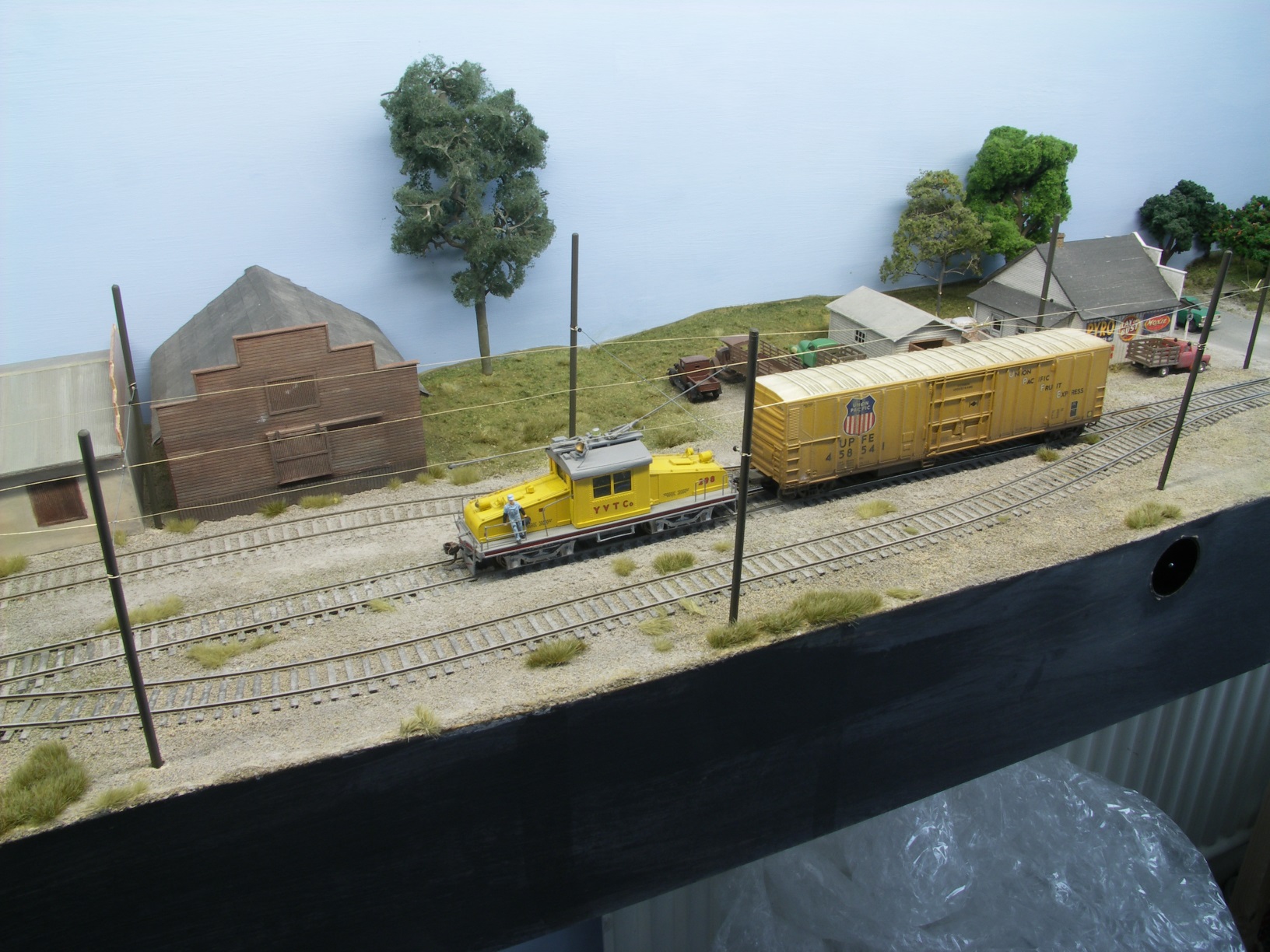
Let’s start with a true branch line layout.  6 foot long in HO and short trains of two or three cars, and the occasional preserved interurban.  This is Andy Gautrey’s Wiley City on the Yakima Valley.  This little layout has a simple track plan, and some well observed modelling.

Wiley City 10 KONICA MINOLTA DIGITAL CAMERA

You can read all about this lovely little layout, with plenty of photos, on RMweb.

Let’s contrast this with an example from the prototype.  When the Pacific Electric Railway (or at least its predecessor) came to the San Fernando valley, there was nothing but fields of grain.  If you go there now, there is nothing but sprawling suburbs.  The interurban opened up this part of the Los Angeles region.  The freeways did the rest of the damage.

At the very end of the Pacific Electric empire lay San Fernando itself.  Even after the passenger service from downtown had been abandoned, the ‘Orphan Spur’ – an isolated mile or two of track that served a few profitable citrus packing houses.  A single locomotive lived on the spur and dealt with all switching.  This little line would make a good model, especially if the passenger service from downtown was kept going into the post-war period.  The map below comes from Bruce Petty’s excellent ‘Los Angeles River Railroads’ site, as does his interpretation of this line.

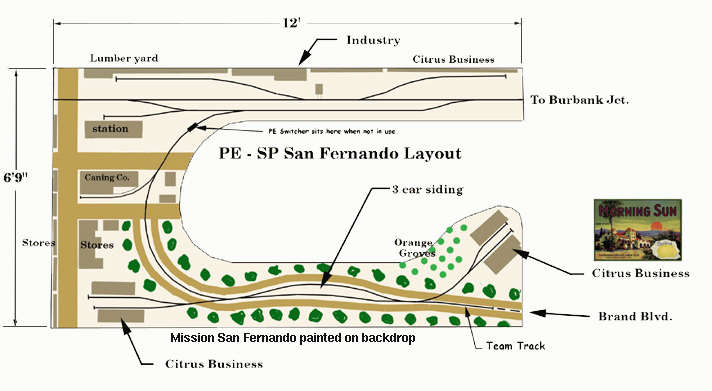
pesfsp_pe_layout

For more, see his San Fernando page .
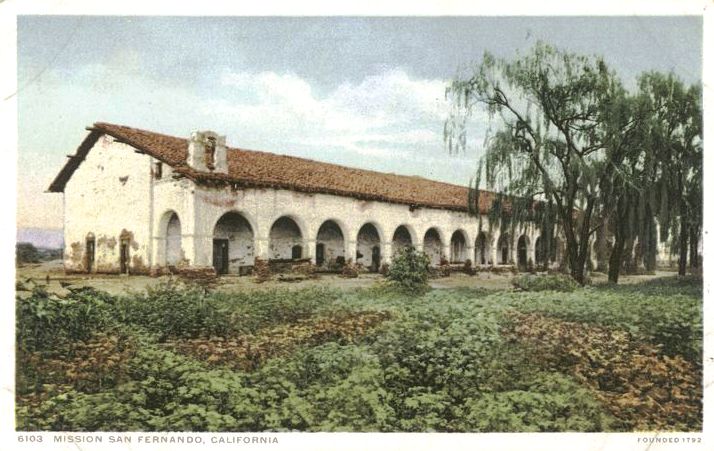
Mission_San_Fernando_Postcard,_circa_1900

One attraction of this line is a chance to model the San Fernando Mission.  The postcard below is its 1900’s form.  It was extended a lot in later years, but the simple building shown here would be the right sort of size for a model railroad.  A little modeller’s licence would place it next to the tracks rather than a road away.

10545
If you are really interested in this line, I can recommend this book.  It’s full of delightful pictures and lots of information on the freight and interurbans and also plenty of social history of the area.  However, you will probably have to get it from the USA, as even Amazon don’t seem to stock it here in the UK.

Posted in Layout design, Traction | Tagged , , , | 3 Comments

Jon’s modules – Mojo coming back!

The mojo returneth (at least in part).  After an interlude that included reading the first 400 pages of Bishop Tom Wright’s 1600 page magnum opus on Paul, lumberjacking a 40 foot pine tree in the garden, and clearing up after my wife pruned the other ten trees to an inch of their lives, I’ve escaped back up the loft.

I’ve been making up the point electrical switches  (see this post) for the remaining six points on the modules.  Relaxing work with a little fiddly soldering to do, but nothing too dramatic.

esng2014

Another diversion at the moment, that will only get bigger is organising the ESNG show, that is rapidly approaching on April 12.  If you are in the south-east of the UK, we can, as ever, provide a friendly little show that is 100% N-gauge….

Posted in Jon's layout ramblings, N Club International | Tagged , , , | Leave a comment

Ffestiniog railway 1970

Another simple blog.  But here are two pictures taken in 1970 at Porthmadoc on the west coast of Wales.  The Ffestiniog was primarily a slate carrier, and ran on a tad under 2 foot gauge.  Although preservation of the line had been going on for some time, the loco roster was limited, and the length of the line was limited by a new reservoir that had flooded the right of way.  This was later solved by the prototype equivalent of a helix….

w1 w2

Posted in Out and about, Prototype | Tagged , | Leave a comment

Hints and tips – N gauge handbrake

Browsing RMweb today (looking for I don’t know what) I came across this idea by Andy Gautrey on his Yakima Valley layout.  It is for HO, but I see no reason it won’t work in N.

“There are also a few 2mm round magnets embedded around the layout, and matching magnets glued to the engine block on vehicles helps to stop them from rolling off the edge.”

Better than my practice to date of setting the tyres in a blob of superglue!

Posted in Hints and tips | Tagged , , | Leave a comment

Welshpool & Llanfair 1970

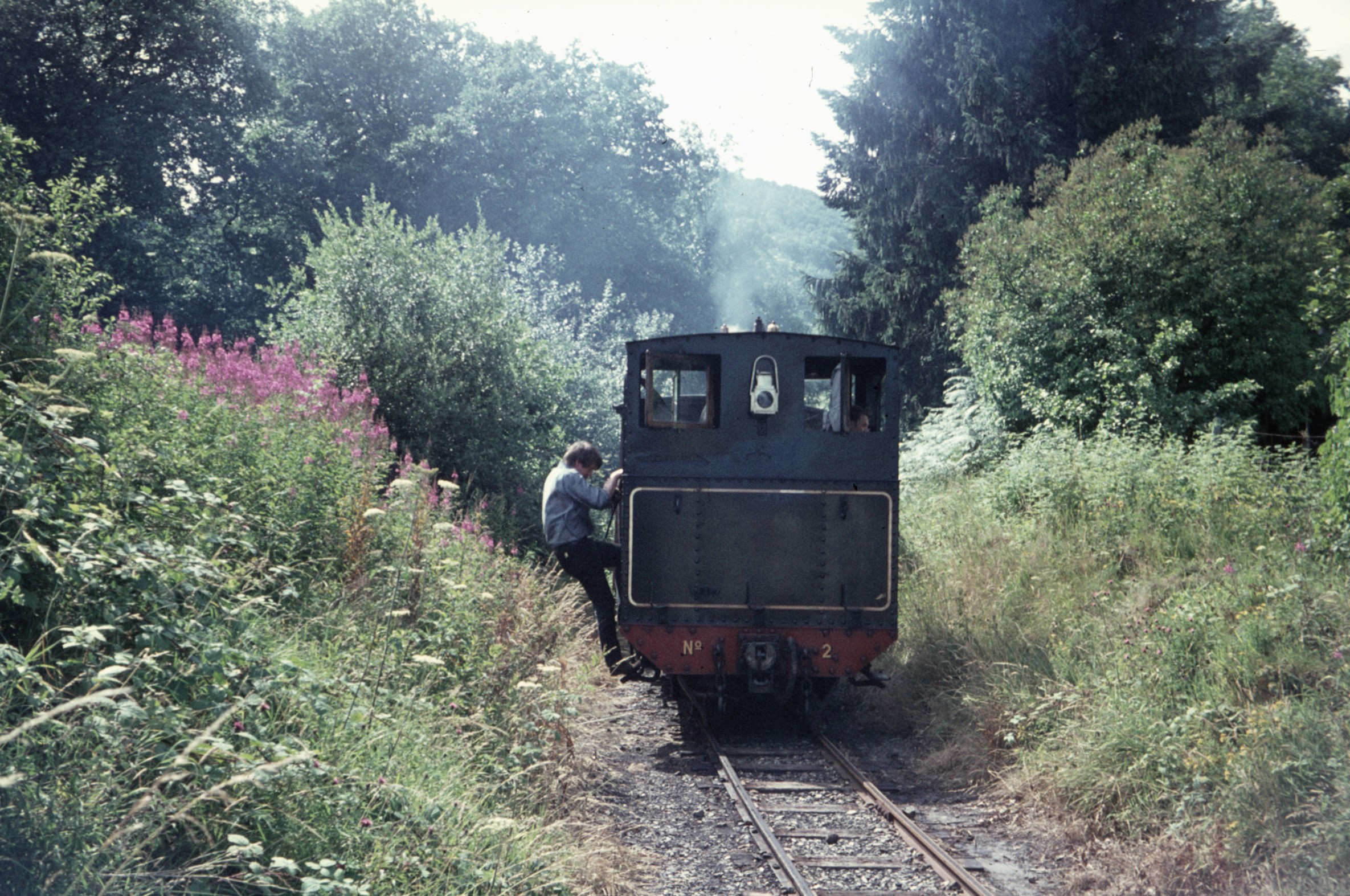
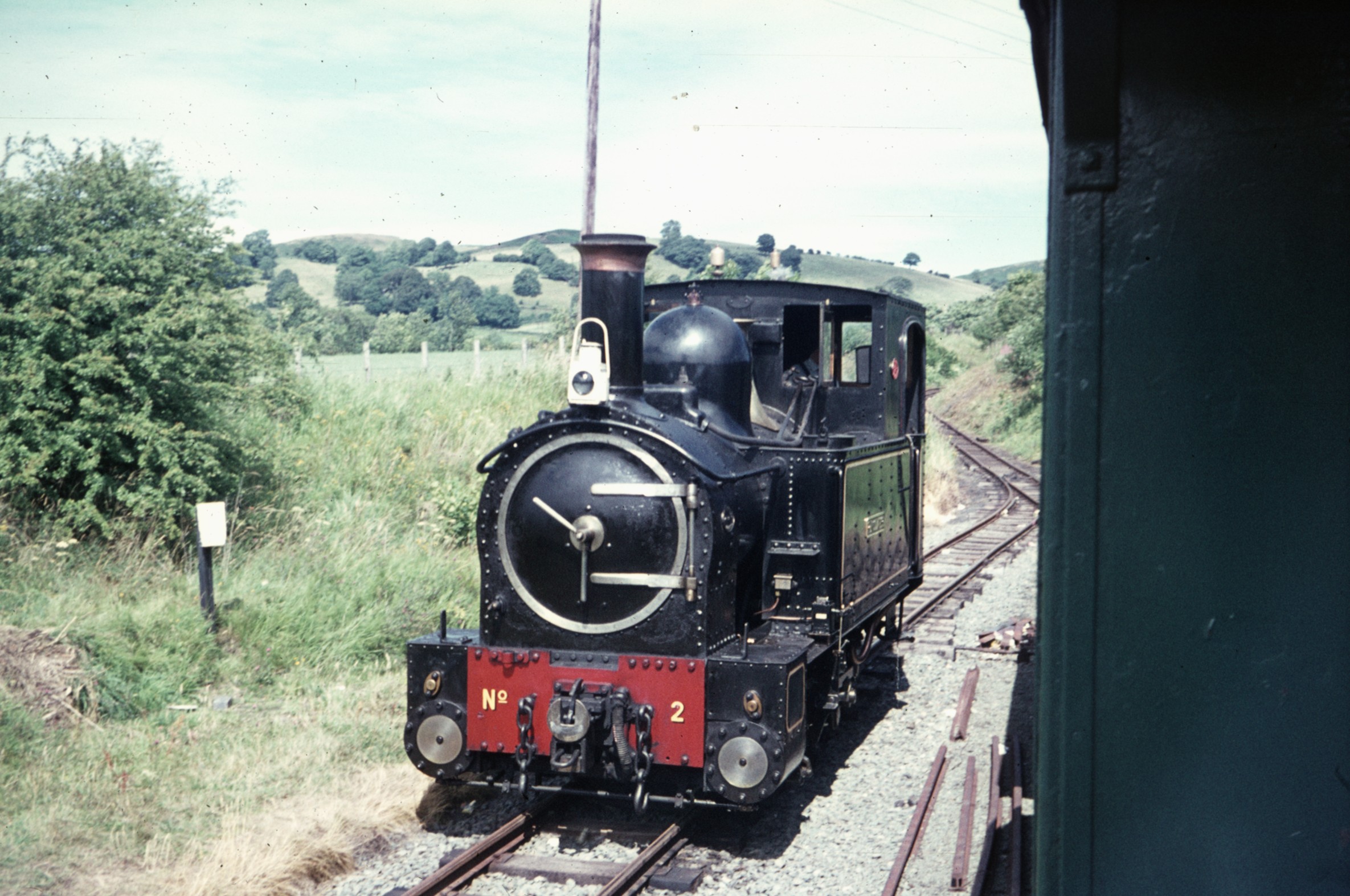
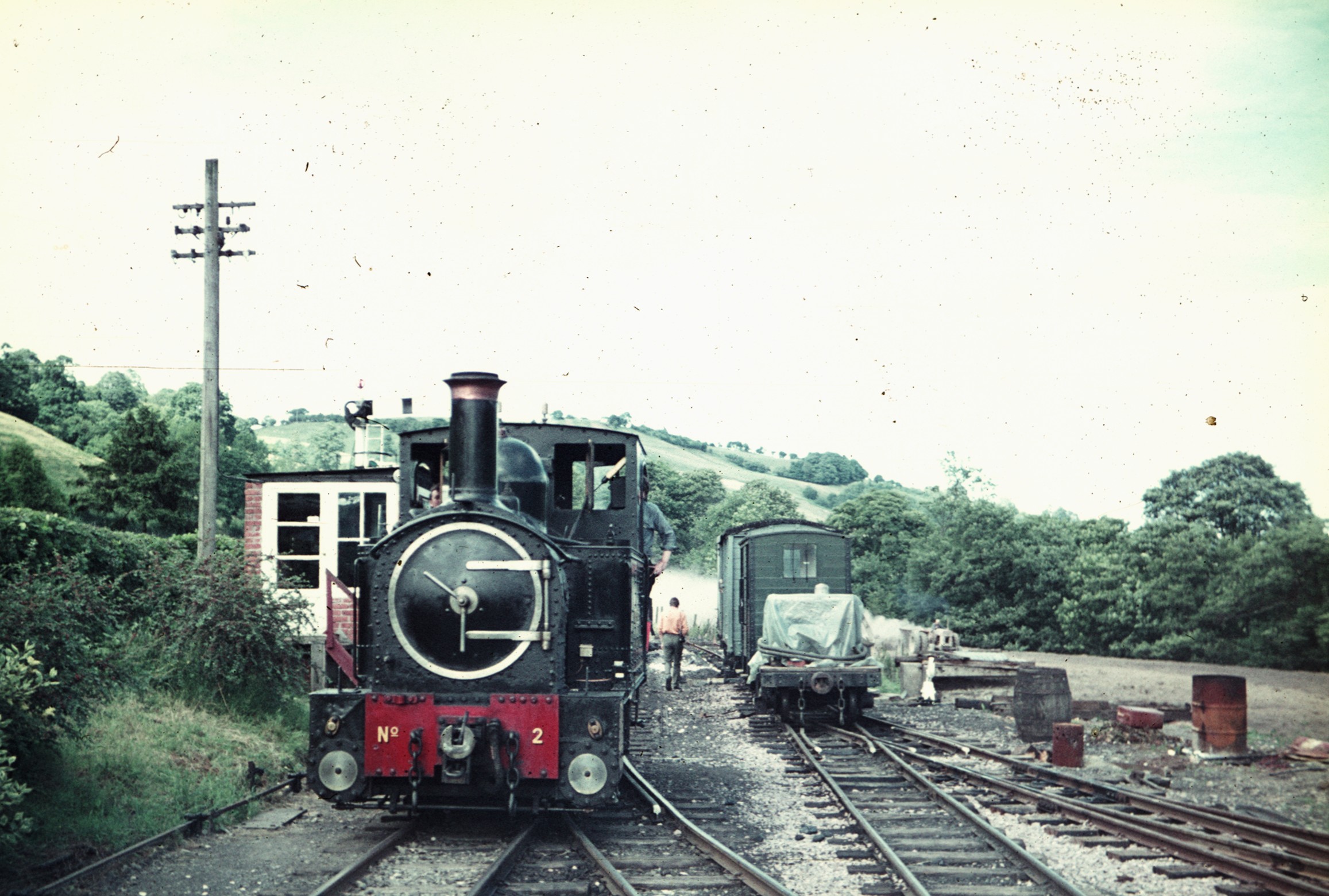
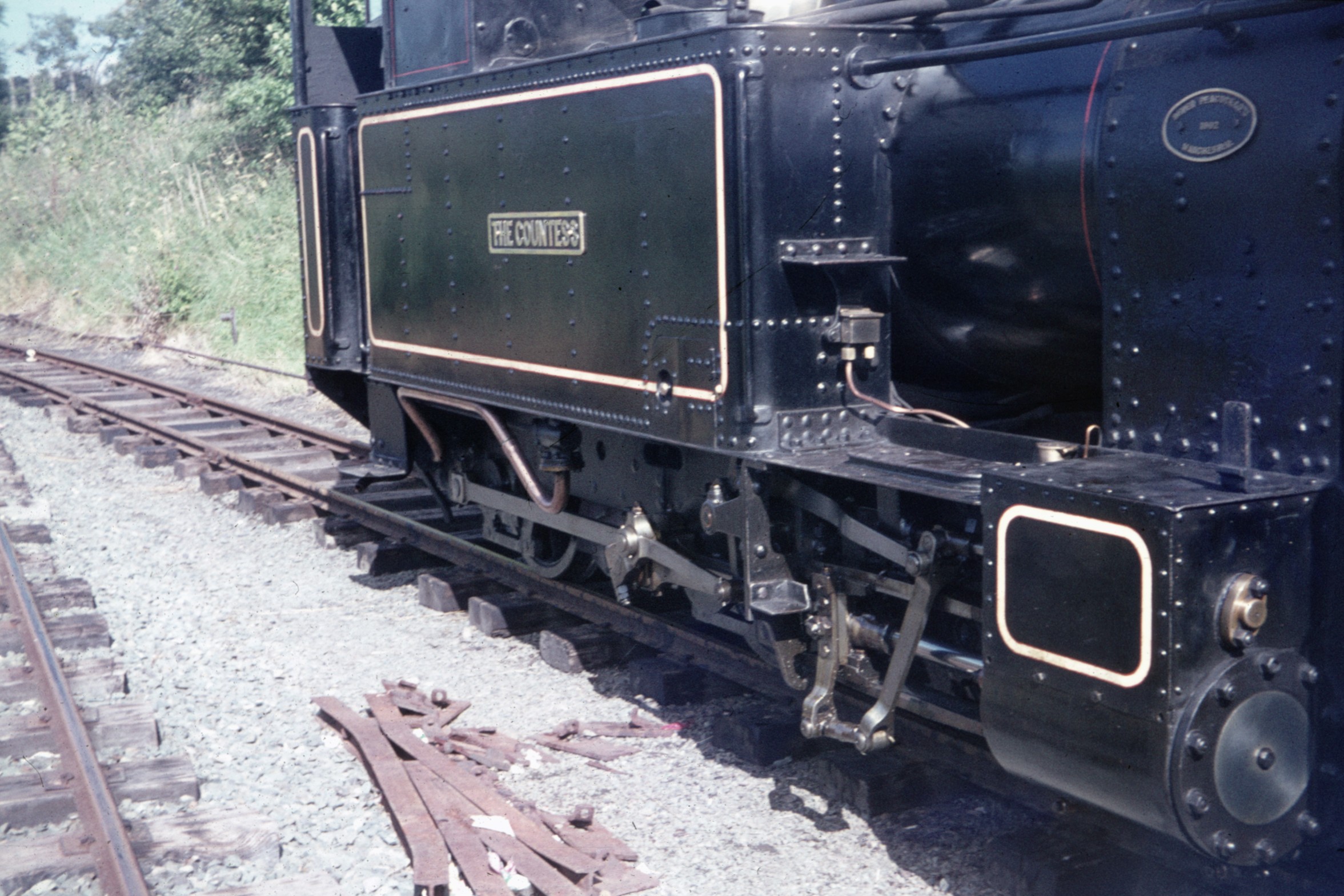
I am going to opt for an easy post (or two) this week, posting a few of my old holiday snaps.  Nothing racy or revealing, I’m afraid, just boring old railways.  So here are four snaps of the 2′ 6″ gauge Welshpool & Llanfair Railway, on the Welsh borders, at the dawn of its preservation in 1970.  One of the original 0-6-0 locos, Countess’ is in charge of the train.

w10 w11 w12 w13

Only a short journey in those days, but nearly the full 9 miles of track has been restored and you can ride behind a variety of European locomotives  – 2′ 6″ is an unusual gauge in the UK, and locos were rescued from all over for the line.  This little railway has always appealed.  It wasn’t a slate or mineral railway, like those in west Wales, but survived on agricultural traffic, and ran through much gentler scenery than the bleak slate country.

Posted in Out and about, Prototype | Tagged , , | 2 Comments

Off my trolley – interurbans

WARNING – if you are from North America, please look away.  This is a confirmed UK resident writing about US railroads, so total accuracy is unlikely!  But I hope in this post to give some idea of the breadth of the prototype – as with ‘ordinary’ railroads, there is a prototype for everyone.  I’ll add plenty of links to other sites, rather than photographs – easier to do this than attribute everything…..

Let’s generalise and split the country into east, west and central USA.  In the east my impression is of smaller interurban lines linking towns.  Perhaps this was because the railroad infrastructure was so dense in this area, that there was little room for more expansive traction systems.  And railroads such as the Pennsylvania and the New Haven were already into electrification, especially for suburban services.  But there is the Aroostook Valley Railroad  carrying potatoes in Maine.  There is the Laurel Line, connecting Scranton and Wilkes-Barre in Pennsylvania, with a double tracked, largely third-rail system, with some overhead.  The main freight yard at Scranton had third-rail throughout – must have been before H&S!  The Laurel Line was also a prototype for a continuous run layout.  The line was double tracked, and at each end, the terminus was a tight, about 50 foot radius loop with the platform adjacent.  No reversing required….

Another small bridge route was the Piedmont and Northern in North Carolina – a short bridge route where some tracks are still used today.

Chicago was commuter land.  The North Shore Line and the South Shore line resembled suburban railroads in many ways, but instead of pantographs there were trolley poles and in places street running.  Freight was an important part of these lines, and some large electric locos could be seen.

The mid-West had extensive passenger interurban services, but freight tended to be carried by box-motors.  I have to include a link to the Indianapolis Traction Terminal –  a monster of a interurban station with an overall roof that could grace any railroad.

In the west of the USA, the traction railroads had a special flavour, where interurban services mixed with heavy freight services.  There were shortlines, such as the Central California Traction and the Yakima Valley Transportation Company.

But the jewels in the crown were the Pacific Electric Railway (note: railway not railroad) and the Sacramento Northern.  The Pacific Electric, in Los Angeles, was the largest electric railway system in the world in the 1920s, with 2,160 daily trains over 1,000 miles of track.  This included two four track mainline sections, where large express interurbans overtook smaller cars or trains of oil or fruit.  Before the freeway came, the Pacific Electric opened up the hinterland around central Los Angeles for development.

The Sacramento Northern boasted 183 miles of track around San Francisco.  It had some interesting features – some cars carried trolley poles, pantographs and third-rail shoes to operate on various parts of the system.  It also had a train ferry with overhead power.

The choice is endless!  Future posts will give some layout ideas for interurban model railroads…..

Posted in Jon's layout ramblings, Layout design, Traction | Tagged , , , | Leave a comment

ESNG meeting – 15 January 2014

The Christmas and New Year were well and truly over, and we had a dozen or so members at last night’s meeting.  It was especially good to see Sean, and be able to congratulate him on a small addition to the family.

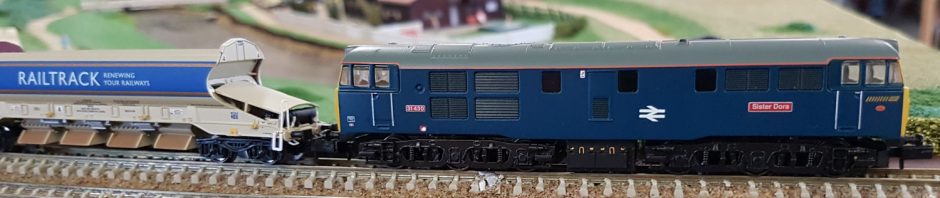
We got the usual circuit up and running, and an interesting range of trains were on show.  David’s Pennsylvania and Union Pacific dooglebugs made a pleasant change from the usual multiple units.  British contributions included a rather nice nuclear flask train.  Paul’s long Japanese goods trains were present – I always wonder how Kato and Tomix make things stay on the track, when other manufacturers’ stock derails?

We spent some time talking about the ESNG annual show (on April 12th ).  It’s coming together, but I have a god bit of planning still to do.

Posted in ESNG, ESNG meetings | Tagged , , | Leave a comment

How long to keep an old layout?

For the author, this would have been a academic question 15 years ago.  At that time I hadn’t actually ‘finished’ a layout.  This has only happened after joining ESNG and going ‘N’ gauge (after forays in OO, EM, OO9 and O).  Since then there’s been a 4×2 foot module built ‘for’ son Michael.  This was close to completion, but scrapped.  Then a quicky 4×1 foot scenic module ‘Two Bridges’ that has been to a number of shows with the ESNG N-mod circuit.  This module was simple, but very much complete and still exists.  It looks a bit tired, and is 3-track N-mod rather than the 4-track that we currently run.

Finally, there is Earl’s Wood, that can truly be said to have been completed.

earls_wood_2 earls_wood_1

Earl’s Wood started as a 4×2 foot continuous run module, but was later modified to a terminus to fiddle yard layout.  It also had three different fiddle yards, none totally successful.  But it does have working point motors, ballast, full scenery, a backscene, lots of people and animals.  (Including a dog that is walking along the parapet of the factory shown above.  My eyesight couldn’t tell the difference between an N-gauge dog and cat.)

So it runs, and is effectively complete.  To keep it running, I need to relay the tracks into the station so that I can build a better, fourth, fiddle yard.  It also occupies some prime real estate in my loft room.  Do I keep it, or do I scrap it and re-use the baseboard?  It’s a difficult choice, but at the moment I am leaning towards scrapping.  There are some buildings that can be re-used, to say nothing of all the vehicles and people and cats and dogs.  I have learnt a lot, had a lot of fun, and exhibited it four times.

Maybe I just need to suppress the squirrel in me, that wants to keep it.  But I forgot – there’s also 12 foot of ‘O’ gauge stored in the back loft….

Posted in ESNG, Jon's layout ramblings | Tagged , , , | Leave a comment

ESNG curry – 11 January 2014

Well, it is a meeting…..  And a very simple blog post.

Eleven out of the expected twelve intrepid members of ESNG enjoyed the delights of the Earlswood Ruchita (yet again) to see in the New Year.  As ever food, service, and of course the company, were very good.  This might even beat a running night for fun.  We all went home very full having indulged in a desert, and will probably dream of our next layout.

Posted in ESNG, ESNG meetings | Tagged , , | Leave a comment

Off my trolley – streetcars and trolley layouts

Again we need a cultural translation here: trolley = streetcar = tram.  Streetcars tended to be smaller that the big interurbans running between towns.  But you could find an interurban winding its way through the city traffic on its way to the city terminal.

What is missing from a trolley layout is extensive freight operations.  Freight cars might be seen on inner city tracks, but this was not common.  What you might see is a freight motor (in the UK think the Southern Region Motor Luggage Van) moving small quantities of freight around.  But the passenger service is intense, although it will consist of a single coach, or perhaps two.  (Having said all this, there will be exceptions to the rule somewhere – please don’t tell me I’m completely wrong).

So a trolley layout has real potential for a tight space.  Short trains, very sharp curves, lots of urban scenery to model.  There is a lot going for such a layout, if you can face the idea of a layout with little freight and few of the conventional railway buildings.

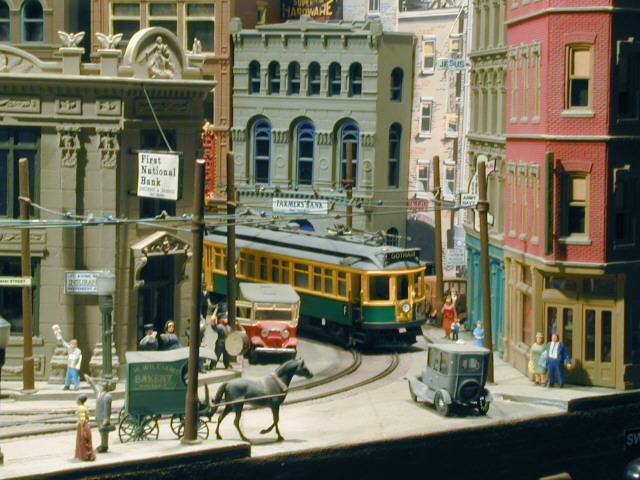
To illustrate the potential, here are two links to excellent layouts.  The first is Fred Miller’s HO scale trolley model site (http://www.fnbcreations.net/tractionfan/).  Here are a couple of photos from the site, showing the high detail and concentrated modelling.  If you wonder about the curves, they are 6 ¼” radius representing a prototype 45 ft radius – in HO scale.  Even TOMIX Japanese tram track has a smallest radius of 4″!

gc003 gc004

I was somewhat annoyed to find that the entire layout now lives in Charlotte’s Trolley museum.  We tried to visit the museum when visiting Charlotte –  but it was closed.  And that was before I discovered the layout was there.

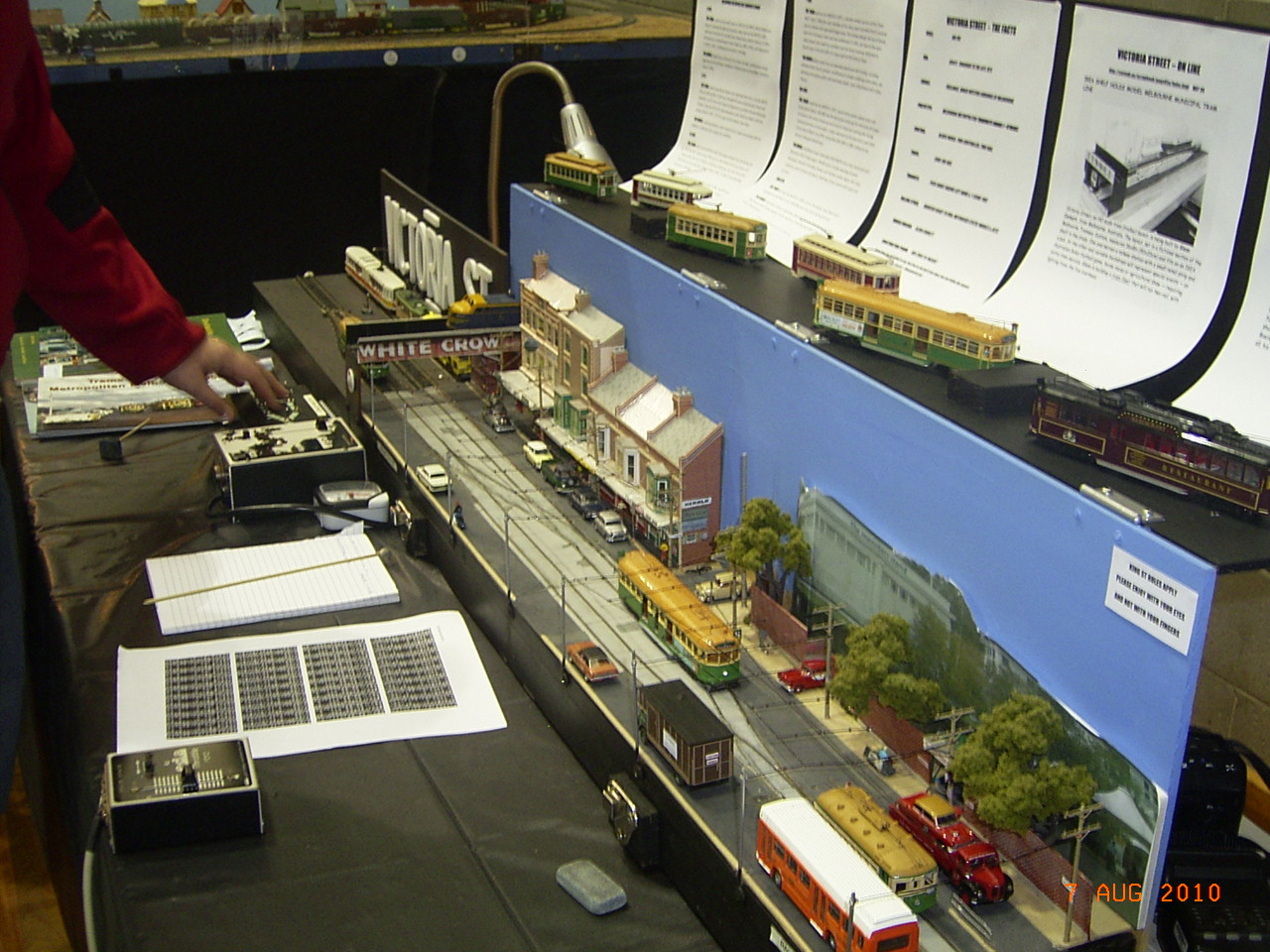
The second layout is again HO and from Australia.  Victoria Street, living at http://glennofootscray.blogspot.com.au/ describes itself as:

“A small model tramway layout loosely based on the Melbourne Metropolitan Tramway Board (MMTB).  Originally set up as a test track, like all layouts evolved into some thing more, with a slight west suburban slant towards its location.

The modules are only 57cm long by 19cm deep, so far there are four complete modules (railway station and racecourse, the original modules), another module is the undecorated fiddle yard (city) and two recent modules are (the railway gates and the bend, Epsom Rd).  Victoria St can run as an end of line tramway, a heritage/regional (SEC) line, and a shuttle passenger service with short shunting at the station to service extra punters for the racecourse to a time table run to a 3:1 fast clock.”

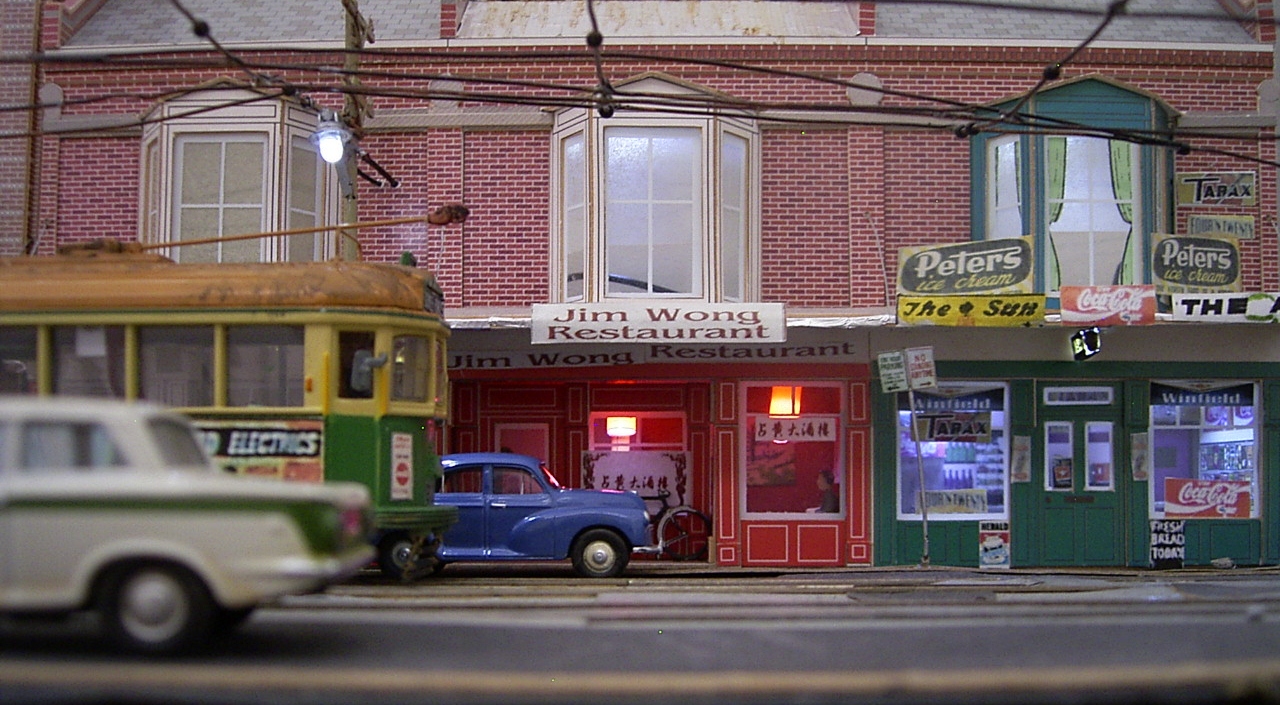
Again note the size of the modules – again remember these are HO scale.  Below are photos from the site, showing the compact size.

7989917027_5fc61acab6_o   5818995435_a63f168b79_o

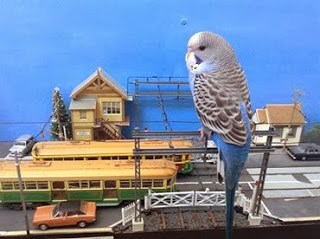
1458711_10152066299369664_362333344_nAnd finally, this photo does suggest that this blogger has visited the layout – unfortunately not, must be some relation.

Posted in Inspiration, Jon's layout ramblings, Layout design, Traction | Tagged , , , | 5 Comments