A trip up the Snaefell Mountain Railway does require good weather – otherwise you can’t see the seven kingdoms. Its summit is 2,036ft above sea level. On a clear day you can see seven Kingdoms from its top: The Isle of Man, England, Ireland, Scotland, Wales, and the Kingdoms of Neptune and Heaven!
One changes trams from the Manx Electric Railway at Laxey. There is also a change of gauge (A whole 3 inches), so the two lines are entirely separate. And you also change from trolley pole to pantograph.
And some views along the line. A couple of pictures catch the Great Laxey Mine and wheel, that we shall visit next time.
A short bus ride away is the picturesque Groudle Glen….
Today, it’s trams, electric and horse. Starting with the Manx Electric Railway….
And along the line. Looks like Michael had good weather for his trip!
The Douglas Bay Horse Tramway. They are trying to extend it again back to its original length. Hope they asked the horse for his opinion on more working hours?
This time around the Isle of Man trip was by No. 1 son, Michael, who went over there last month. So I’ve hijacked some of his many Facebook photos. We’ll start today with the Isle of Man Steam Railway.
Sean took two layouts to the Northolt club open day, plus Lucas to run them, and Allan to transport them….
Also at the show was an old friend. This was Northolt’s new layout, Batty Moor. They got it second-hand from the Twickenham club. I remember it coming to our exhibition a good many years ago. Excellent layout of the Settle & Carlisle line.
Meanwhile, Ron and Chris went to the London Bus Museum 418 running day. Starting with a rail replacement service at Purley.
Just the two ‘real’ buses.
But lots of lovely Routemasters.
And a few of the rest…
Ron had a few comments on the organisation….
It was obvious more people attended than anticipated. There was a long queue at Kingston after lunch break and Chris and I took a service bus back. On return to Epsom the queue for any bus reached back from the Clock Tower to the traffic lights. Several buses arrived, emptied out and went to lay over. No bus left for over 30 minutes and the controller kept a low profile unlike at Kingston where we kept informed. I am on way home via Kingston. Chris stayed in Epsom as he did not fancy a long queue to come back from Epsom.
Allan & Chris recently went to the Dorking historic bus running day. Sunday in Dorking is a good venue for such an event, as the usually full station forecourt is empty of scheduled buses! I’m told that they managed to get a ride on all of the routes.
RM’s, including a red-and-yellow Glasgow escapee!
RF’s, very much part of my childhood, seeing them every day on the way to secondary school.
And the rest…
Up to date – the Metrobus Graf Zeppelin – hydrogen powered, and the gas sits up there above the passengers!
And three photos stolen from Chris’ Facebook feed…
South Croydon 1925, with the LBSCR overhead electric still in place.
A little bus interest – I remember going to Norfolk on holiday through the old Blackwall tunnel, long before that Dartford upstart! They ran special buses with cut-down roofs to get round those sharp bends.
Interesting dockside photograph with a Sunderland flying boat, and a Swordfish on floats, and some interesting wagons in the background.
Short Sunderland Mark I, L5802 ‘SE-F’, of 95 Squadron, Coastal Command at Pembroke Dock.c1942, Notes (a) Unusual Type B roundal with a 1:2 ratio instead of the standard 2:5 as on the “Stringbag’ in the background. (b) Badly faded EDSG on the ailerons.
What to do with your old locos. The scale covered South Australian Railways narrow gauge 4-8-0 ” T ” class locomotive T24 being transported on the SAR’s broad gauge Crocodile low loader. Both loco and low loader look a bit worse for wear!
Another atmospheric picture offering a little cameo…..
That’s what I call a lovely locomotive. Norwood Junction in 1958.
My son Michael, volunteering on the Bluebell, was hiding on this beautiful new Maunsell restoration for its test run. There were people literally with their ear to the floor listening for any unknown ‘clonks’ or ‘clanks’!
Why can John Atkinson, whose photos capture southern region EMUs in all their glory, always find a unit I’ve never heard of. 8MIG, for goodness sake!
The novel feature of the two 8MIG units was the provision of a former loco-hauled RMB buffet car marshalled in the middle of the unit between the 4CIG and 3CIG parts of the set. The Southern already had two of these cars, 1872 & 1873, modified with 27-way jumpers and air braked with 750v heating to run on Charter and Special trains between two 4TC units when needed. These cars were given a minor overhaul before being formed into the 8MIG units, they still retained propane gas cooking however and the CIG units were unable to heat them as they had no low-level power jumpers like the TC sets did. This view shows car 1873 formed in 2602 as the leading unit of the 09.55 Portsmouth Harbour to Waterloo at Woking Junction on Friday 27 May 1983.
An unusual bit of double heading – a Co-Bo and a Black 5 – both filthy, heading into Carnforth with an express from Barrow on 7th April 1966. (photo Brian Flannigan)
Don’t know what it is or where it comes from, but it’s so ugly I’d buy at least one!!
Another fascinating object that would make a great model…..
History of the Treadwheel Crane The treadwheel crane, also known as a walking wheel crane, is one of the most iconic lifting devices from ancient and medieval times. It operated using human power, where a person would walk inside a giant wheel (similar to a hamster wheel) to generate rotational force, lifting heavy loads via a system of pulleys and ropes. Origins: The origin of the treadwheel crane dates back to Ancient Roman times (around the 1st century AD), where it was used in the construction of large structures like temples and aqueducts. Its widespread use re-emerged in medieval Europe, especially between the 12th and 19th centuries. Golden Age of Use: These cranes were commonly used in harbors, church construction sites, and castles. In major ports like Gdańsk (Poland), Strasbourg (France), and Bruges (Belgium), the treadwheel crane played a key role in loading and unloading ships. Some cranes were even built permanently atop stone towers or large wooden structures. How It Worked: One or two people would walk inside the wheel, much like climbing stairs. Their movement turned a drum that wound up a rope to lift heavy cargo. Depending on the wheel’s size and human effort, the crane could lift tons of weight. End of Its Era: With the rise of steam engines in the 19th century, treadwheel cranes became obsolete, replaced by more efficient and powerful machinery. However, several of these historic cranes still survive today as monuments and engineering heritage sites.
Sunday afternoon, and 1o members turned up for a very sociable afternoon – and we ran a few trains. Simon was having moderate success with a very long freight….
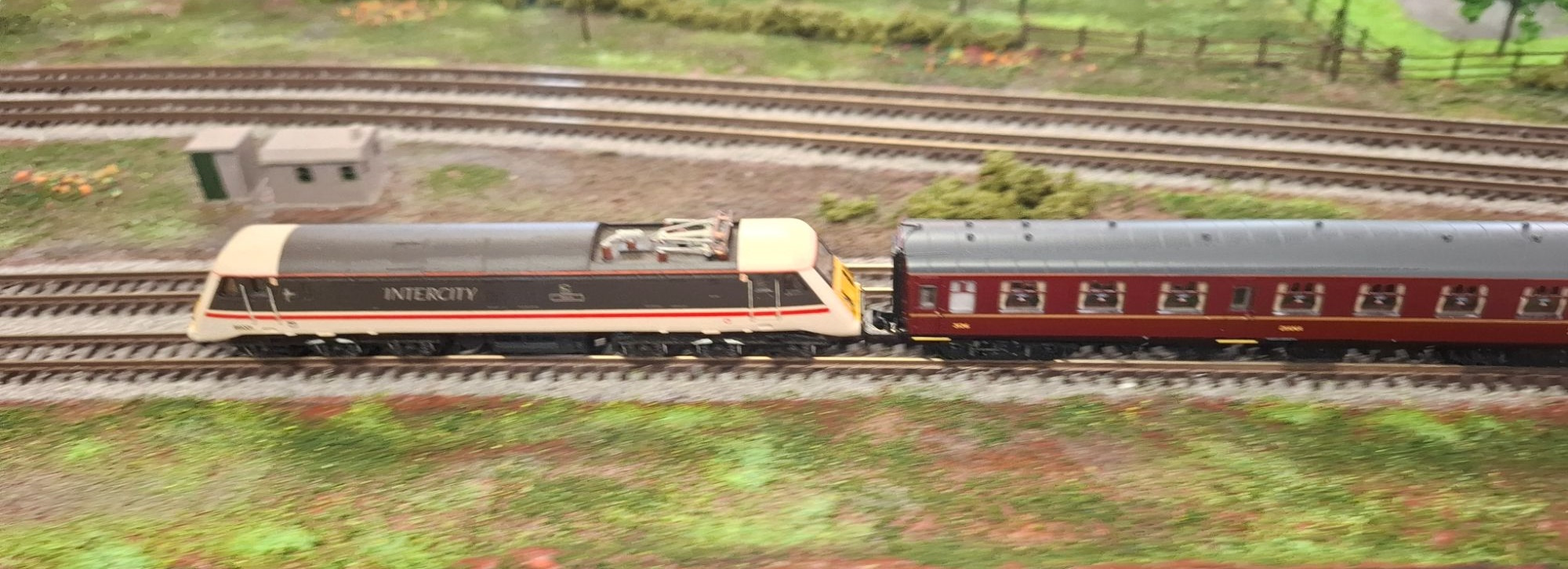
And Brian’s not-quite-as-long inter-city (without the restaurant car – retired for repair.)
And a variety of other runners….
Whoops!
A couple of old-timers (and for once I don’t mean the ESNG members!)
I’m much better at starting things than finishing them! But I have completed those Gresley full brakes started under covid lockdown. Decals, glazing, and roof completed, though I won’t finally fit the roof till I see whether they need any more weight to run smoothly.
I’ve also completed a couple of Lehigh Valley coaches. Although I haven’t modelled American much recently, I saw that Interurban Models were making 3D printed Lehigh Valley coaches, so I bought a pair. Very well printed, and easy to complete, though I replaced the 3D bogies in the kit with MicroTrains ones. These coaches will replace two Bachmann ‘shorty’ coaches that were pretending to be these slightly longer vehicles (and donated their bogies.) I’m tempted to get another pair, including a combine.
Finally, something not on my project list, but one that I’ve been thinking about for some time. Six or seven years ago, ESNG commissioned a Dapol gunpowder van in a totally fictitious livery to celebrate 21 years of the club. We sold over 90 of the 100 made, but the last few were hanging around. I decided to buy them and renumber them to make a full train. If NCI can have the European ‘friendship train’, ESNG can have the Redhill special! An easy and satisfying little job, as I now have seven wagons (and may get a few more!)
And here are all projects on display. A very satisfying week, even though I didn’t get much decorating done.
We started the meeting with a working party to look at a few faults here and there. One regular was missing, as he was on forced garden duty…..
Derek Atfield continued to realign some of the corner tracks, with generally positive results. Simon and I checked the electrics on the fiddle yard. We found no problem, but the points need cycling occasionally to get a couple of tracks working. We’ll meet again next month and take the under-board covers off and apply a little contact cleaner to anything that moves – or doesn’t when it should.
However, during the evening two other tracks played up, and this problem was solved by leaning on the baseboard at a critical point. More detective work needed!
By the evening, we had nine members through, though there was an early and a late shift.
Simon ran a long train of brass coaches – I’m afraid that they didn’t stay on the track as well as their Kato equivalents!
Welcome, Emily!
A helping hand from Gordon (though I doubt whether the lazy so-and-so is doing much….
And Mt Atfield’s faceless version is a very acceptable (if slightly blurred) generic UK 4-2-2 single driver loco, very close to a GNR Stirling single.
Colourful trains from Michael….
Chris’ Railtrack set….
Derek’s Post Office train goes further back in time…..
Southern goods, including a set of ESNG Vindaloo wagons…
This is the blog of the East Surrey N Gauge model railway club. Find out about our club activities here, as well as news and views on N-gauge railway modelling.