Meanwhile, back in Earlswood….

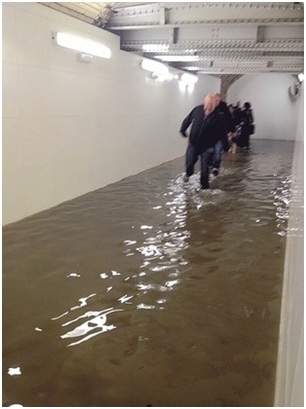
From the Surrey Mirror:   Train passengers angry at having to wade through ankle-deep water

earlswood flood

Passengers were forced to wade through ankle-deep water after heavy rain swamped a train station underpass.  Dozens of people were left without any alternative after getting off the train at Earlswood Station and making their way down to the subway at platform two.

Many passengers took to Twitter on Saturday to vent their anger, claiming no warning had been given about the problem, and saying more should have been done to solve the issue.  Passengers were eventually advised to continue their journey to Gatwick Airport and return to Earlswood on the opposite platform.

According to a Southern Rail spokesman, the problem occurred due to a technical problem with a pump, installed to deal with flooding. The spokesman added: “Heavy rain fell and the subway was flooded.

“The pump down there wasn’t working and it was closed that day. Now it’s working again.

“Because it [the station] is located on the bottom of the hill, we’ve set the pump up to remove the water, but a small problem with the pump on Saturday meant it didn’t clear like it was supposed to.”

Posted in Prototype | Tagged , , | Leave a comment

Jon’s modules – track at the end of the world

track_end

End of the line on the board.  The track is soldered to the copper clad plate, and power is fed to the plate by telephone wire.

Posted in Jon's layout ramblings | Tagged , , , | Leave a comment

And even better….

From the China Daily, 14 November….

Toilet walls net complaints

A men’s bathroom at the Suzhou Railway Station has been the target of a host of complaints because it uses transparent glass walls, people.com.cn reported on Wednesday.  The station’s property management company promised to cover the glass with frosted stickers as soon as possible.

Now, there’s a modelling challenge for ‘N’!!  Perhaps the wrong sort of glass?

Posted in Prototype, Weird and wonderful | Tagged , | Leave a comment

Train runs late after one hits boar

From the China Daily, 13 November….

A train on the Quanzhou to Jinjiang line was held up for more than an hour after hitting a wild boar on Monday evening.  The incident created multiple delays on the line with seven high-speed trains in Quanzhou stations running late.

Would our train operators call this the “wrong kind of pig”?

Posted in Prototype, Weird and wonderful | Tagged , | Leave a comment

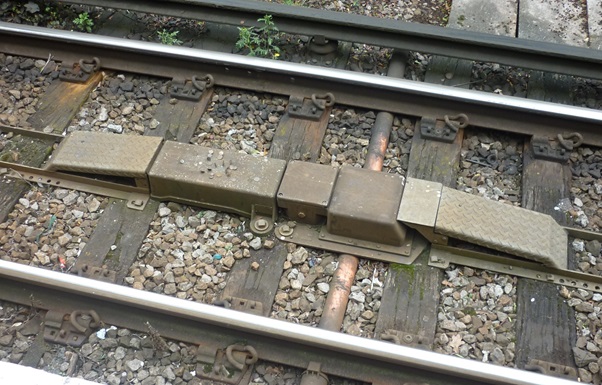
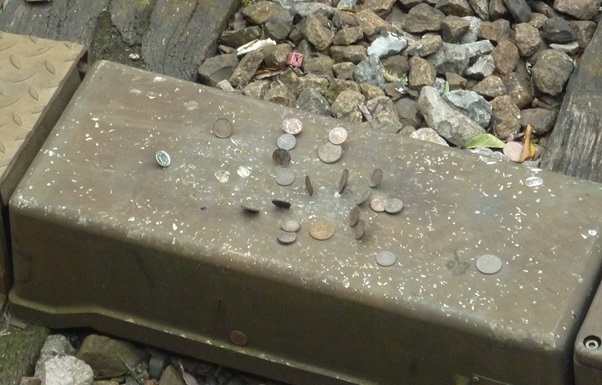
Model this in ‘N’

magnet_1

magnet_2

This looks like just another track magnet for train detection…. (Surbiton platform 1).  But look a bit closer at the magnet – try this in ‘N’ gauge if you dare! There must be too many rich people in Surbiton…. (Photos by Jon).

Posted in Prototype | Tagged , | Leave a comment

Layout design – different voices – the art of presentation

Over the next few weeks, I want to explore some ideas about layout design.  There are a number of interesting voices in the railway magazines and on the internet, with practical ideas that are can be of interest and help in layout design.

But first I want to head for Australia.  The Prince Street Terminal blog recently drew attention to an interesting narrow gauge layout:

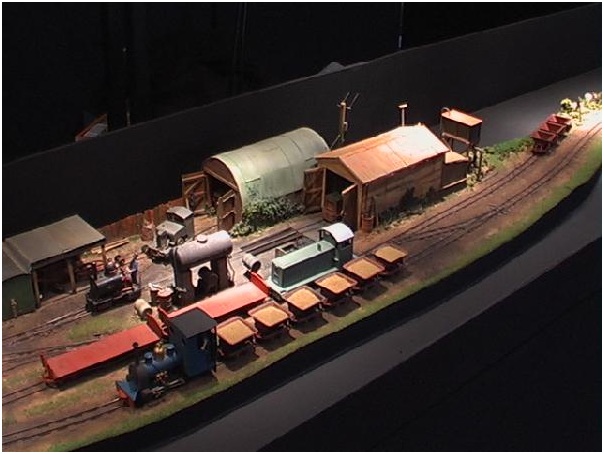
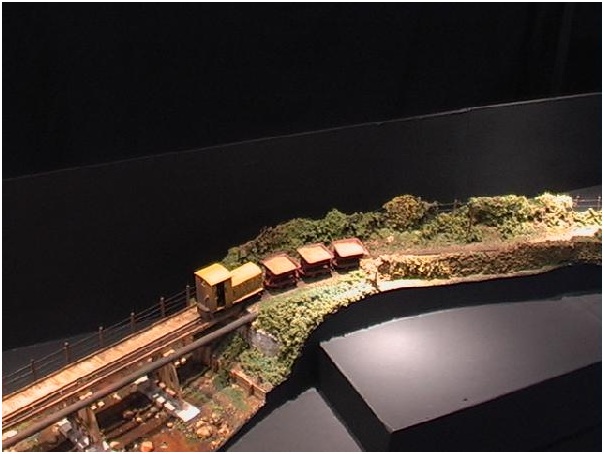
Years ago I came across photos of the Totternhoe Mineral Railway exhibition layout and instantly “fell in love” with their approach to layout design and the space it occupies. In line with what I’ve been trying to explain above, its builders determined the arrangement of track and scenic elements within the overall scene and then wrapped beautifully flowing benchwork around the whole thing. Trying to make such a free-flowing design structurally stable would be very difficult for a layout that stays home and even more so for one that is expected to be portable and to attend exhibitions. To respond to those practical demands they developed a very innovative approach that feels so beautifully architectural in its very nature and just so elegant: They perched their beautifully flowing scenes on top of regular, rectangular, frames and then painted everything flat black. The layout is carefully lit to focus the lighting on the scenes. In many ways the presentation style draws a lot from theatre design and it just works so well. The lighting focuses the viewer’s attention squarely on the layout itself without any distraction away from the show. Furthermore, the whole layout, not just the track, appears to meander through its environment. A viewer seeing the layout for the first time can instantly relate to it and the builder’s intentions with little explanation and that’s the essence of good design.

The pictures below have been taken from the Gn15 (minimum gauge modelling) forum.  More can be found at  http://forum.gn15.info/viewtopic.php?t=3334

aus_2 aus_1

I like the concept.  Flowing curved benchwork is good to look at, and allows the layout to flow with the changing size and shape of the railway and its surroundings.  However, it is not easy to make, and even less easy to incorporate odd shaped baseboards into our club modular systems.  The concept of a flat black background also eliminates any problems with backscenes, square corners to scenes, how to get the train into and out of the scenic section, and all those problems that we have developed scenic tricks to hide.  90% of a fine layout is in the quality of modelling.  However, what sets it all off is the presentation, or perhaps the ‘theatre’ of the model.  This approach achieves this only too well…

Posted in Layout design | Tagged , , | Leave a comment

ESNG meeting – 7 November 2013

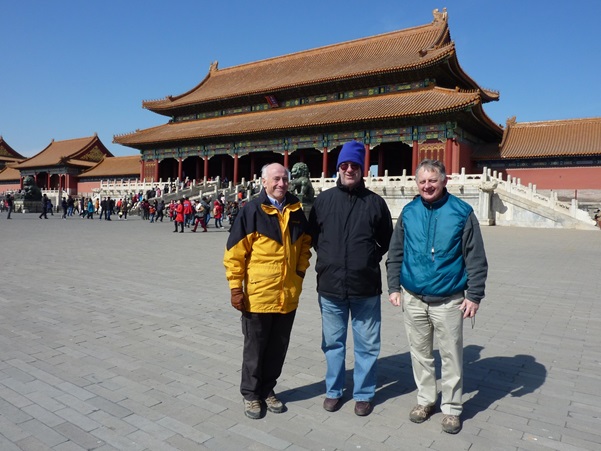
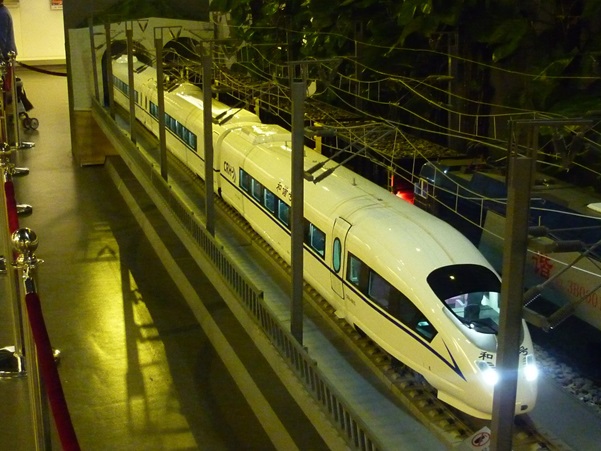
I can’t tell you anything about what went on at this meeting, as I am sitting in a sunny if cold Beijing.  But here’s a picture of the Forbidden City, and a large scale model of a Chinese high speed / bullet train.  Both taken last year, I’m afraid.

forbidden city   beijing bullet

Posted in ESNG meetings, Out and about | Tagged , | Leave a comment

Extreme ‘ERIC’?

extreme_eric

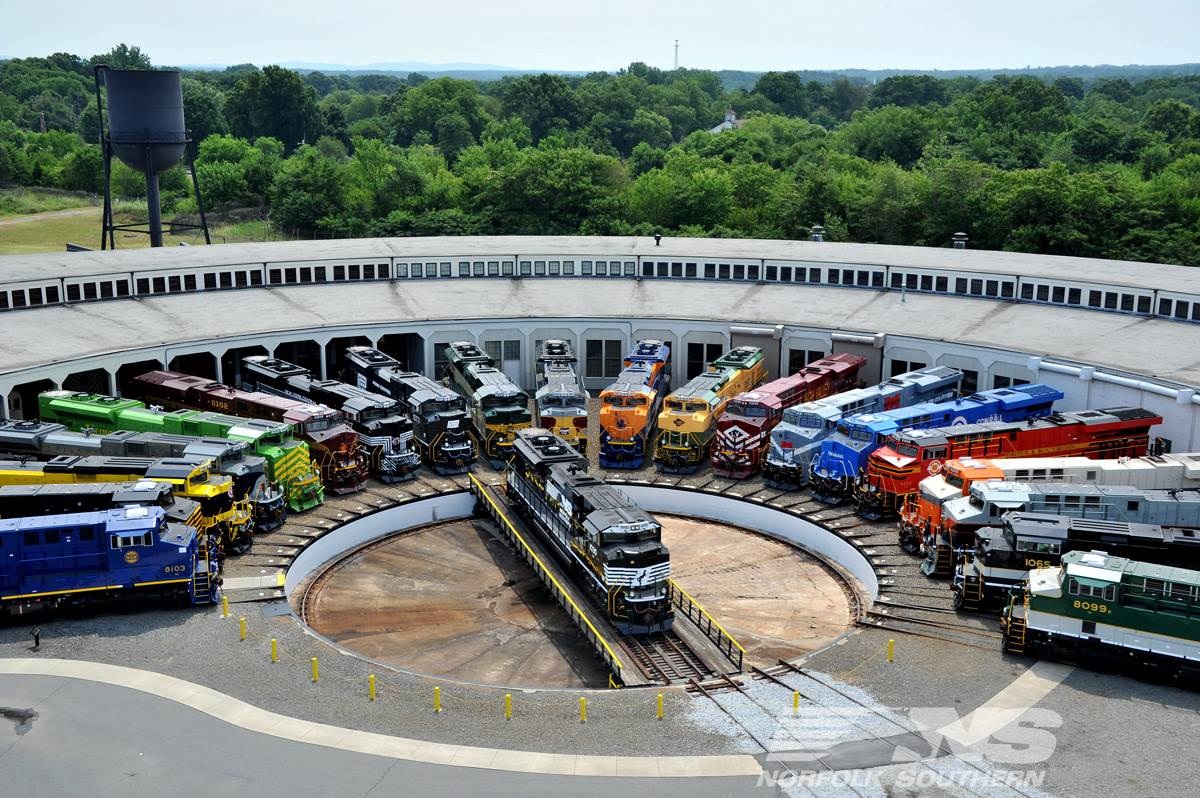
With all the Norfolk and Southern heritage livery units in place. (Photo N&S).

I’m still waiting for the Lehigh Valley heritage unit to come out in ‘N’ – then I may be tempted by a modern diesel.

Perhaps we could fill ‘Eric’ with American locos at Stuttgart this year????

Posted in ESNG, Prototype | Tagged , , | Leave a comment

Jon’s modules – PECO lash up

Sitting looking at a sunny but smoggy Beijing morning, here are a few ideas on PECO track.

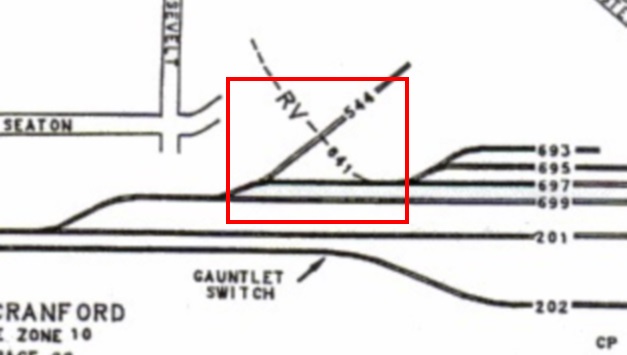
The PECO range of points offer a consistent geometry and make track planning and laying all too easy.  However, one track configuration caused problems on my second board.  The diamond crossing that carries a siding and the main short line is fed by two points, as the picture below shows.
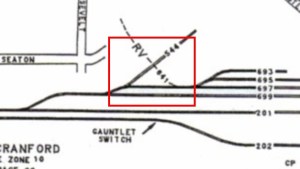
crossing layoutThe PECO fine scale code-55 range has a lovely short crossing, that would fit between two large or medium radius code-55 points, all fitting perfectly.  At least, until one wires it up (oh no, not more wiring problems).  The crossing is live frog, and the frog polarities need to be changed according to the leg that is carrying the train.

Now, the code-55 crossing is ready wired, with four connections for the four crossing frogs.  As I thought about it, I realised that although a live frog crossing can be linked to the point frog polarity for, say, a double junction, the polarity of the crossing will depend on the setting of the two points, and cannot be unique.  To use live frogs, one needs to have an additional switch for the crossing (or go DCC, which I’m not.)

Of course, there would be no problem with a dead frog crossing.  And PECO make a code-80 universal short crossing.  Using the heavier rail is not a problem – if anyone notices it, remind them that prototype crossings often had heavier rail than the track on either side, due to the heavy wear at a diamond.  But just to annoy us, the geometry and angles of the universal range is slightly different from the code-55 fine scale range.  So although code-80 joins well with code-55 with a normal fishplate, perhaps with a tiny bit of tidying with a file, the geometry doesn’t work.

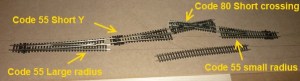
Not to be denied, I got out all my points and tried to get the geometry to work.  I soon came up with the lash up shown below.  The code-55 small radius point has a larger frog angle than medium and large radius points.  If I used a short Y point on the other leg of the diamond, the angles were spot on through the junctions.
peco lash up

There was one catch, of course.  The large radius / short Y point combination gave a track spacing of about 40mm.  This was easily reduced to 27mm or so (the PECO standard spacing) by taking one sleeper and about 10mm of track off the two points and the crossing.  Take care doing this – take too much off and the short frog rail will probably have inadequate support and drop out (as my first crossing did – fortunately I had a second one in the rail box.)

The end result is not only one with the correct geometry, it will also look interesting on the layout – breaking away from the standard PECO geometry.  Now to lay it and wire it up.
Posted in Jon's layout ramblings | Tagged , , , | 1 Comment

Track cleaner idea?

One to keep you amused as I jet off for a couple of week’s work in Beijing…..

Well, it’s different!  (Click to enlarge)

vacuum

Posted in Prototype, Weird and wonderful | Tagged | Leave a comment