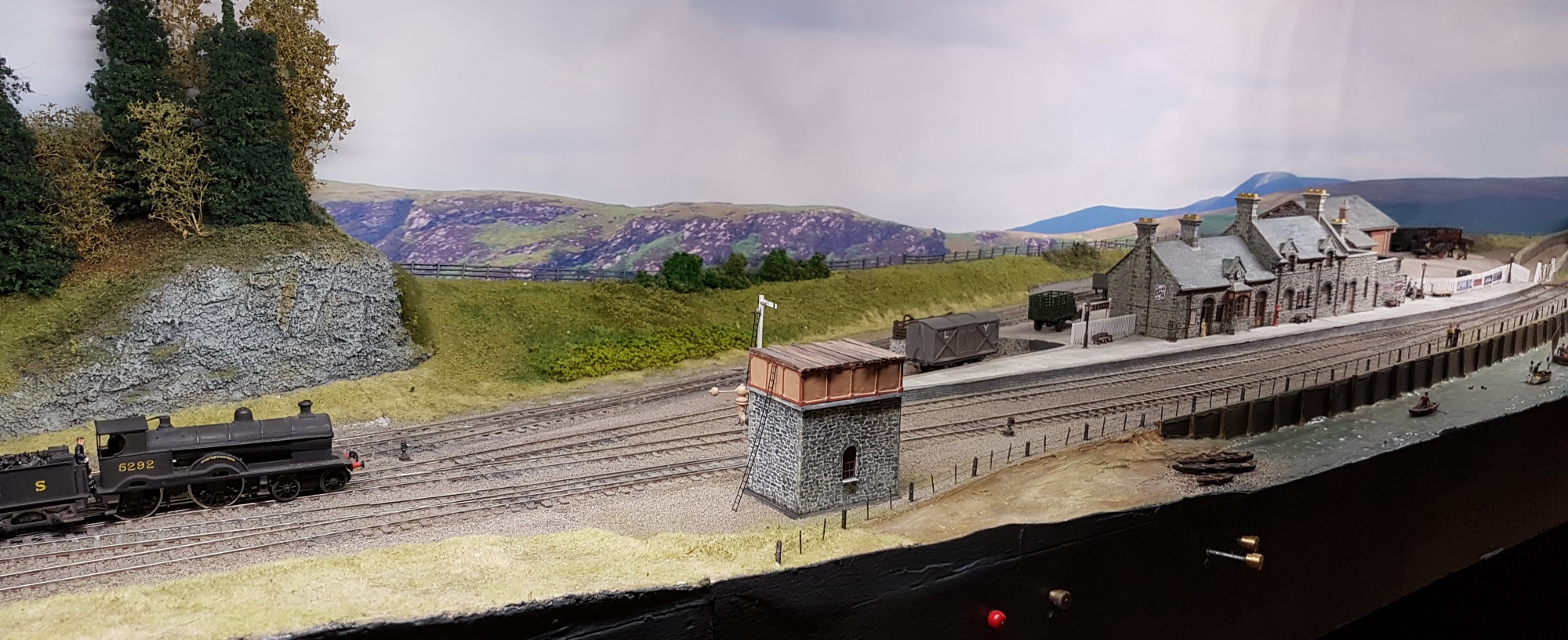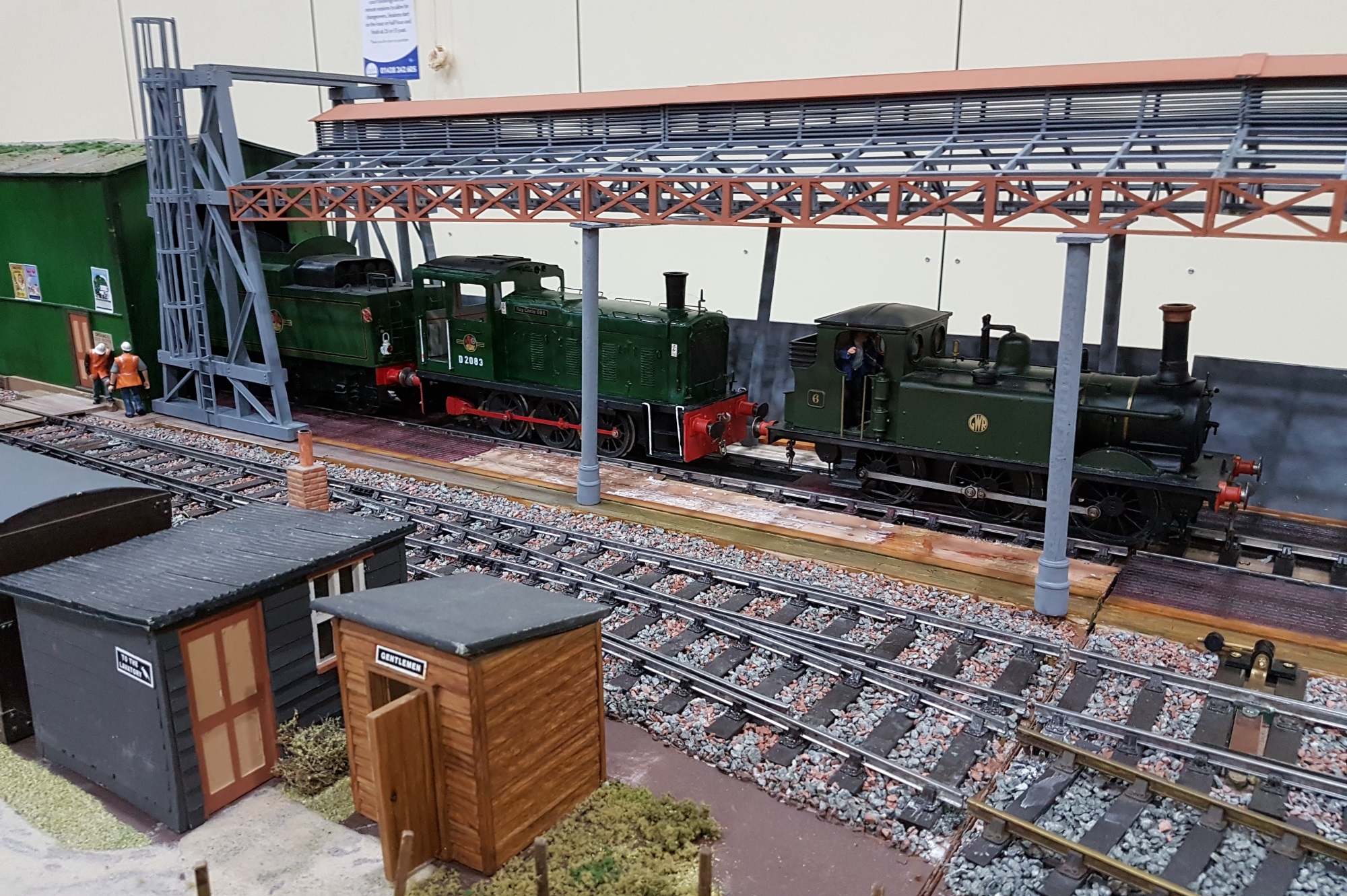
Down the line from Holborn

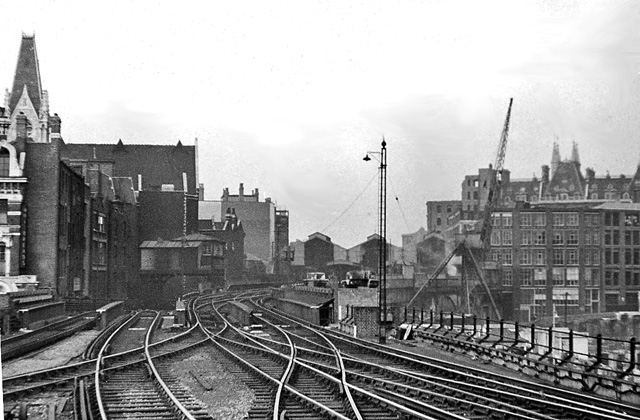
Whilst I mull over possible ways of modelling Holborn Viaduct, let’s move a little down the line to the junction of the Holborn and Charing Cross lines, just outside London Bridge.  Here we find Ewer Street depot, again built on brick viaducts above the mean Southwark streets.  The Kentrail website noted that…..

This was an interesting depot arrangement, situated upon a long thin site positioned immediately adjacent to the incline linking the London Bridge and Blackfriars lines. It formed part of the then newly created SE&CR Joint Managing Committee’s London Bridge area improvements. This had included the widening of the original London & Greenwich viaduct to the east of the terminus, which provided an additional two running lines and saw the abolition of the unique right-hand running on the Greenwich line. Terminating platforms at London Bridge were increased by four, by transferring the continental freight depot from here to a purpose-built facility at Southwark, upon a brick-built platform, level with the top of the viaduct. Situated immediately north of the ascending Blackfriars tracks, Southwark Continental Freight Depot essentially comprised a wide platform surface of two faces, serving eastward-facing terminating tracks. The platform was provided with a pitched roof canopy, and the depot’s entry lines were controlled by a signal box positioned at the eastern end of the platform surface. Incorporated into the depot’s site was a locomotive stabling point, which included a 54-foot 10-inch turntable flanked by a 30-foot long water tank, a coal stage, and a coaling crane. Thus, the facilities on offer here were those typically found at a motive power depot although, of course, there was an absence of any form of shed building. Despite being situated upon what was virtually the same site as the freight depot, the locomotive stabling point was instead referred to as ‘’Ewer Street’’, after the road which ran from north to south alongside the site’s eastern elevation.

The Grand Vitesse Depot received fruit and vegetables from the Continent, and some more valuable goods.  The plan below shows how the goods sidings and locomotive stabling point were shoe-horned into an area next to the London commuter lines.
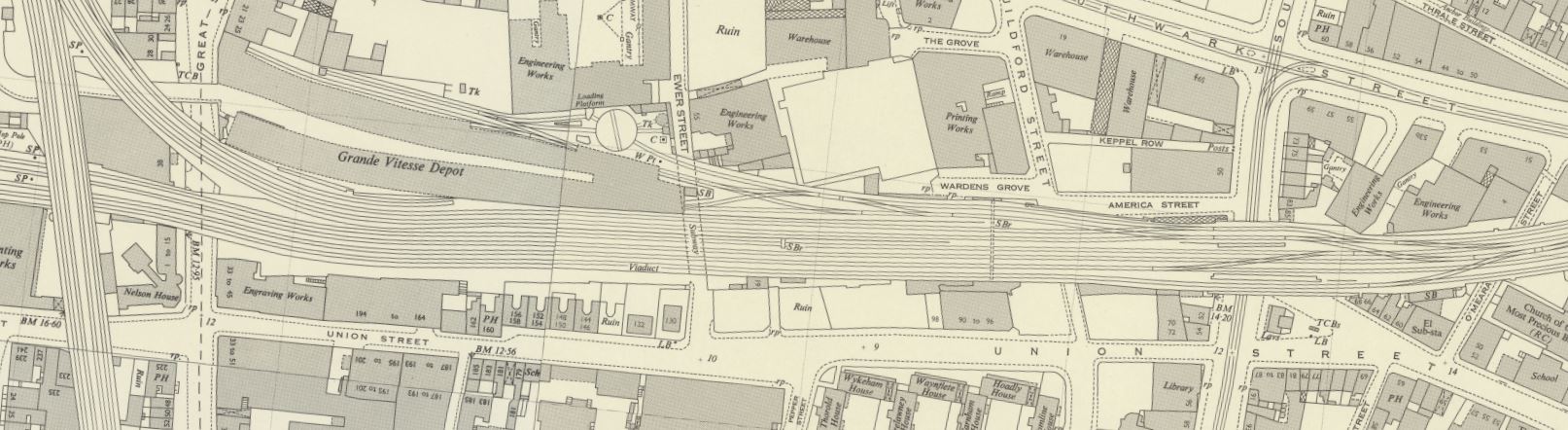
Ewer Street has featured in the model press as a possible layout before, and an old (I think) Model Railways article described how difficult it was to get a locomotive into the stabling point in the wartime blackout.  This was compounded by the Depot platforms being off limits and patrolled by Railway Policemen and customs officials looking for a driver or fireman looking for free fruit.

The next photograph shows Ewer Street from the air, with the turntable central in the picture.

In this photo the EPB EMU is parked in the old Grand Vitesse depot.

Here’s an interesting photo taken in 1948. Justifies use of an ‘Austerity’ on Southern lines?

Unusual freight train at London Bridge
View eastward of a train on No. 2 Up Eastern line, headed by ex-WD ‘Austerity’ 2-8-0 No. 78597, built late 1944, stored briefly at Longmoor then shipped over the Channel in 12/44: it was returned to England in 4/46 and after overhaul at Ashford was loaned to the SR (at Hither Green) in 5/47, then taken into BR to become eventually No. 90390: it was transferred to the LMR in 9/51 and withdrawn in 9/65. (Note that here it still has the Westinghouse pump fitted for working trains on the Continent. The train is comprised of Continental fruit wagons, the front one being Italian (FS), presumably returning to Dover for the train-ferry to Dunkerque from Ewer Street (Southwark) Depot.
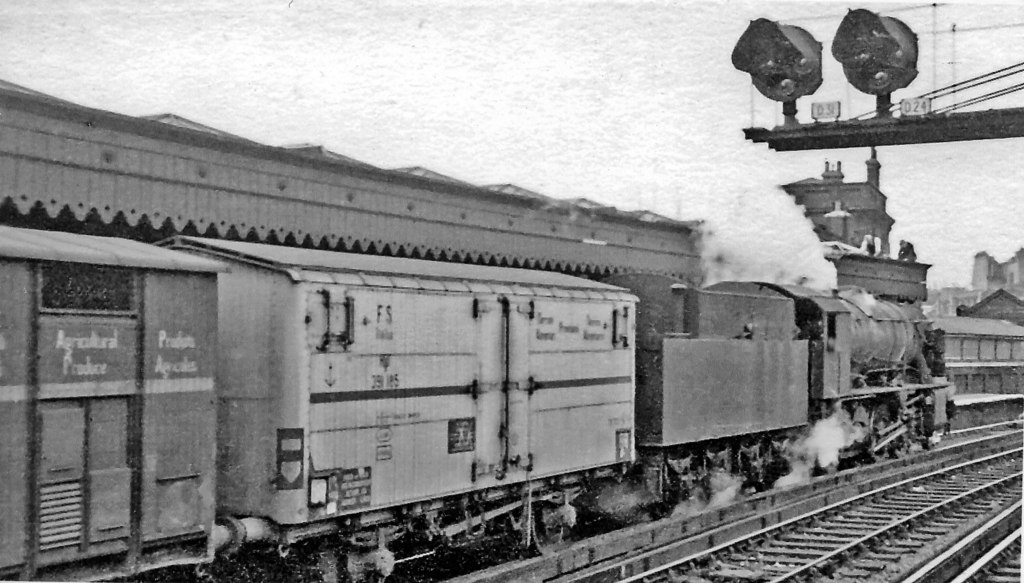
Photo by Ben Brooksbank

When we come to a model of the site it has a lot going for it – locomotive facilities, vans (including ferry vans) and non-passenger stock and EMU’s passing on the main line.  It is also interesting how long the site is.  The figure below shows an 8′ length in ‘N’ marked on the map.  This is far longer than the track between Holborn and Ludgate!

I see this as potential N-mod boards.  One could leave out the branch to Holborn, leaving 4 tracks at the front in best N-mod style, and straightened at the left hand end.  The Herne Hill-Holborn viaduct would still cross the lines, but vertically, forming a natural end to the module. The Grand Vitesse Depot would be turned a little and narrowed to be close to the 4 track main line.  The whole layout would be compressed a little to fit within 8′.  And Ewer Street stabling point could be modelled much as is, depending on the complexity of pointwork that is modelled.  This could form both a good home layout, and an exhibition module.

Posted in Hints and tips, Inspiration, Layout design, Out and about | Tagged , , , | 2 Comments

On my workbench #4

Progress!  The second board for my N-club modules is wired and the three point motors fitted.  The wiring looks neater in the photograph than in reality, but it is at least all held in place with hot glue, and the wire colours are reasonable consistent.  Not entirely, as it’s impossible to maintain colours on a ladder of pointwork with the live frogs feeding each other.

Next was how to get power to the tracks.  The square platform in the centre of the board is to hold a small sealed box transformer.  I was originally going to tie this in place, but consulting with Mr Atfield it was suggested that mains electricity on baseboards was verboten.  However, I wasn’t convinced, and retreated to my books and the internet.  I found Mr Rice suggesting a ‘sealed’  (i.e. a wooden box with a screw on cover) compartment for the transformer within his ply baseboard structure.  A widely exhibited large narrow-gauge layout described how the sealed transformer was tied to the underside of his layout – and this is obviously acceptable to exhibitions.

So I went for a compromise.  The transformer is tied to the platform with cable ties, and is easily removable, but can remain in situ for transport.  A plug power supply is needed for the Cobalt point motors.  Both supplies are plugged into an extension lead fixed to one of the leg units, and hence is not part of the main baseboard.

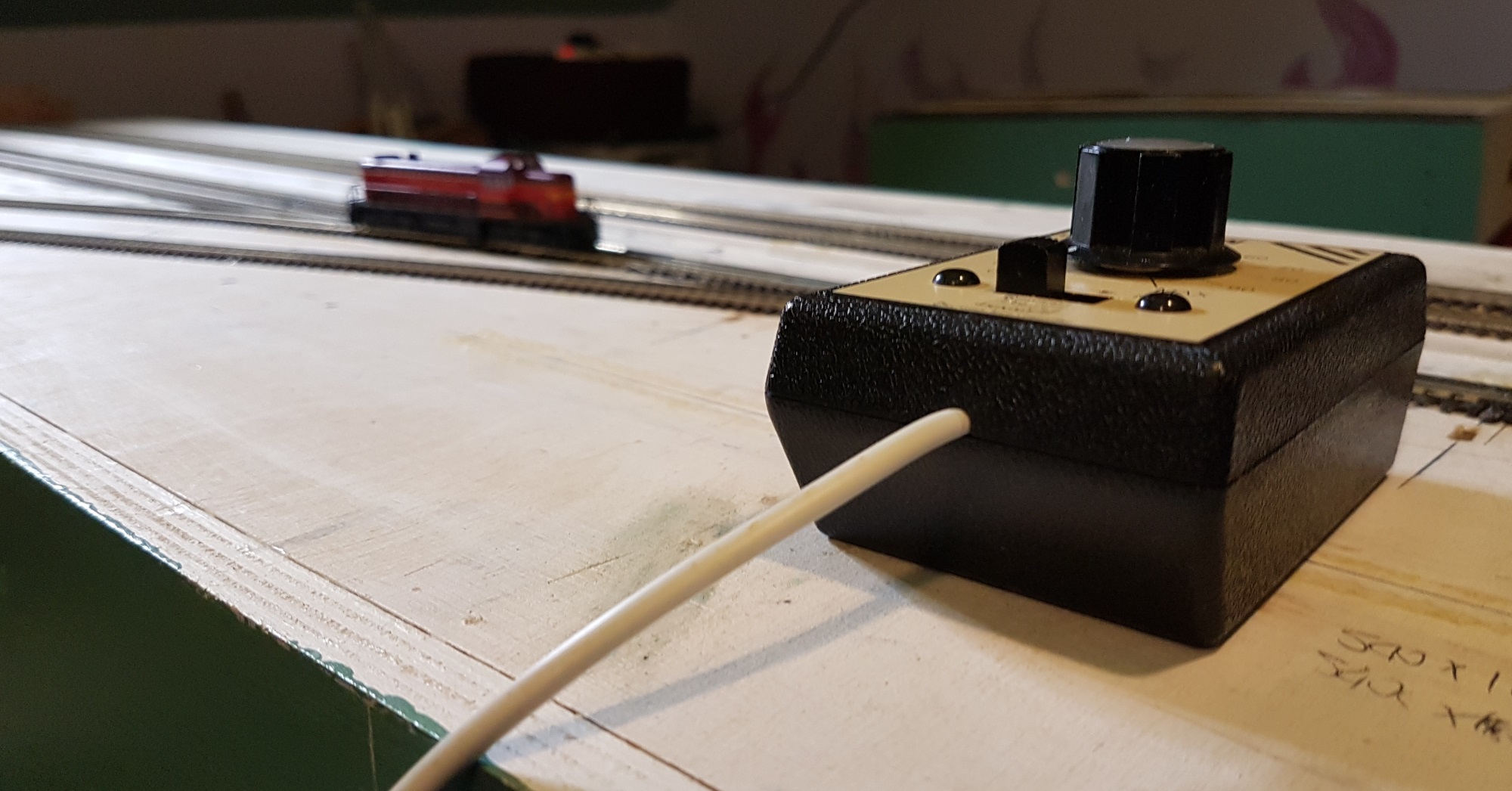
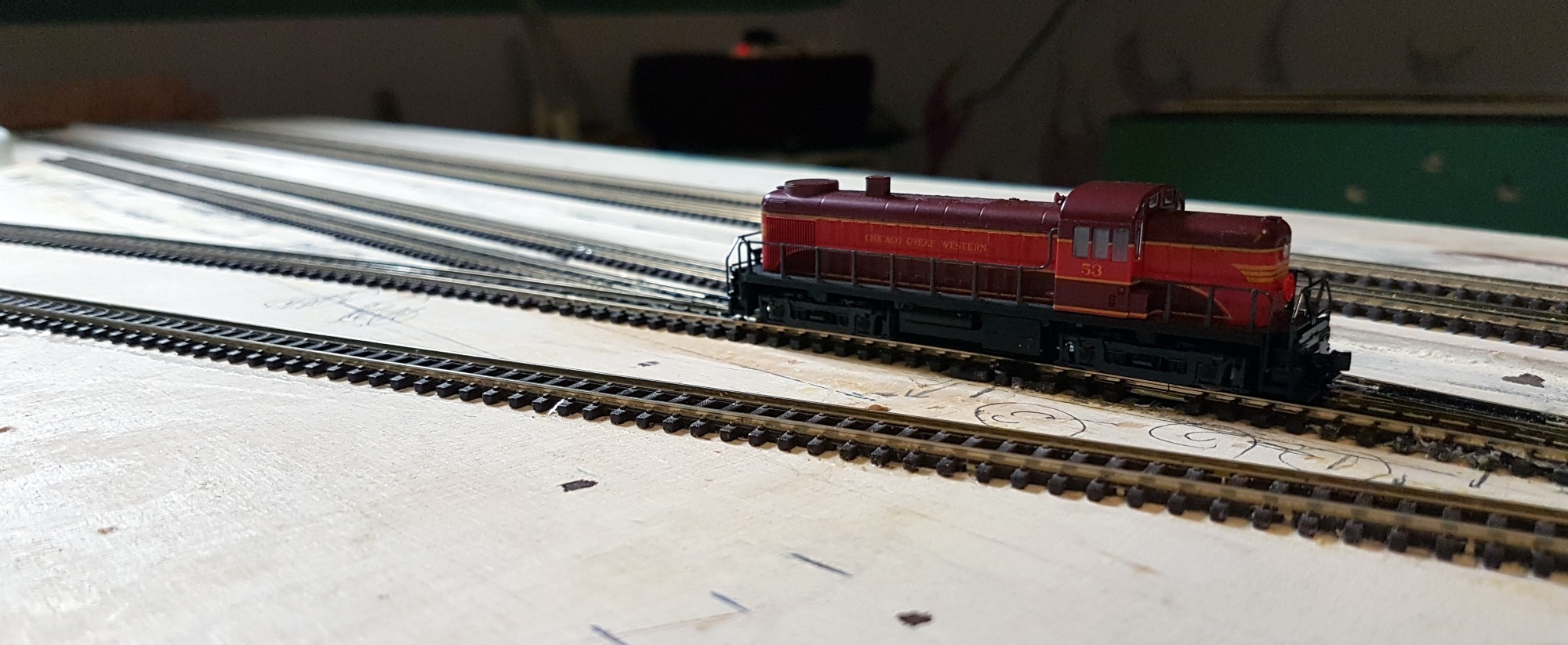
And I plugged in my old Gaugemaster hand-held controller and the test loco (an old Rock Island Kato RS-2) happily ran over the whole board.  Back to where I was a year ago when I decided to rebuild the modules…..

Since these photos, the two boards have had a quick spray with ‘sleeper grime’ (remembering to mask the moving areas of the points – I’ll hand paint these later.)  I’ve sketched out roughly where the buildings will go, and found the appropriate kits in my gloat box of American buildings.  Now on to making some buildings and ballasting the main lines.  I’m not sure what to do in the yard – I’m wondering whether to just fill the track to rail level as general grime and gunge.

Posted in ESNG, Jon's layout ramblings, On my workbench | Tagged , , | 4 Comments

Chiltern Model Railway Exhibition 2018 #2

How did the show match up with last year?  There was a lot more ‘N’ and 2mm modelling on show, but overall I felt that there were less ‘inspirational’ layouts than last year.  But this is of course a subjective and personal view, and the show was well worth a visit.  The only annoying bit was the long wait for a parking space, as the car parks were operating on a ‘one out, one in’ basis.

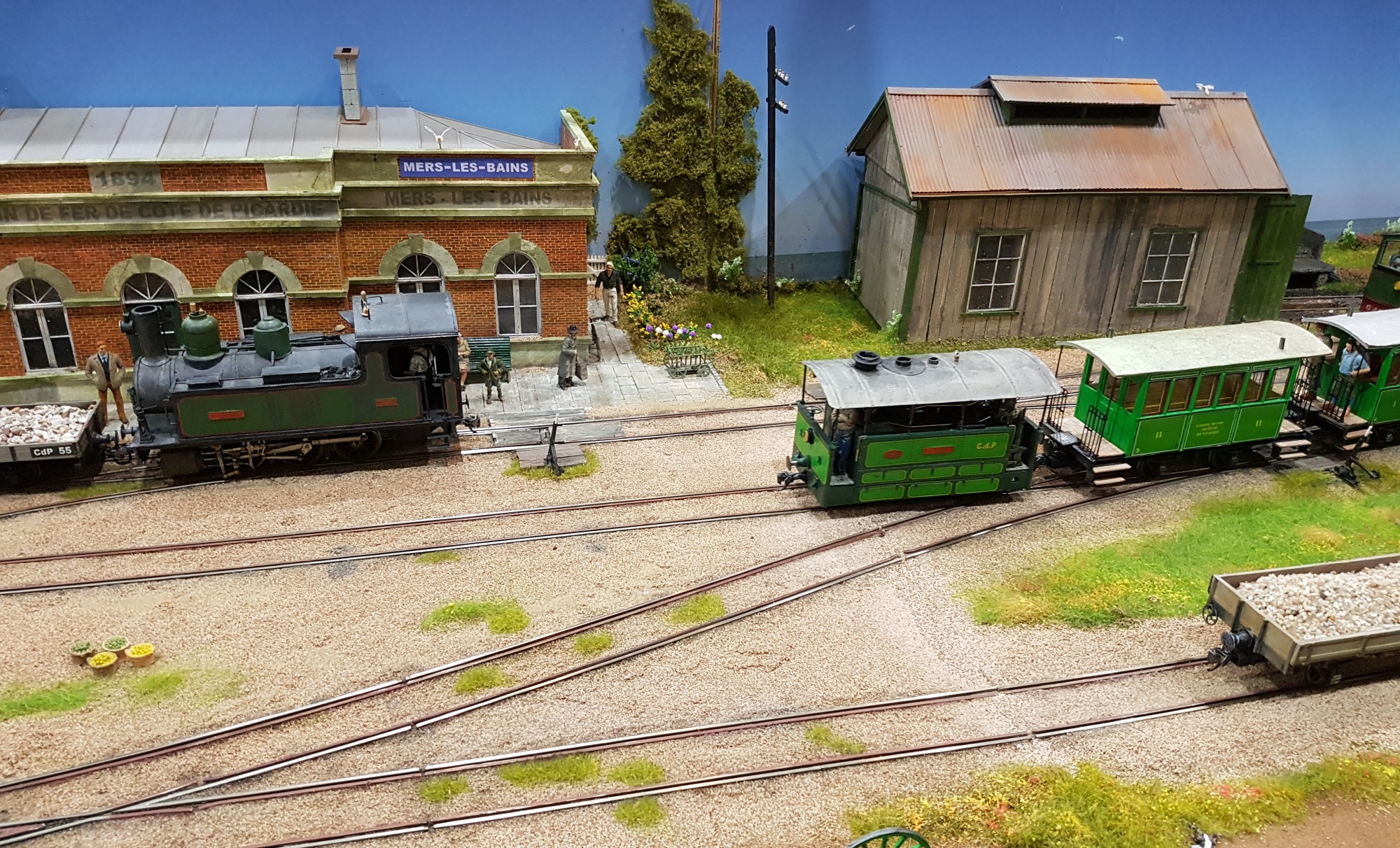
So to the layouts. Mers Les Bains in 1:32 scale is a regular on the circuit, but always worth another look.  There are more scenic details on show every time I see the layout.

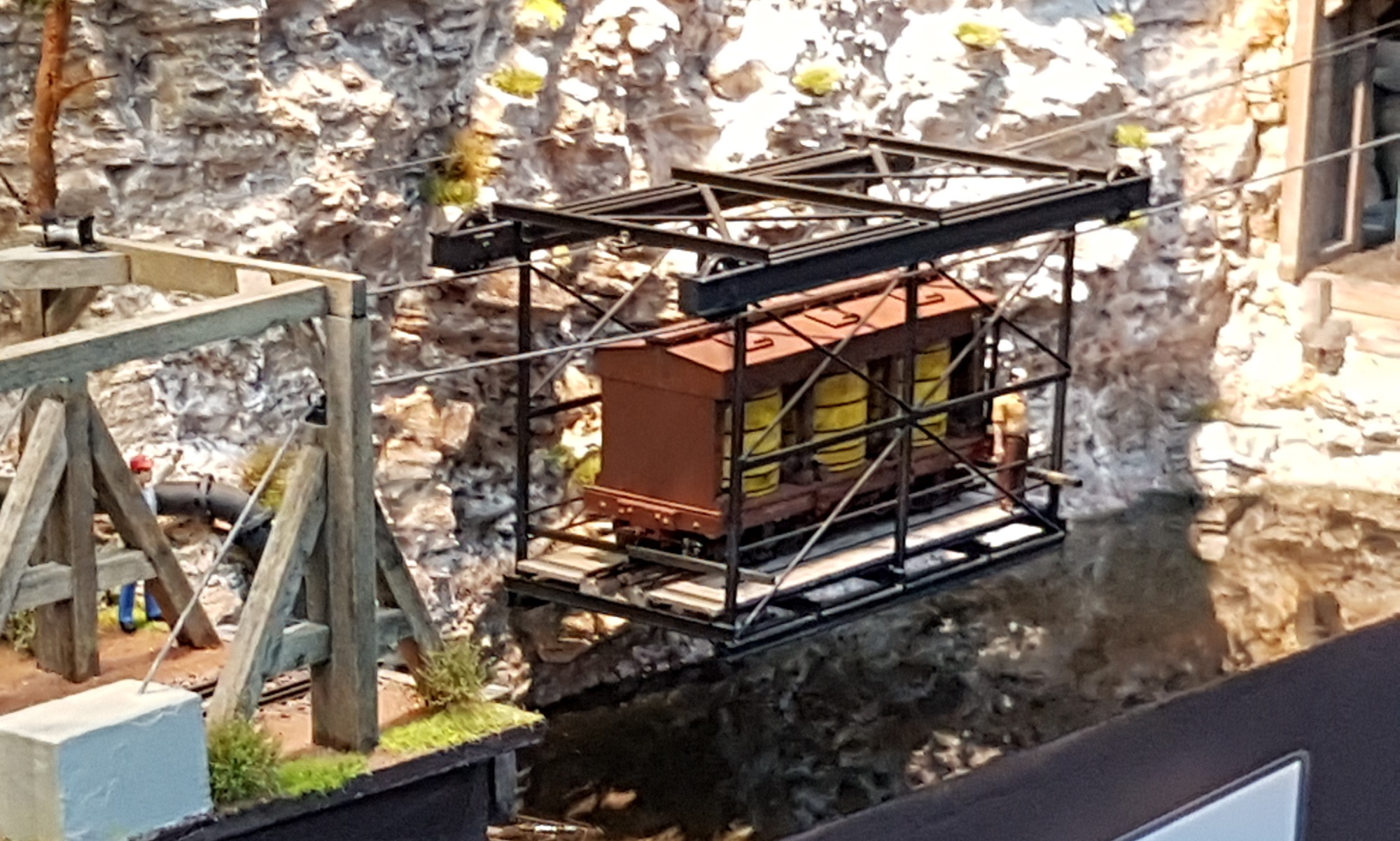
Aerial & Pickles – US narrow gauge in 1:48 – had this amazing working transporter bridge.

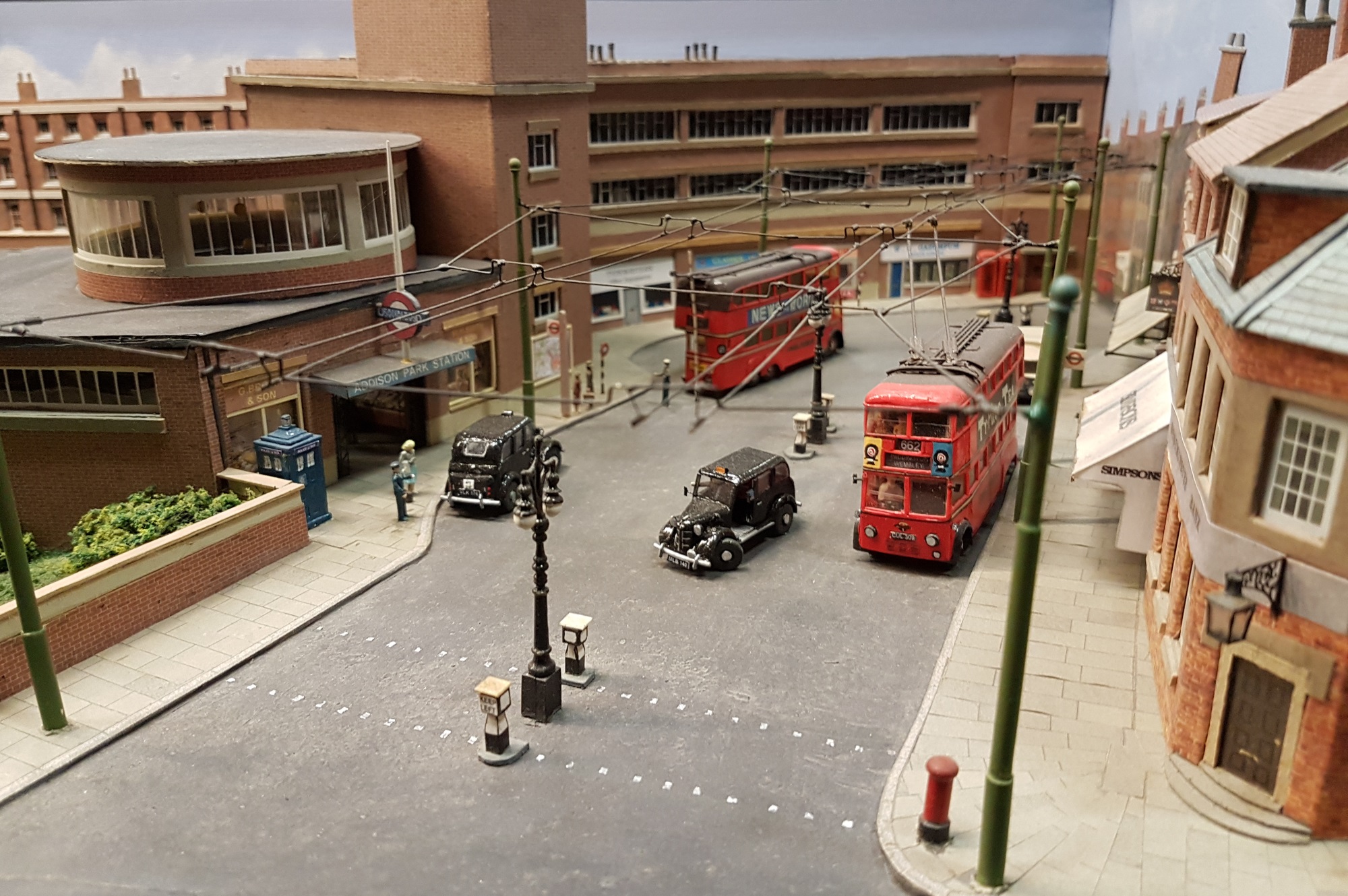
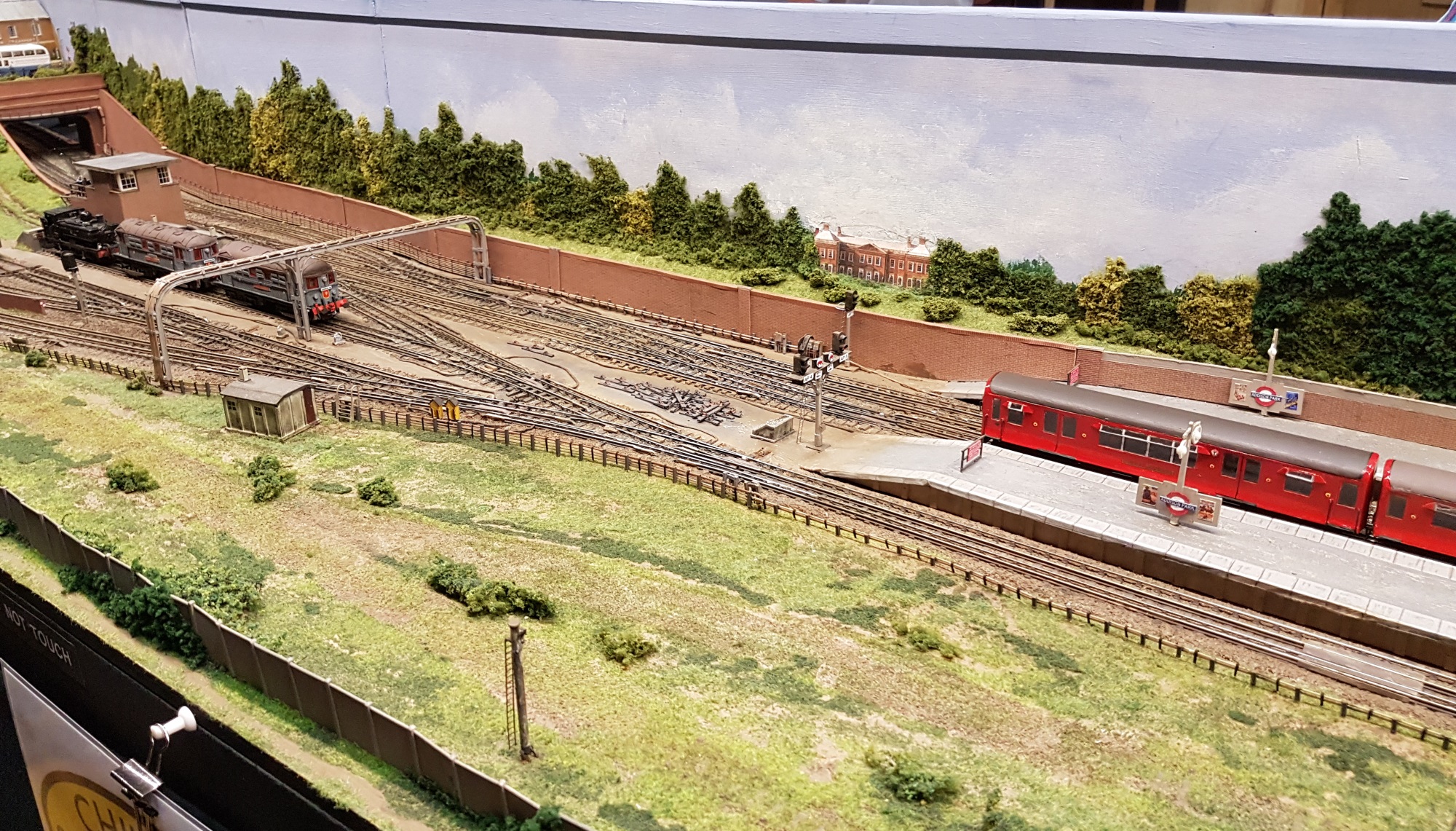
The third and fourth rail department….  Addison Park is unusual, both in modelling in 3mm scale, and also modelling the London Underground…..

Readham has some impressive Southern Electric kit on show….

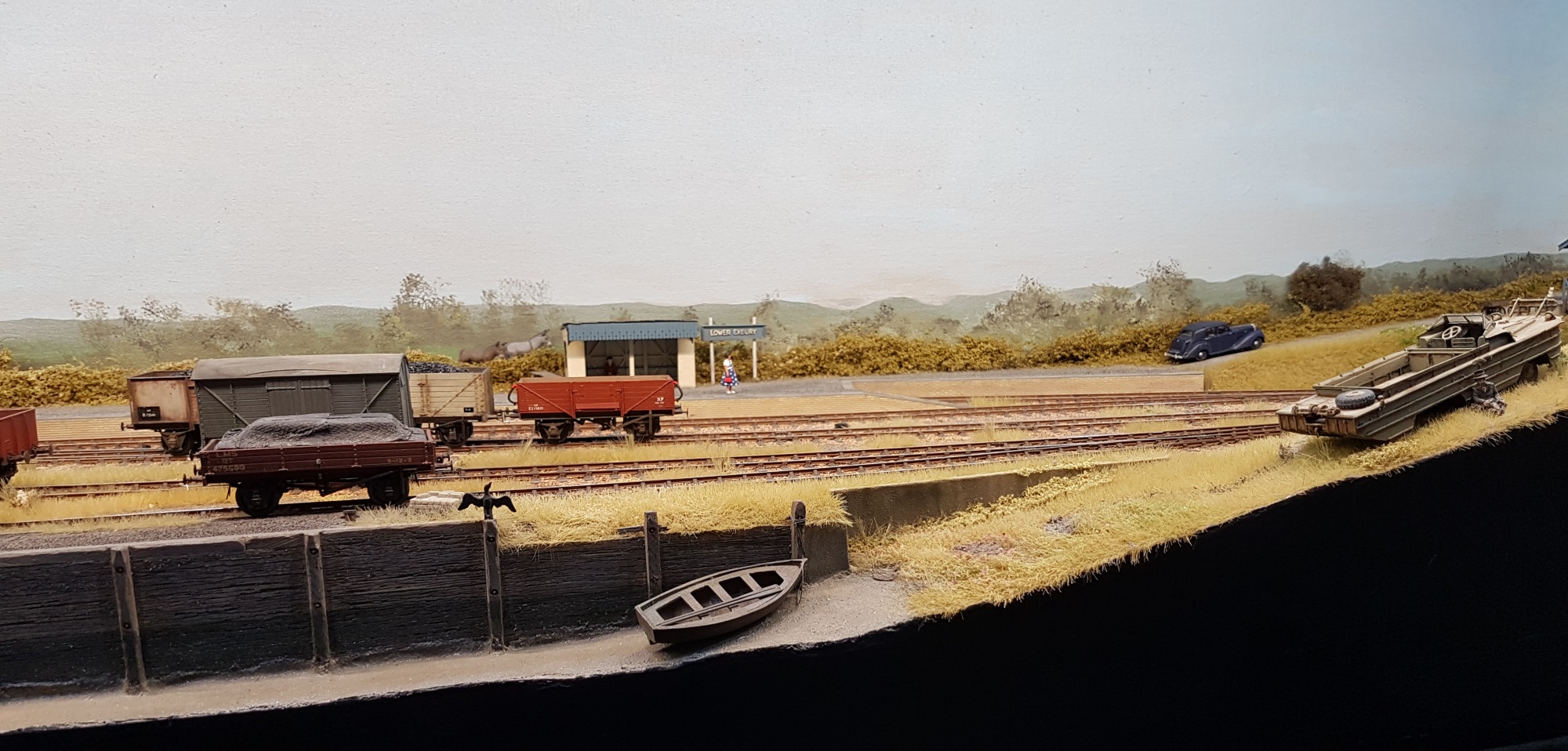
The bucolic branch department, all with a watery theme.  I loved the cormorant (and DUWK) on Lower Exbury (P4)…..

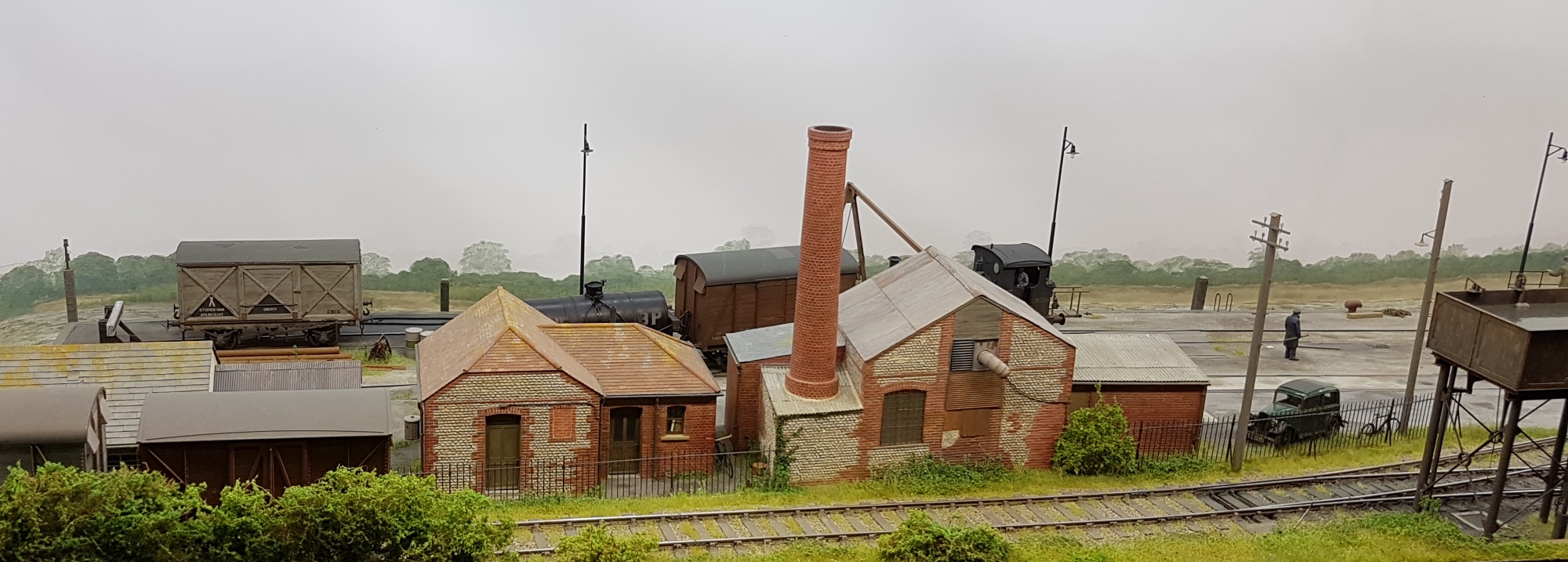
Arun Quay (O) is a delightful piece of modelling….

And the location of Lakebank (again 3mm) is again obvious by the Swallows and Amazons sailing around next to the quay…..

Gauge 3 seems to be in fashion, as there was a long layout in this large scale.

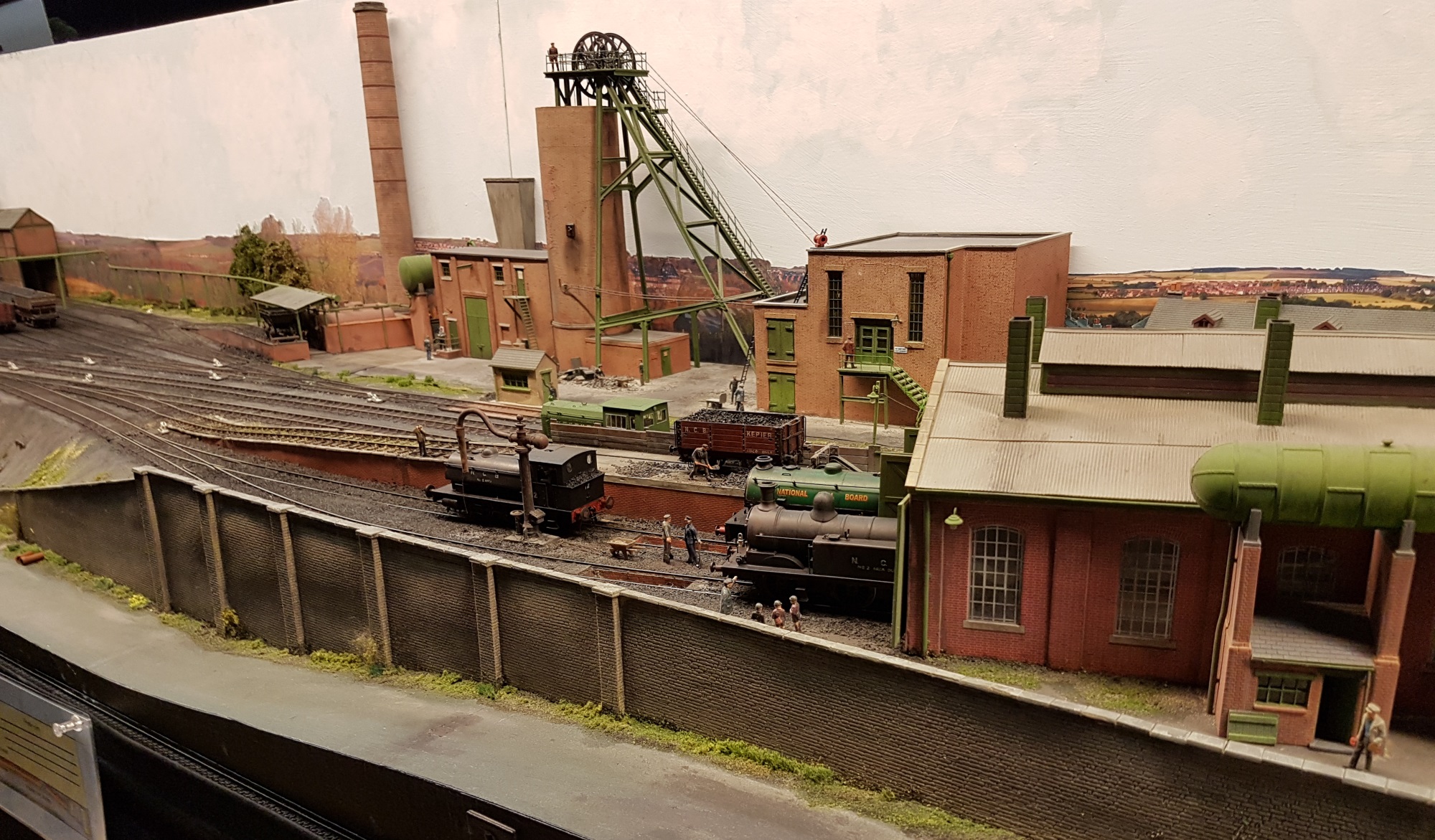
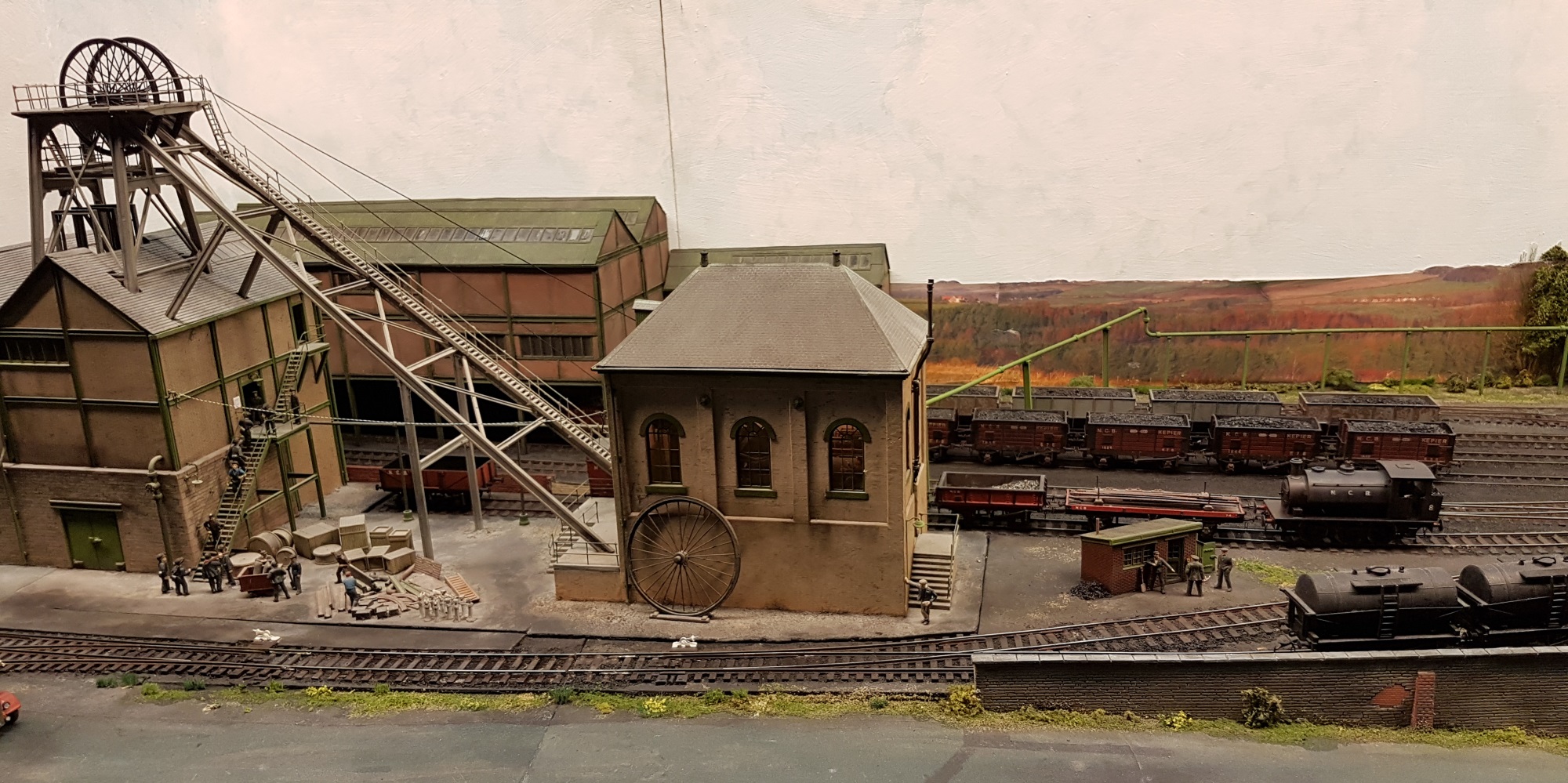
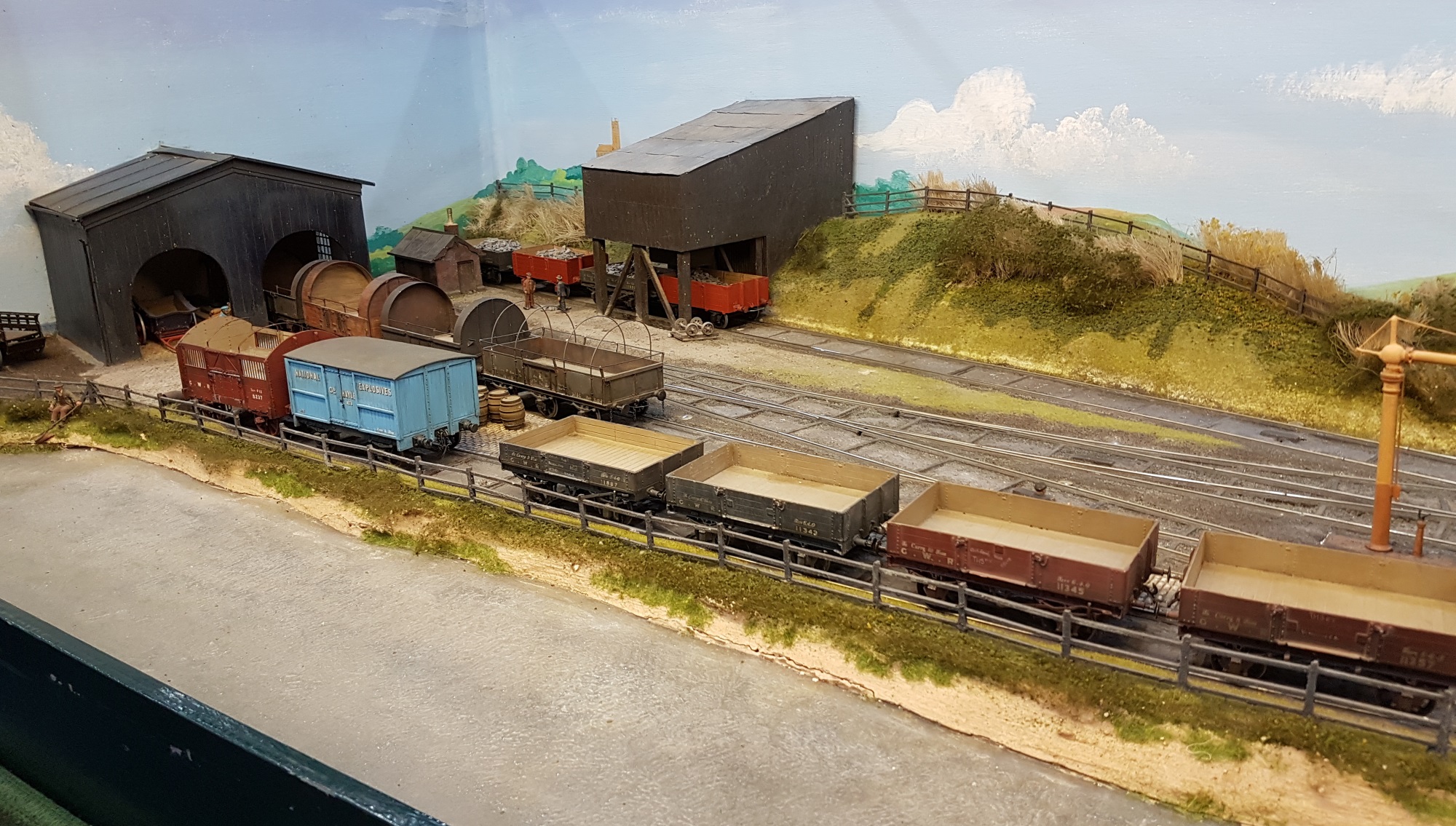
Kepier Colliery (OO) showed the attraction of industrial scenery and rows of grimy coal wagons pulled by small tank engines.

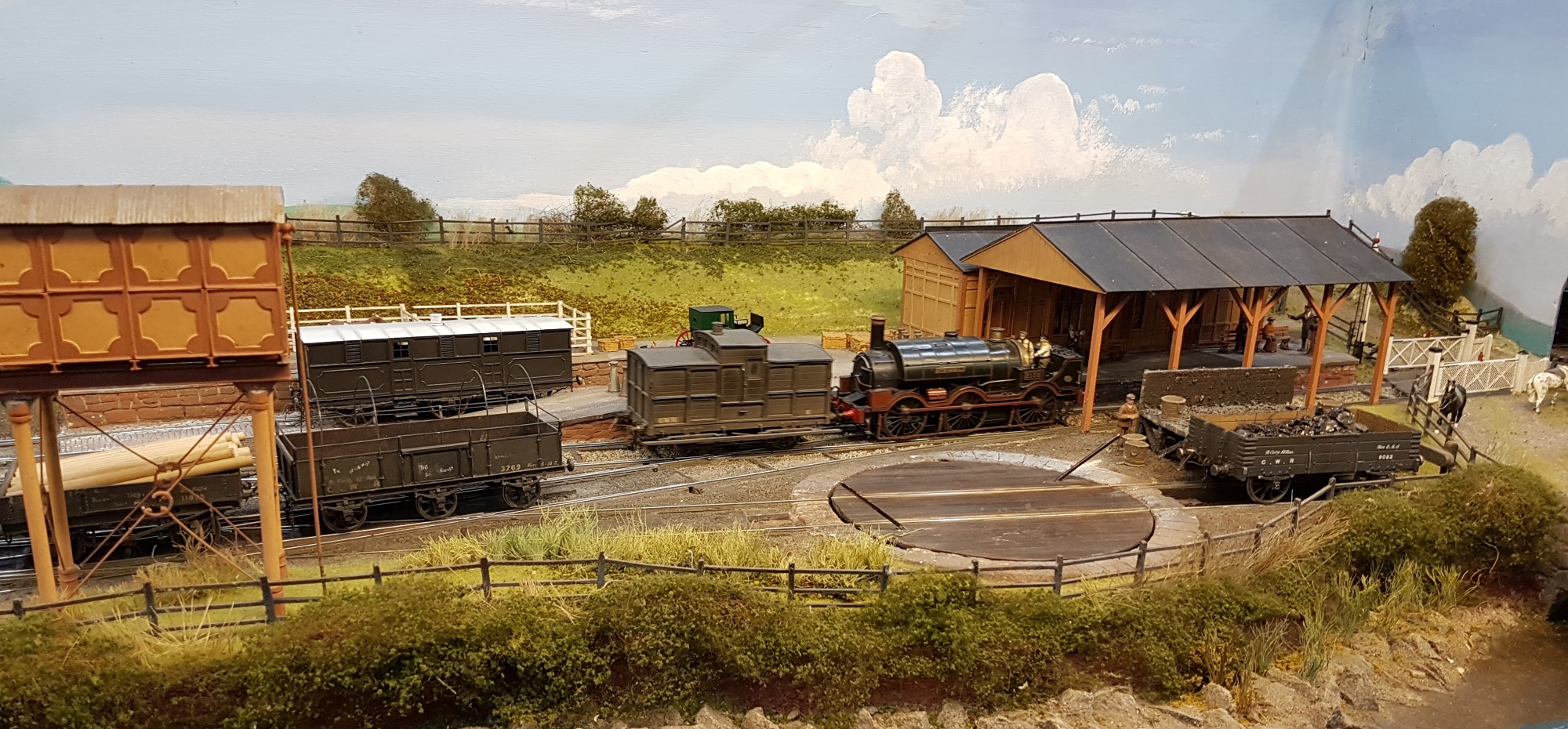
There was even some broad gauge GWR on show….

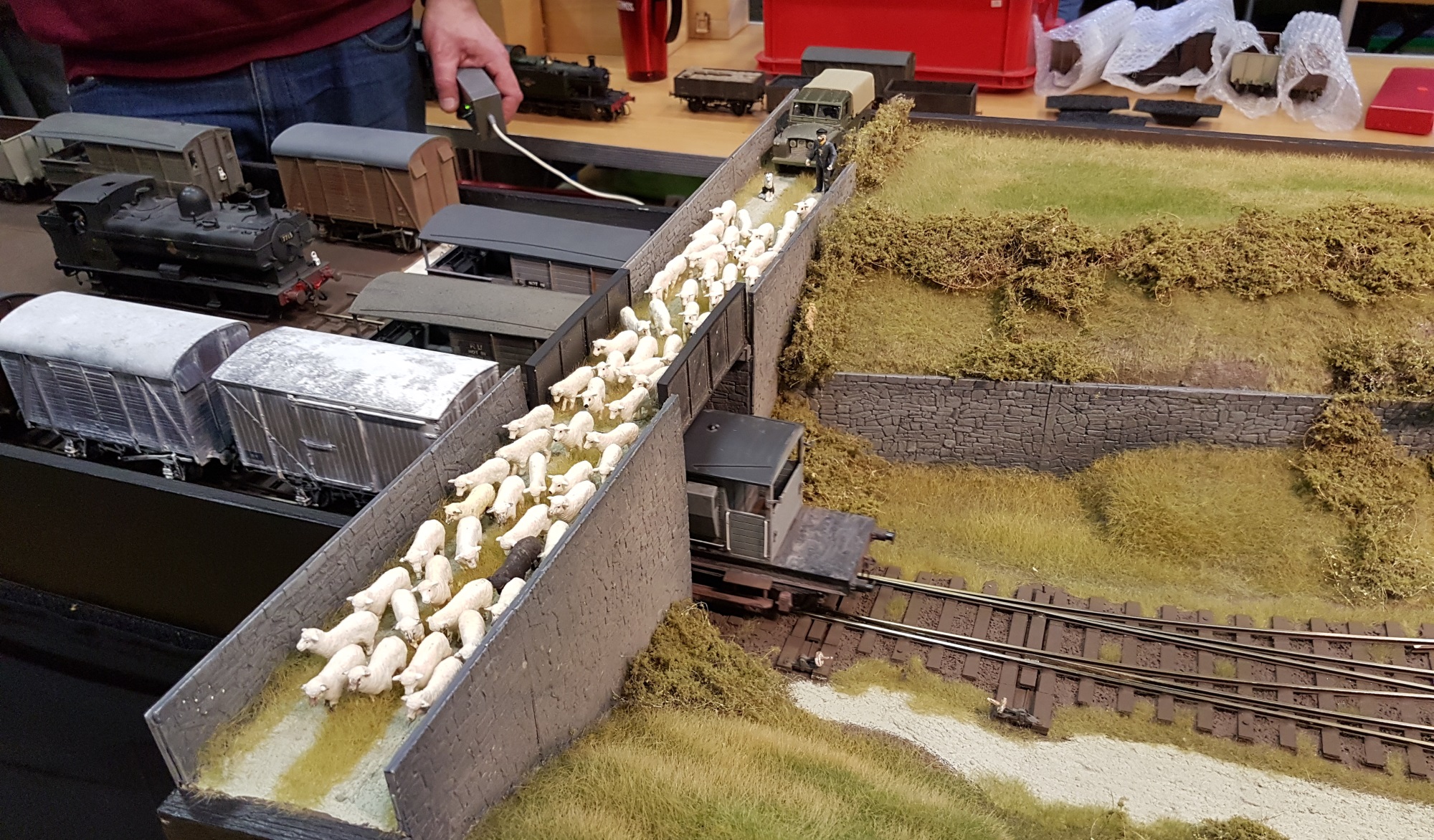
Scenic win – no bus on the bridge, just a flock of sheep!

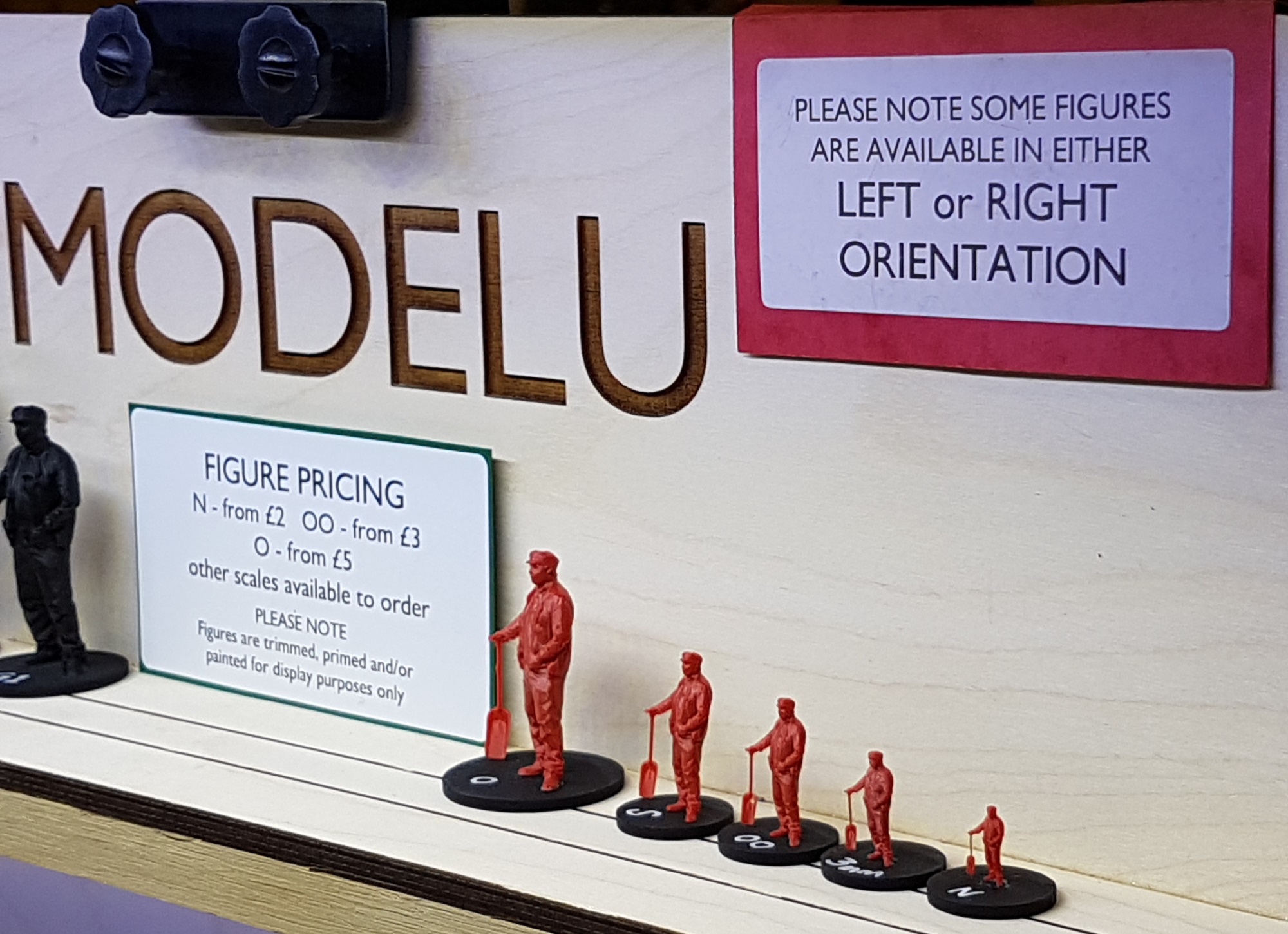
Finally the politically (in)correct department.  Modelu make excellently realistic 3D scanned railway figures (and can do personalised figures at a price).  But I am not sure how you can spot the orientation of an ‘N’ gauge railway employee…. (Sorry, couldn’t resist this one!)

Posted in Exhibitions, Inspiration, Out and about | Tagged , , | 1 Comment

ESNG meeting – 17 January 2018

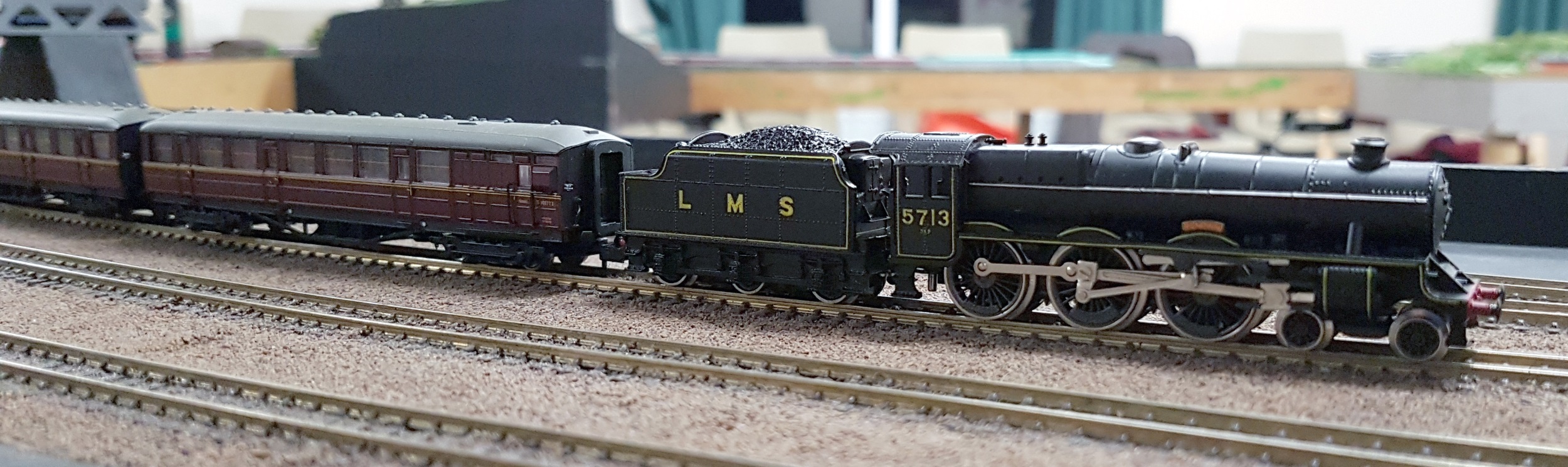
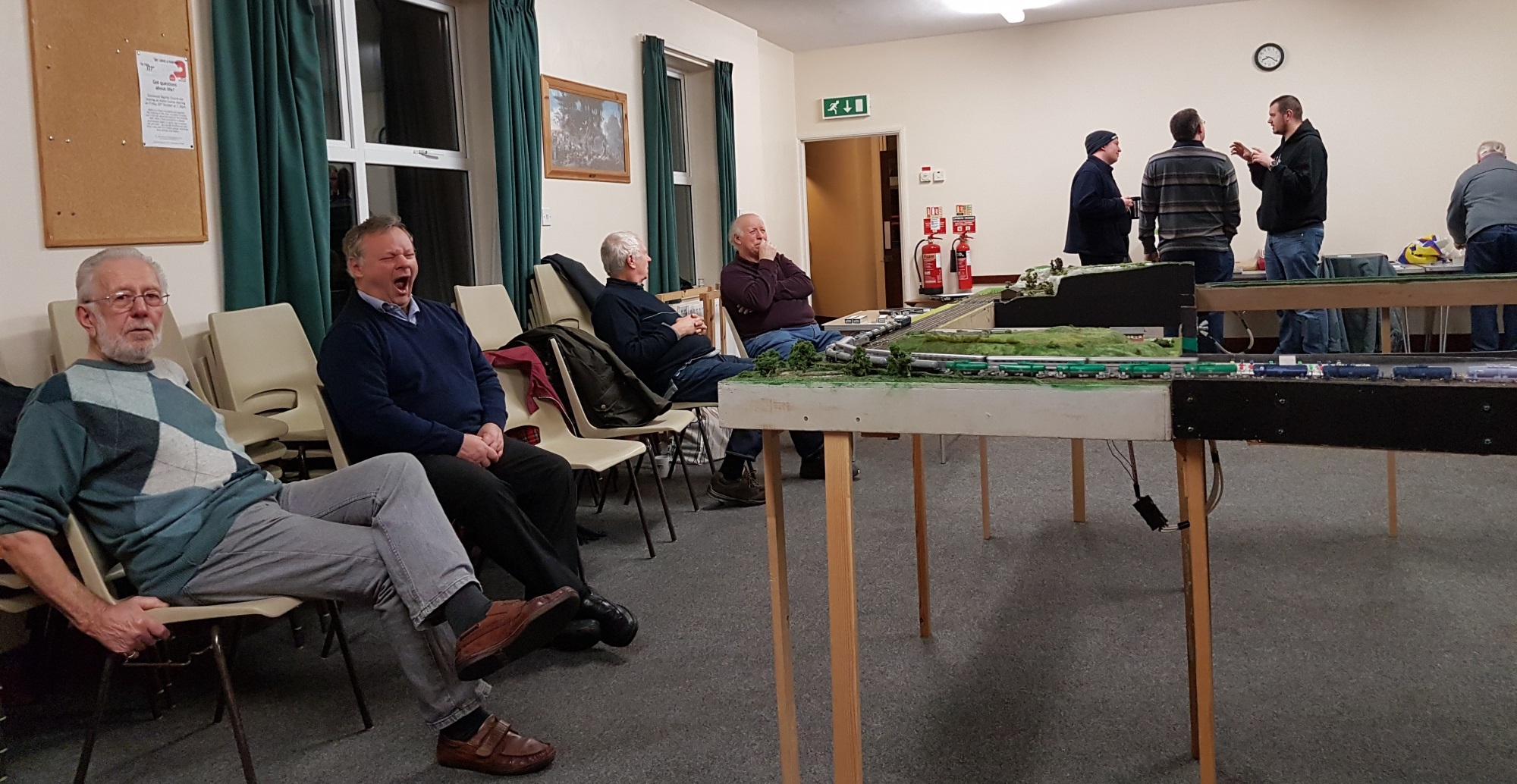
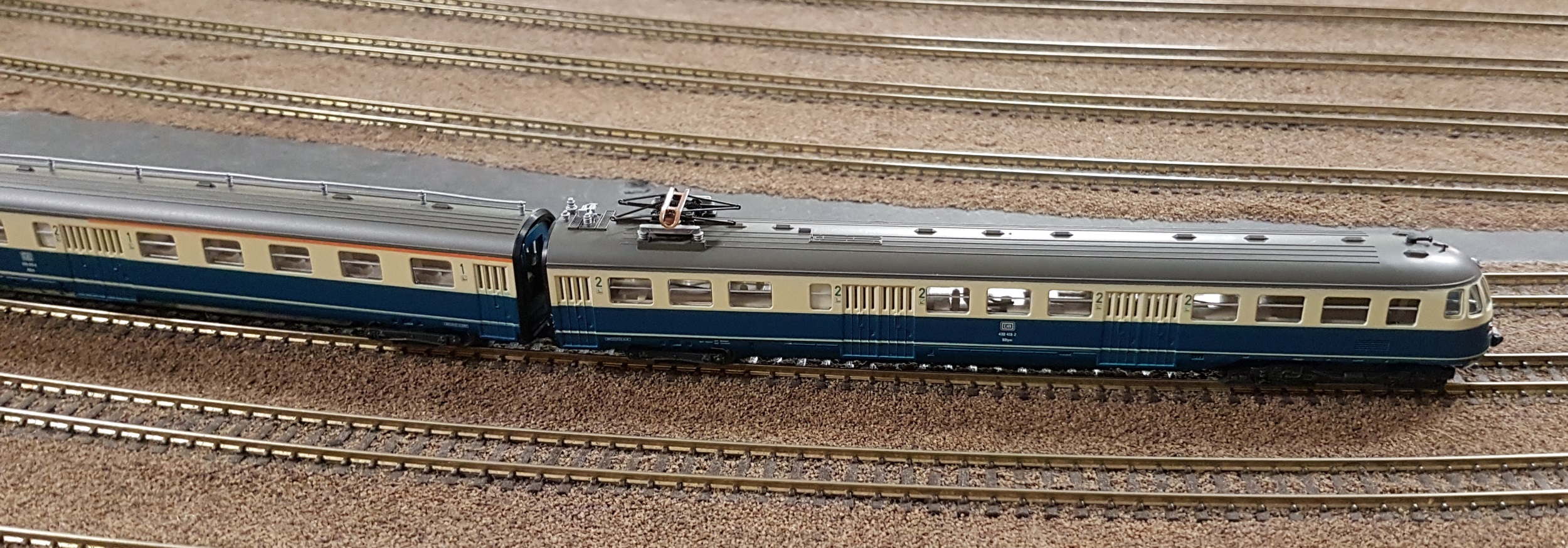
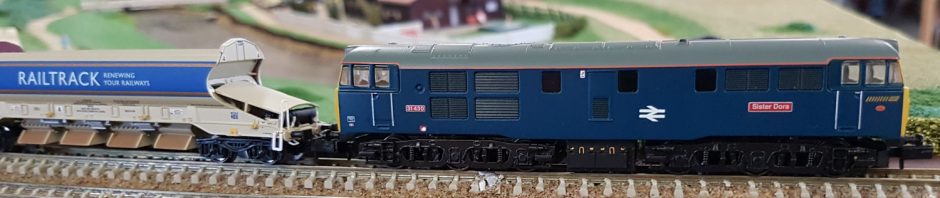
A fairly quiet club evening – and sorely missing the Cha(I)rman’s tea making expertise.  But there were some interesting trains on view.  Derek ran this Peco Jubilee and Dapol Gresley coaches.  A mismatch in both time and region, but a most attractive train.  The Peco Jubilee still stands up well against more modern models in detail and performance.
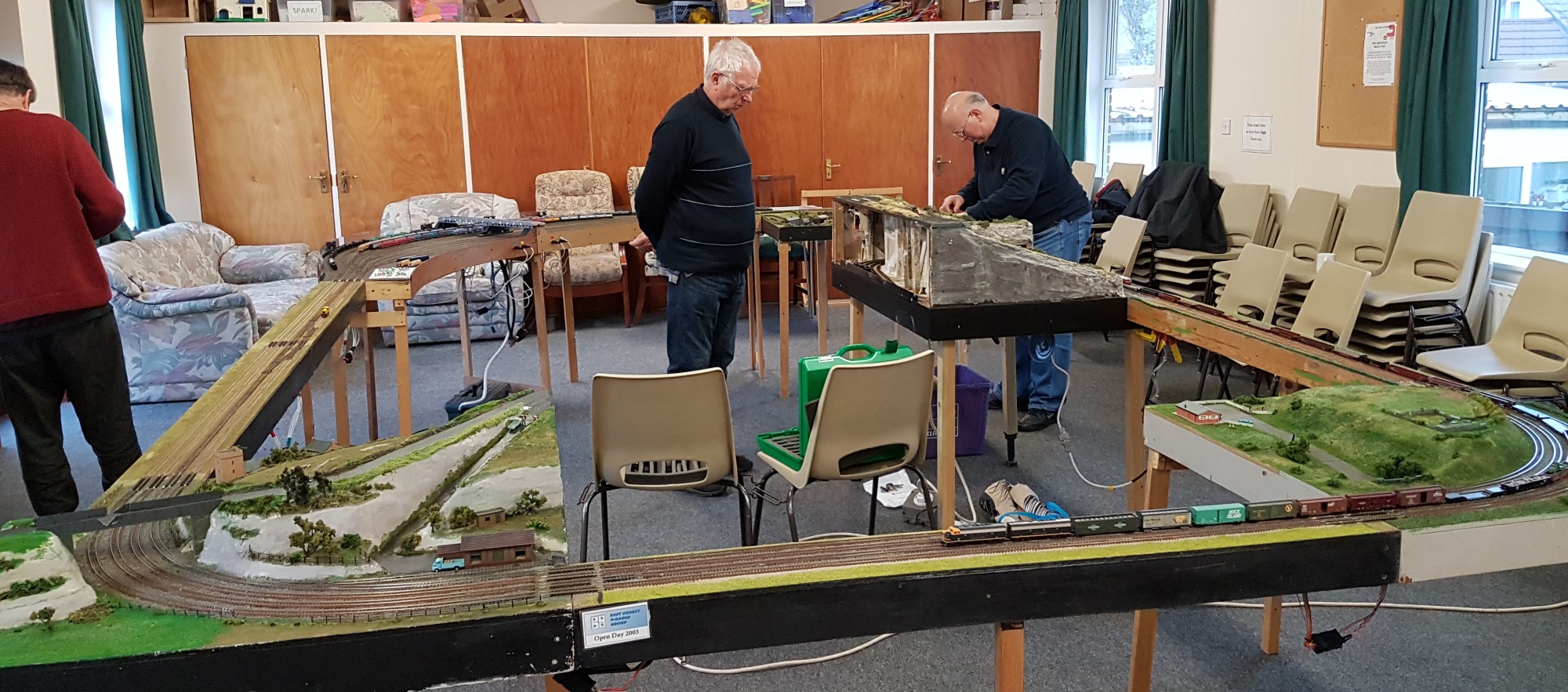
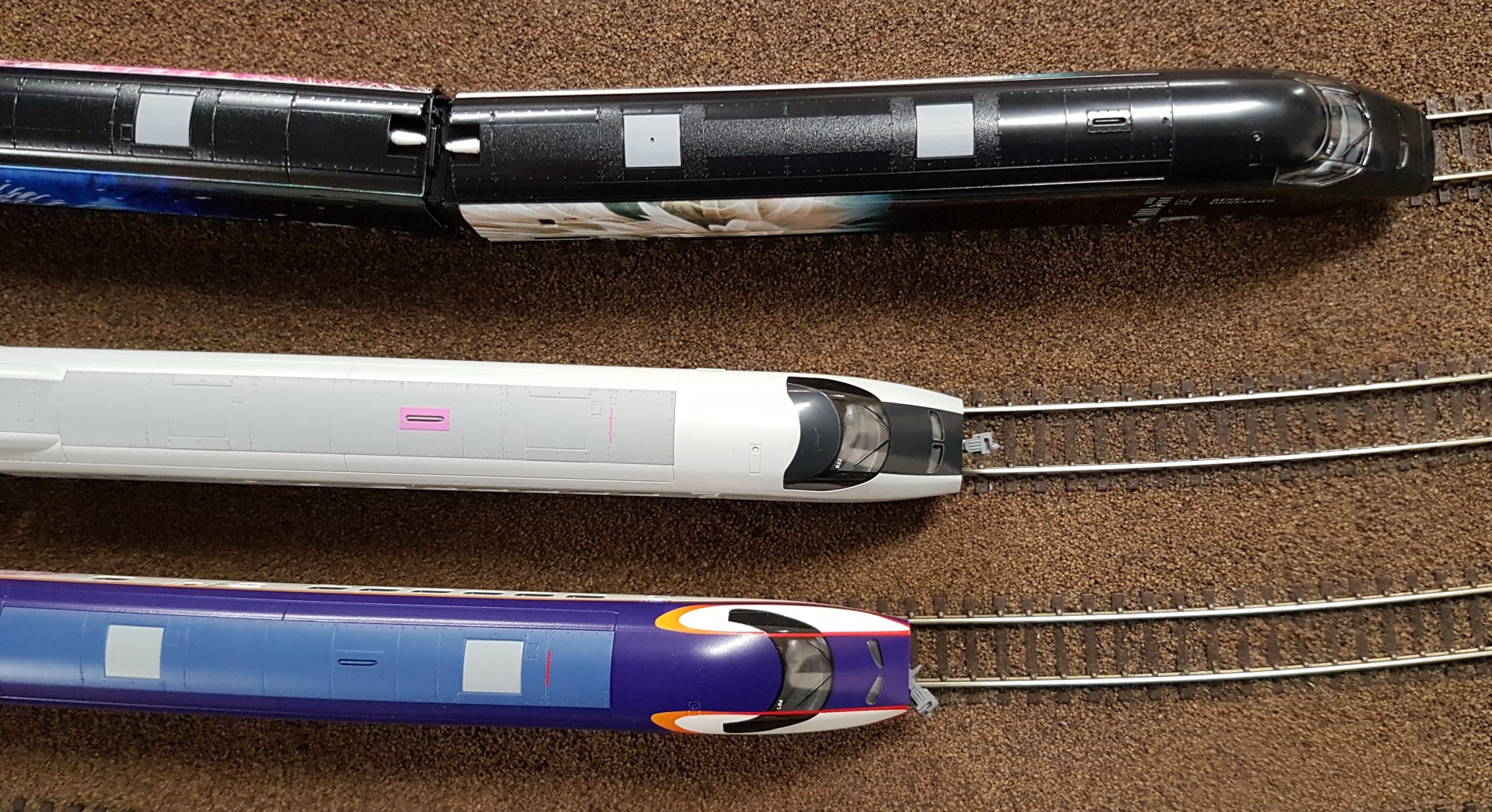
Paul occupied all the outer tracks with a range of Japanese bullet trains.  And it looked a bit like the tropical bird enclosure at the zoo – a wide range of exotic colours on view!!

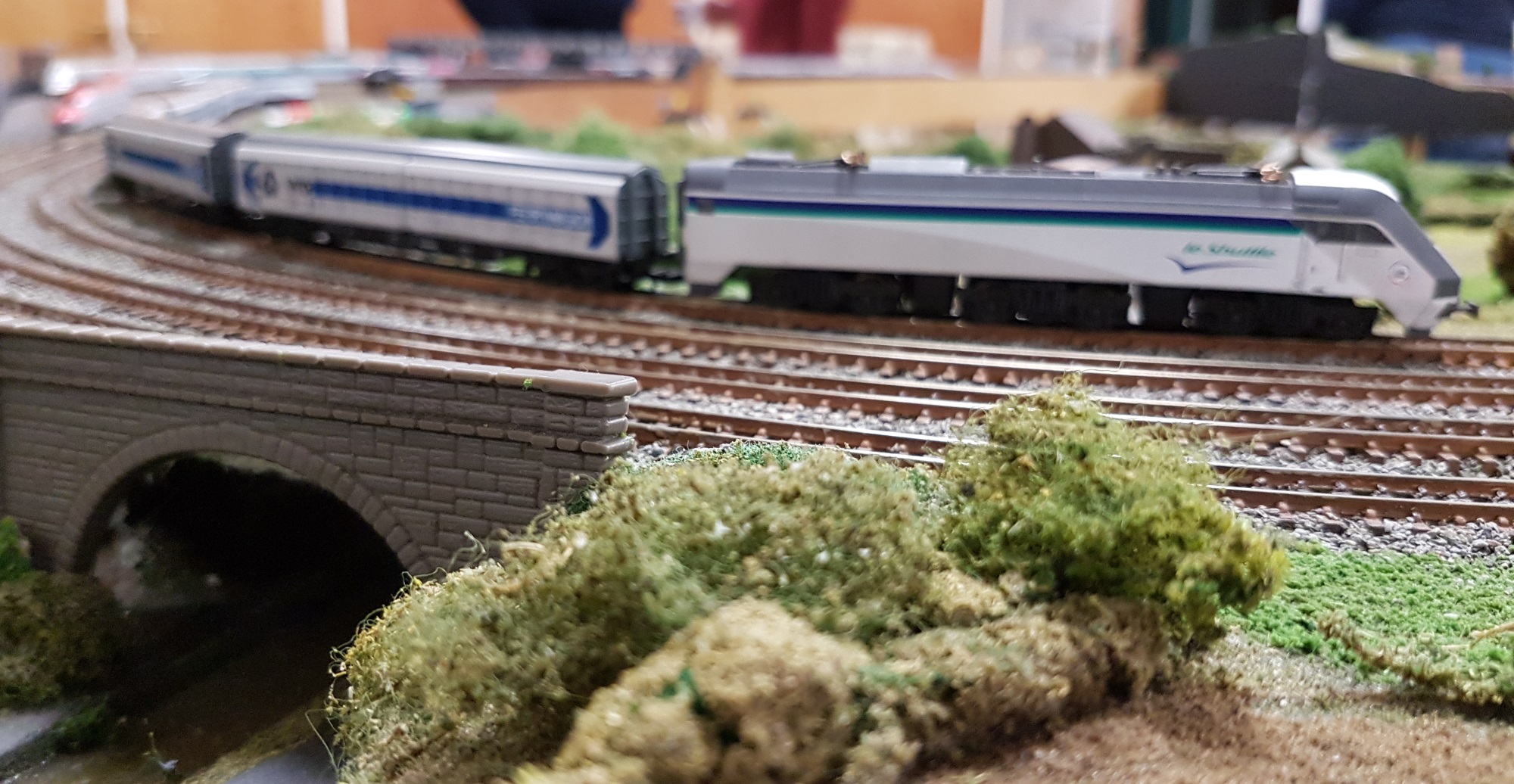
Peter was running a Channel Tunnel shuttle service.  You don’t often see these CJM ‘Le Shuttle’ locomotives…..

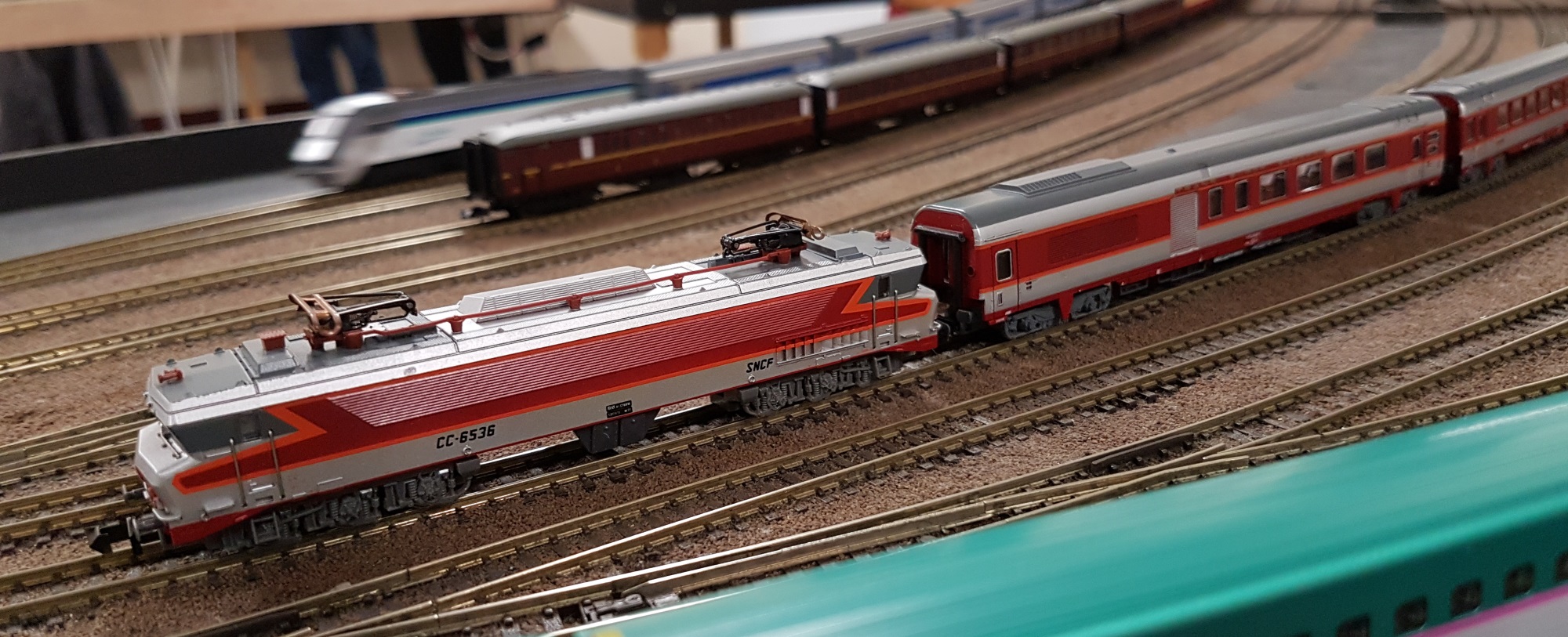
Whilst t’other Peter continued the French theme with this lovely Co-Co locomotive and coaches.  French locomotives of this era all seemed to have this distinctive cab shape.  I recall reading the Meccano Magazine as a kid, and seeing the advert for the Hornby-Acho French Bo-Bo with similar lines. (Now this dates me…..)


Can’t remember where this came from, so apologies for any copyright.  A clever bit of Photoshopping, or could it be the prototype for Graham’s roll-up fiddle yard?


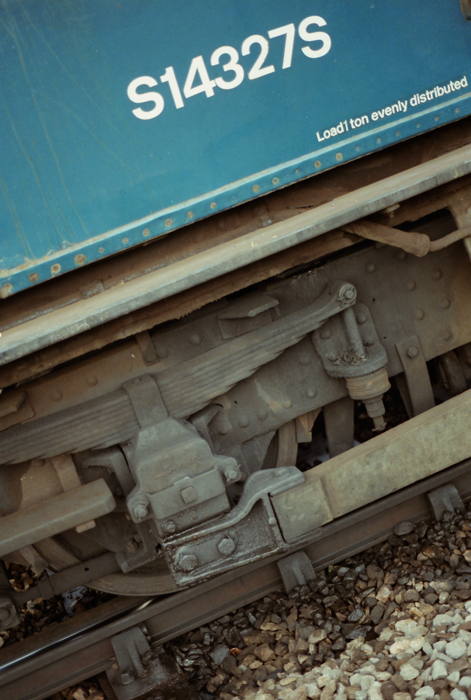
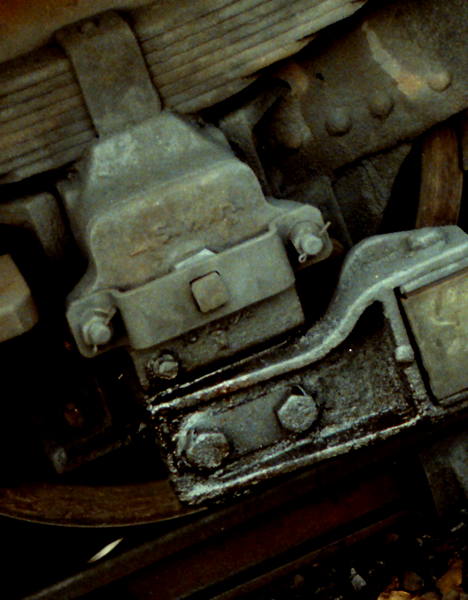
And I borrowed these two pictures from RMweb.  An EPB unit in BR blue, but still with an original LSWR axlebox cover, pre-1923.  The Southern Railway certainly didn’t waste much!

Posted in ESNG, ESNG meetings, Out and about | Tagged , , , , | 4 Comments

Chiltern Model Railway Exhibition 2018 #1

Time out with Mr Atfield on Saturday, visiting two shows north of the river (Thames).  We started at the Brentwood toy fair.  These things are a real lottery for ‘N’ gauge – it’s OK if you want to buy Hornby or buses, though – but there was a lot on offer today.  I was lured into some Farish van, especially when the trader accepted my optimistic offer.

Then on to Stevenage and the Chiltern Model Railway Exhibition.  We took about 25 minutes to find a parking space, but once inside there was plenty to look at.  We’ll start, as ever, with the small scale stuff, and a second post will have a few other things that caught my eye.  Not much detail – just photos – as I didn’t buy a show guide.

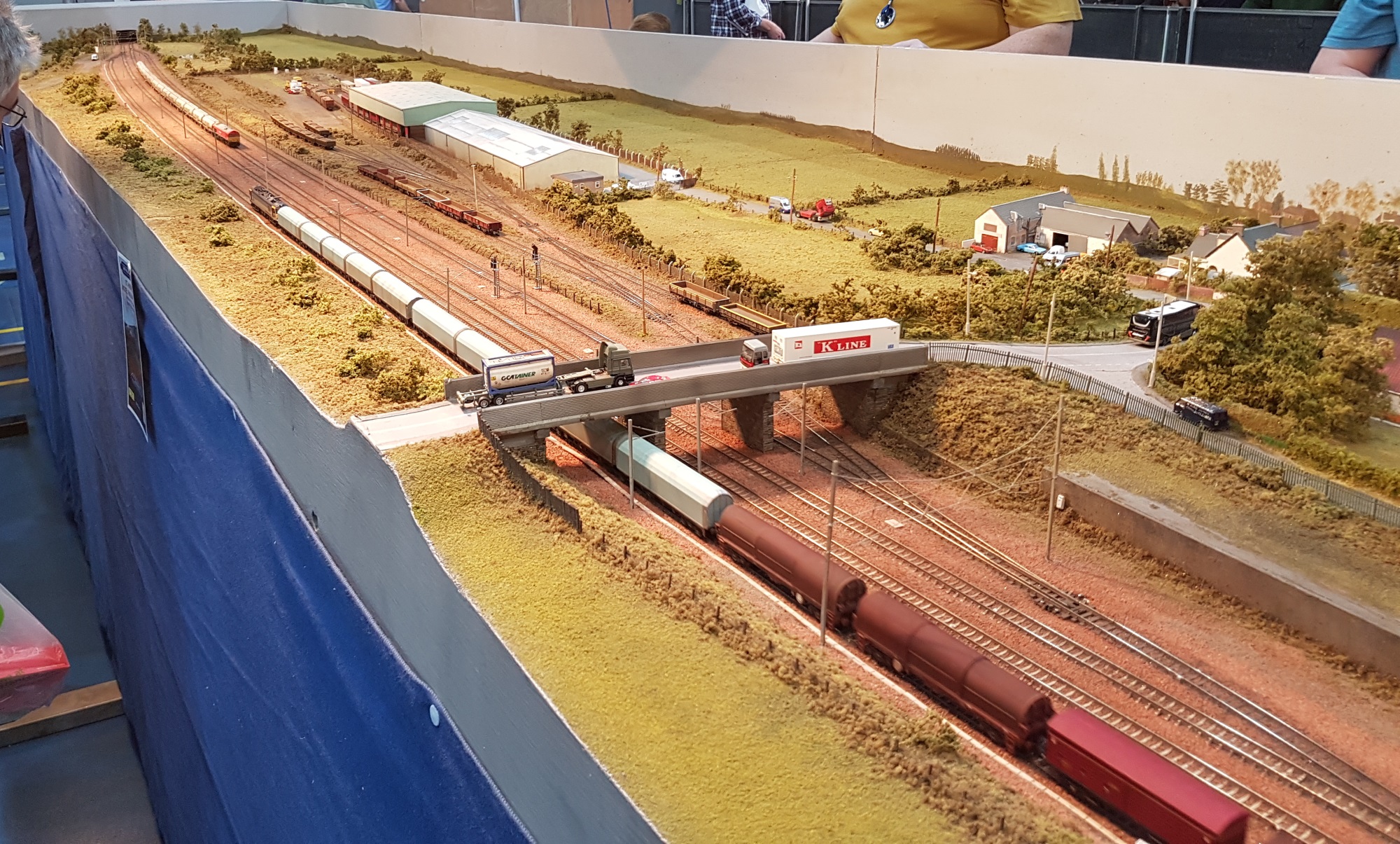
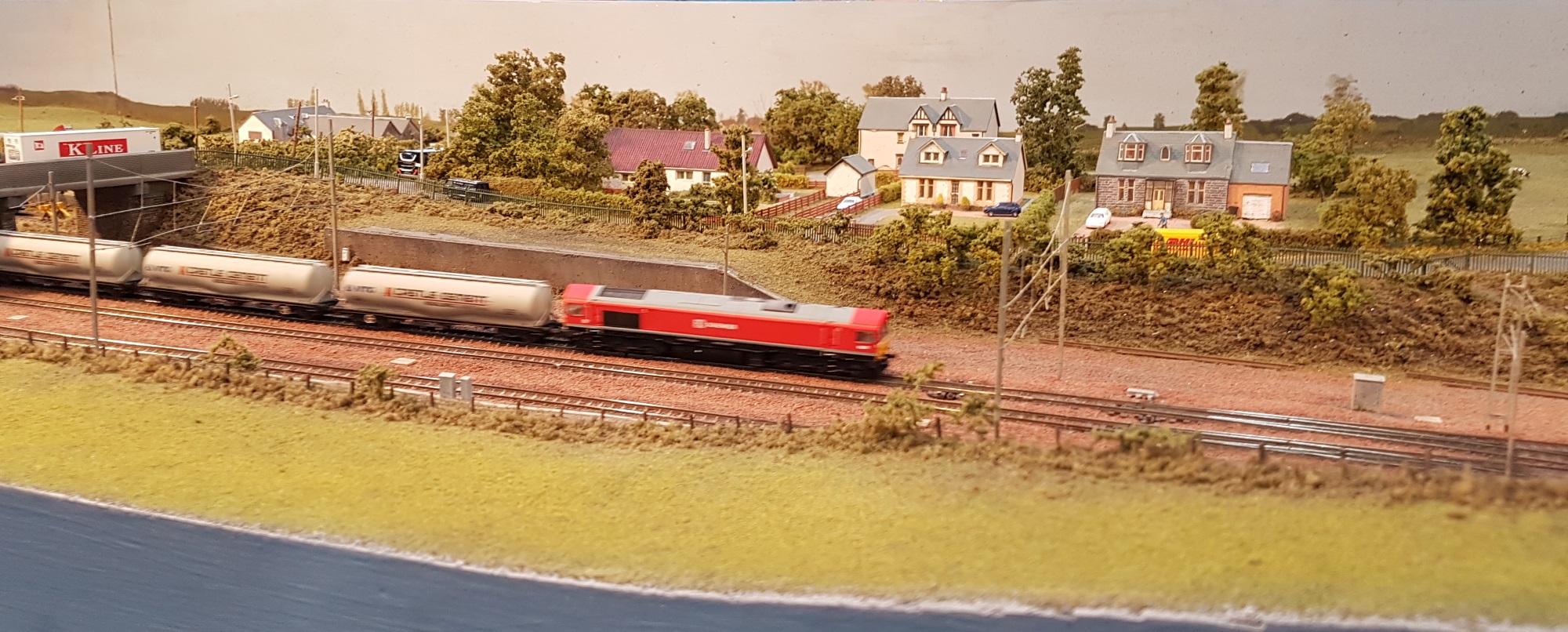
Law Junction was, I believe, from a Scottish club, and showed a stretch of 4 track electrified main line.  Tidy modelling, and conveyed the wide open spaces with trains in the landscape.

The Bridge at Remagen was meant to be at last year’s show, but had to drop out.  Most interesting modelling of WW2 railways, with loads of German military trains and other hardware.  I see that I missed a picture of the actual bridge.  This was certainly one of the highlights of the show….

Next the 2mm finescale, Great Western department.  Both photos taken from the end of the layout, when the improved appearance of finescale is most obvious.  First Llangerisech….

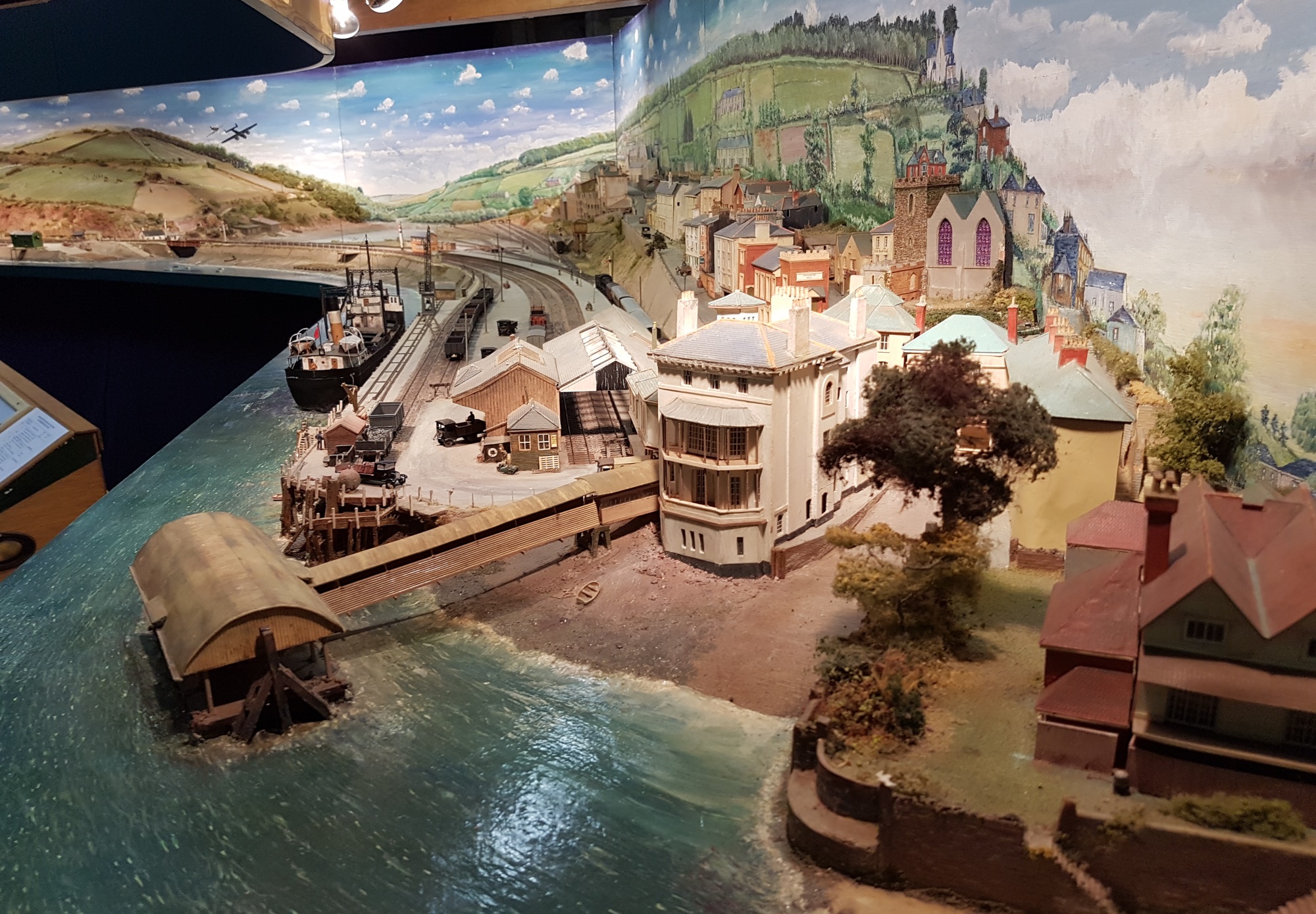
Then the enormous Kingswear.  Must be set in WW2 again, as you can see the Spitfire chasing an Me110 in the background.

Rannoch captures the bleak character of one of Britain’s most remote railway stations.  If you get off the train at this moorland halt, there is nothing much for miles!

Smaller still is the amazing Forth Railway Bridge in ‘T’ scale.  This isn’t so much a model railway as an architectural model with something moving.  But so impressive!

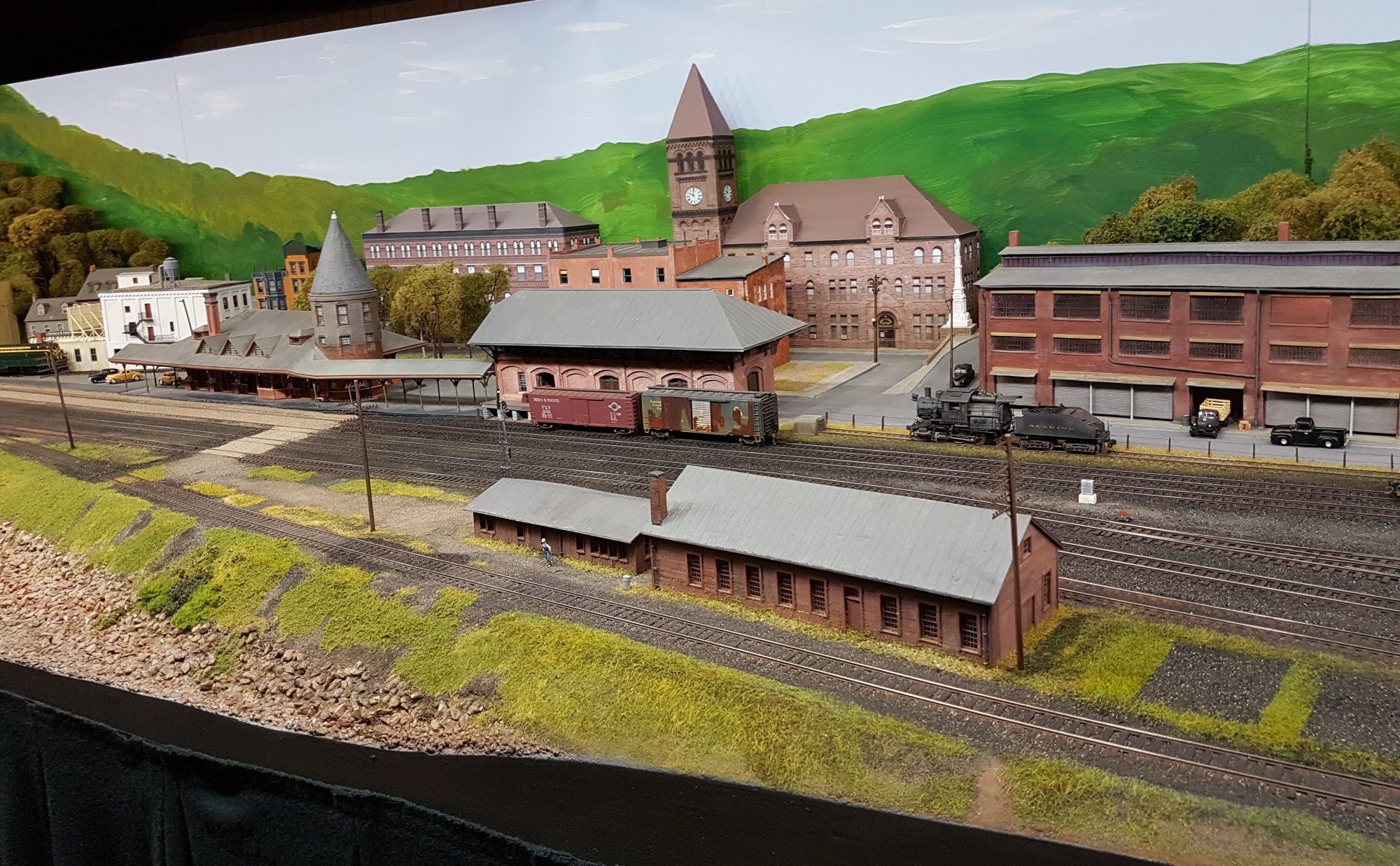
Moving up in size, Mauch Chunk was perhaps my favourite, with an accurate model of the Central of New Jersey station.  This lay on the opposite bank of the Lehigh River to my favoured Lehigh Valley Railroad.  Another example of how impressive USA prototype layouts can be when they use UK modelling styles and techniques.

I liked the idea of modelling the miles of yard tracks by starting the fiddle yard in the open.

A Baldwin ‘Baby Face’ diesel enters the station.

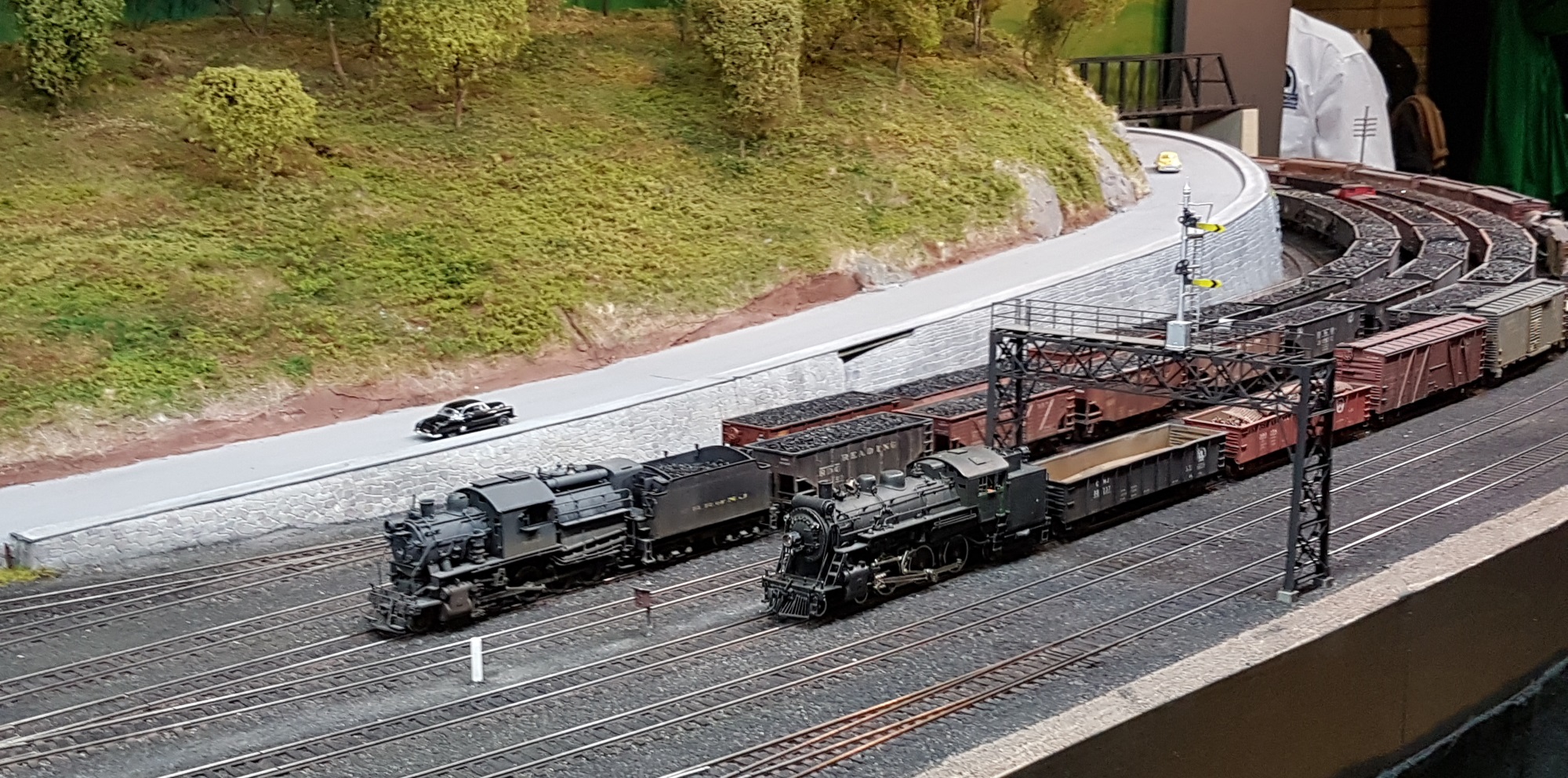
‘Camelback’ locomotives were probably unique to the north-eastern anthracite lines.  This Reading 0-6-0 switcher is full of character.

Posted in Exhibitions, Inspiration, Out and about | Tagged , , | 3 Comments

ESNG meeting – PlayDay 14 January 2018

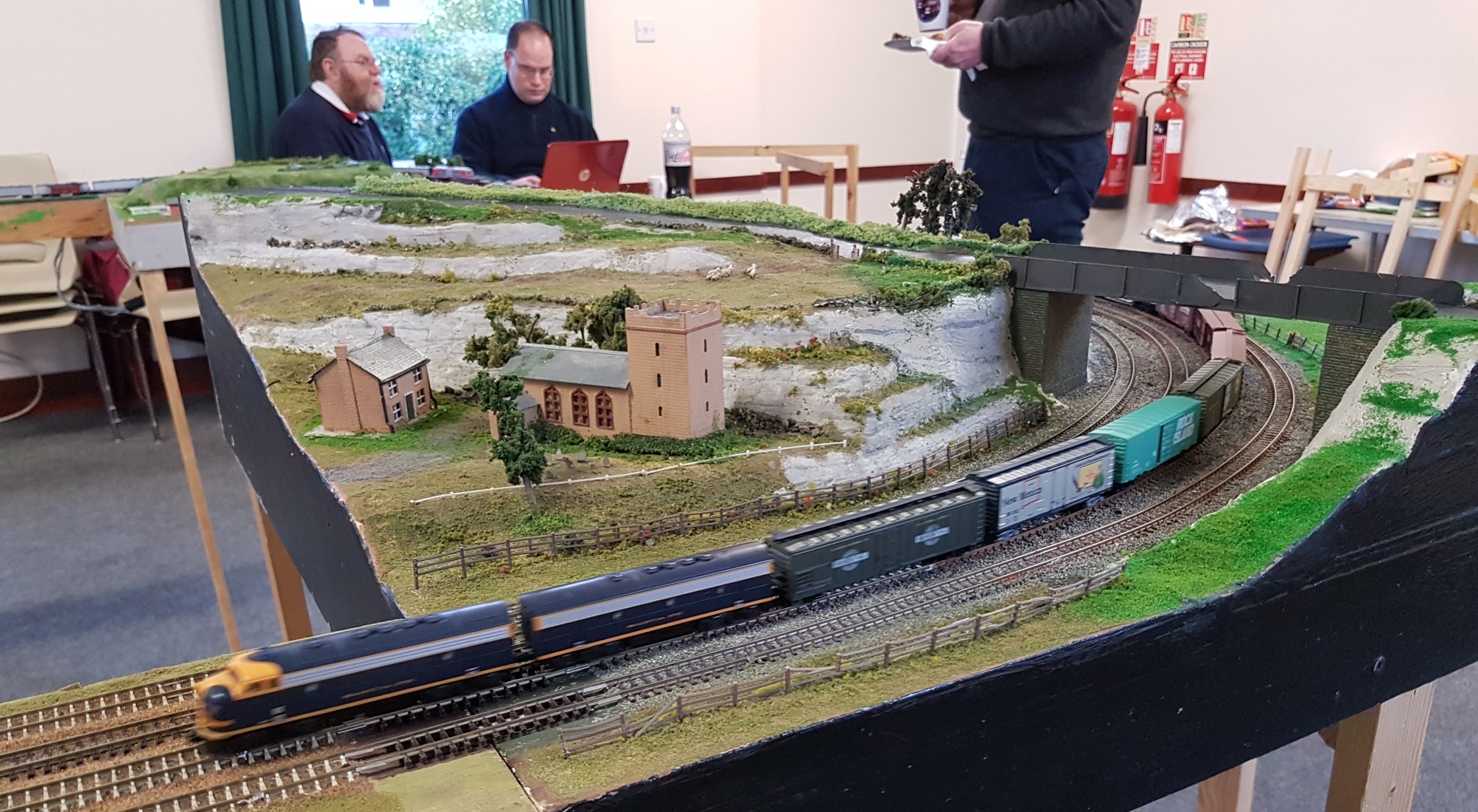
Just the eight of us at yesterday’s PlayDay, but we had a pleasant afternoon running trains.  We quickly put together a large circuit…

And Simon was soon running some USA freight…..

Dave brought his quarry along, and was testing locomotives on the layout….

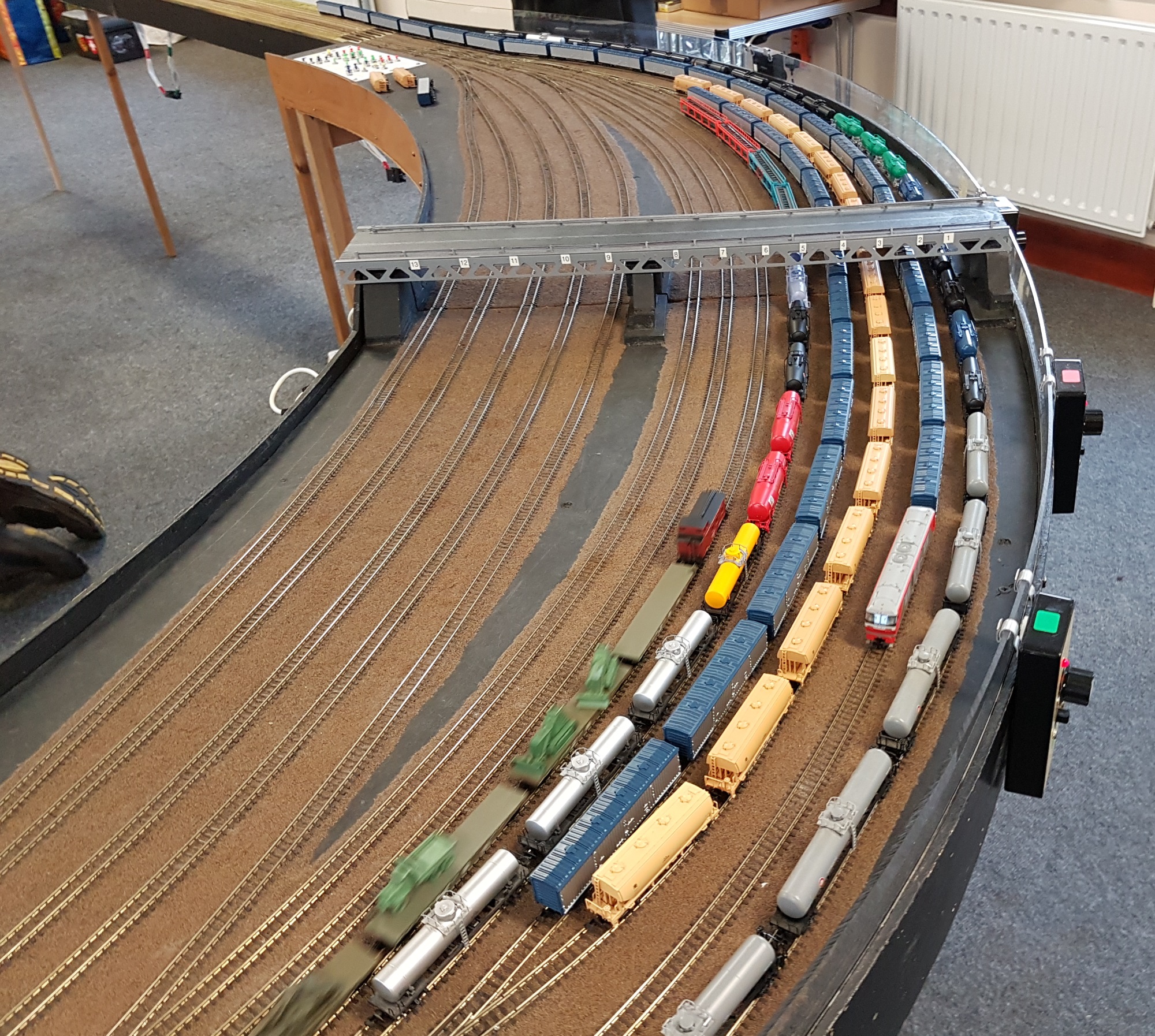
Paul filled the fiddleyard with Japanese tank wagons…..

Then put together a ‘whole circuit’ van train.  About 132 bogie vans, if I remember correctly.  Not quite the club record!

I ran in my second Farish NCB O4.  At just £49 from Rails, it would have been rude not to buy it!

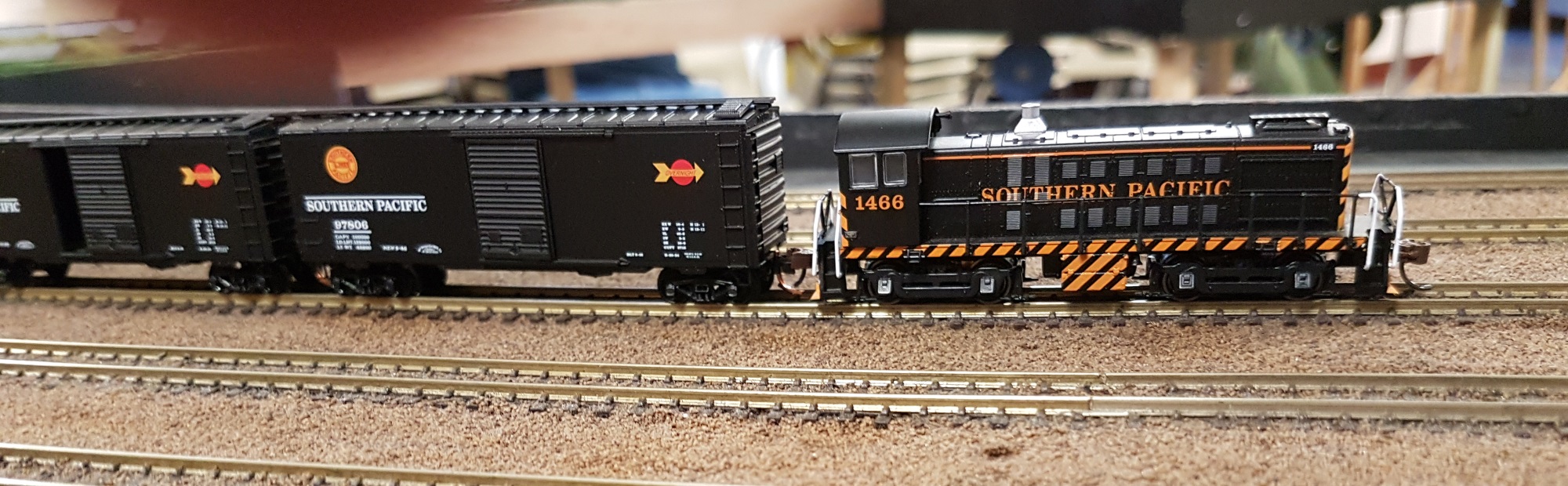
I then ran a couple of Southern Pacific good trains.  The grey 70-tonner looks tiny against the Alco S4 switcher, but both managed a sizable goods train (though not up to Paul’s standards!)

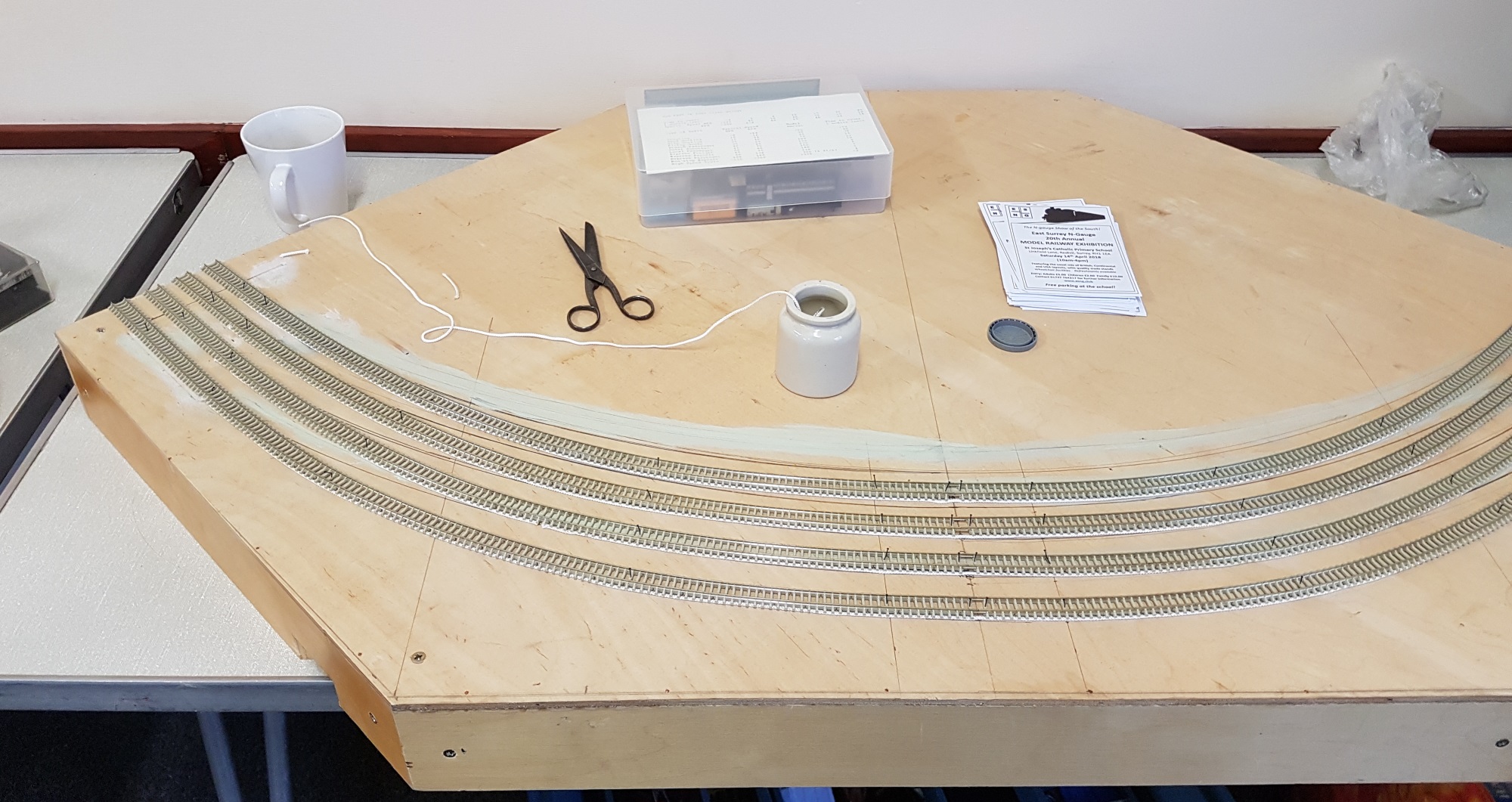
Meanwhile, Derek was super-elevating the track on the new club N-mod corners.  A length of string under the outer sleepers PVA’d in place seemed to do the job…..

The only complaint about the afternoon was that we didn’t have enough takers for a visit to the curry house….

Posted in ESNG, ESNG meetings | Tagged , , , | 2 Comments

Modular model railways – the pros and cons?

Dave emailed me recently about exhibiting our ‘N’ gauge modular layout at local exhibitions.  His comment was (in part)….

Hi – not having much success with exhibitions at the minute. The larger ones don’t seem interested in modular layouts….  We seem to have more success at places that put on exhibitions which are second to the main attraction – like Rural Life, Bluebell and Gaugemaster – or smaller shows.

My response was (in part)…..

A lot of shows will tend towards ‘scale’ layouts, so are not interested in our ‘anything goes’ approach to exhibiting. Which is a shame, as there are usually a number of rubbish generic ‘OO’ tail-chasers at most big shows. And we all know that a modular circuit does get plenty of viewing from those who just like watching the trains go by.

The modular approach might be classified as being not scale enough, or too much fun and not enough rivet counting?  However, I remember doing the Gaugemaster show in 2016, and on the Sunday Paul took over the outer two tracks with Japanese Bullet trains, whilst the inner two ran mainly UK stock.  And we had lots of spectators, who appreciated the unusual and interesting trains, and perhaps the way the Kato stock stayed on our trackwork at high speed.

It is interesting that the latest focus in the free USA web-zine, ‘Model Railroad Hobbyist’, is the ‘TOMA’ concept – The “One Module” Approach.

With TOMA, the idea is to build your home layout using portable
sections, and to complete each section all the way from bare
benchwork to a finished module section with all the scenery,
details, structures, and bridges totally done. If you have signals
or lighted grade crossings, they all work. In other words, each
TOMA section is completely finished before going on to the next
TOMA module section.

Rather than just have a “still life” layout section, TOMA thinking
encourages you to add flattop staging to both ends of the
module, then go ahead and run trains. No need to wait for the
entire layout to get into operation. With TOMA, the idea is to
experience the entire breadth of the hobby from beginning to end including ops – but because you’re doing your layout just a small piece at a time, you can get to completion a lot more quickly.

Now I’m impressed that the hobby in the USA is moving in that sort of direction – possibly due to the space for basement size empires becoming less common?  And of course they have had ‘N-track’ and ‘One-track’ around very successfully for years.  But we’ve also been doing it for years in the UK.  Firstly in layouts that do expand, and secondly in modular layouts.

I also replied….

For modular layouts there is potential in the Alpenbahn approach (and also to some degree in N-club), where the appearance of the modules is uniform, and they are based on a consistent location, so that put together they are ‘scale’ enough for most exhibitions. Our trouble is that our interests are too far reaching!

I am not sure that our membership would be interested in building a consistently themed set of modules, that would pass both as a ‘fun’ layout, and on occasion a ‘scale’ layout.  But maybe it’s worth thinking about?

Posted in ESNG, Exhibitions, Layout design | Tagged , , , | Leave a comment

Virgin on the unreadable?

An article in the papers today caught my eye:

Virgin West Coast train firm stops selling Daily Mail

Virgin Trains has announced that it has stopped selling the Daily Mail newspaper on its West Coast trains.

A spokesperson for Virgin said it regularly reviewed products sold on its trains, adding that “after listening to feedback from our people” it decided to stop stocking copies of the paper.

A Daily Mail spokesman called the decision “disgraceful”.

Last year, stationery chain Paperchase apologised for a promotional giveaway in the Mail following criticism.  The Virgin spokesperson added that when it stocked the paper, which it stopped carrying in November, it only sold one copy for every four trains.

The spokesperson told the BBC that the paper had never been stocked on its East Coast trains under the management of Virgin/Stagecoach.

And Drew McMillan, head of colleague communication and engagement at Virgin, told staff in an internal memo: “Thousands of people choose to read the Daily Mail every day. But they will no longer be reading it courtesy of VT. There’s been considerable concern raised by colleagues about the Mail’s editorial position on issues such as immigration, LGBT rights and unemployment.”

“We’ve decided that this paper is not compatible with the VT brand and our beliefs.  We will continue to offer The Times to customers, but we won’t be stocking the Daily Mail for sale or as a giveaway.  This won’t suit all of our customers or all of our people – it’s certain to draw some criticism. But we’ve listened to many colleagues over the last few months, and we feel that this is the right move to take.”

There’s more where that came from!

Now (sorry Mail readers), I have a lot of sympathy for Virgin.  A glance at the front page of the Daily Mail (otherwise known as “The Hate Mail” or “The Daily Fail”)  can depress one on the brightest of mornings.  However, I did wonder about equivalents in the model railway world.  Who might not sell what?  How about….

Rail Unions ban Graham Farish from staff shops

A union spokesman said that the lack of a guard in all models showed support for management and a total disregard to the safety of the operators….

Samsonite withdraws sponsorship of TINGS 

It is rumoured that the well-known luggage manufacturer Samsonite will withdraw sponsorship from the N-Gauge Show.  A spokesman for the company stated that the inappropriate use of their products, especially rucksacks, to assault other model railway enthusiasts had caused them to rethink their policy.  However, a TINGS organiser was hoping for new sponsorship from Lynx or Brut, and free samples would be offered to any member of the public carrying a rucksack…..

(For those not in the know, unwashed rucksack carriers are rumoured to frequent TINGS and Warley, using BO and bags to fight off other enthusiasts and get the best bargains.)

Any (slightly libellous) examples welcome as a comment!

Posted in Inspiration, Out and about, Prototype, Weird and wonderful | Tagged , , , | 1 Comment

Holborn Viaduct

This is a layout idea that has been bumbling around for a few months.  It all started with a thread on RMweb, describing some possible ideas for the 2mm Association Diamond Jubilee layout challenge.  This involves developing a cameo layout with visible dimensions of 600 x 240mm.  That’s a tiny space, but it’s surprising what one can come up with in the space.  Perhaps not surprisingly, many ideas were urban, where the railways didn’t have much space anyway.

So this is the design that caught my eye, based on the old LCDR Ludgate Hill station, just to the north of the River Thames, and a stones throw from at least three other stations.  It didn’t stay open for long, but the remains of the station lasted until the Thameslink remodelling, completed around 2012.

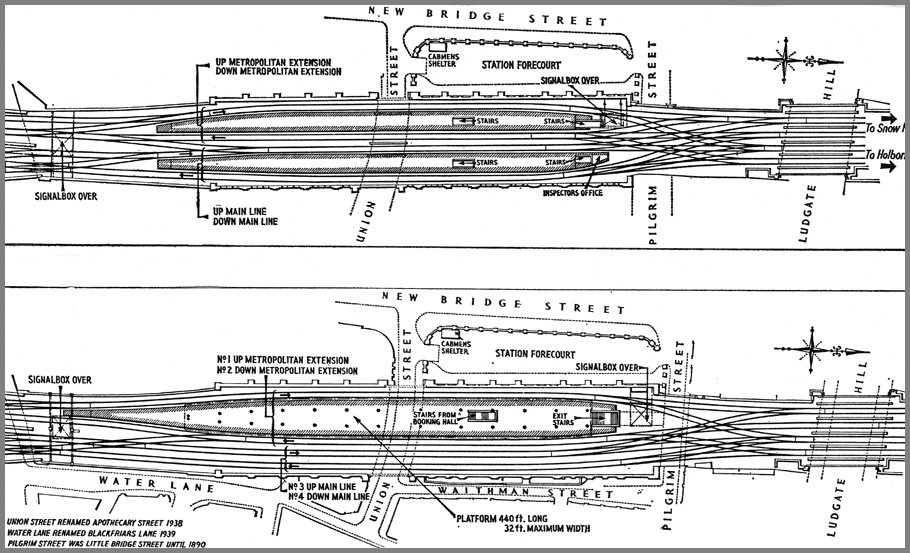
The layout sketch below shows the station in its early 20th century form, with some wonderful pointwork.  The bottom two lines go to Holborn Viaduct station, just off the plan.  The top two drop down to Snow Hill and then through to Farringdon and to the north London stations.  Early last century, there were services across London, and visiting trains from the Midland and LSWR.  Plus masses of cross-London goods, that continued into the 1970’s.  These lines, greatly modified, now form the route for Thameslink services.

And this is how the layout might look, though this is the post-war look after that nice Mr Hilter from the Ball and Compass (Monty Python reference) thinned out the buildings during the 1941 Blitz.

And here’s a view early in the century, with all buildings intact and a train of private owners wagons – empty coal traffic – heading north.  In our era of gas central heating, it is easy to forget just how much coal traffic there was from the northern and midlands collieries down to London.  Every suburban station would have had a coal yard, now converted to a car park or blocks of flats.

This drawing from ‘The Engineer’ shows the remodelling of the original station, abandoning one platform, still early last century.  The pointwork is marginally simpler!

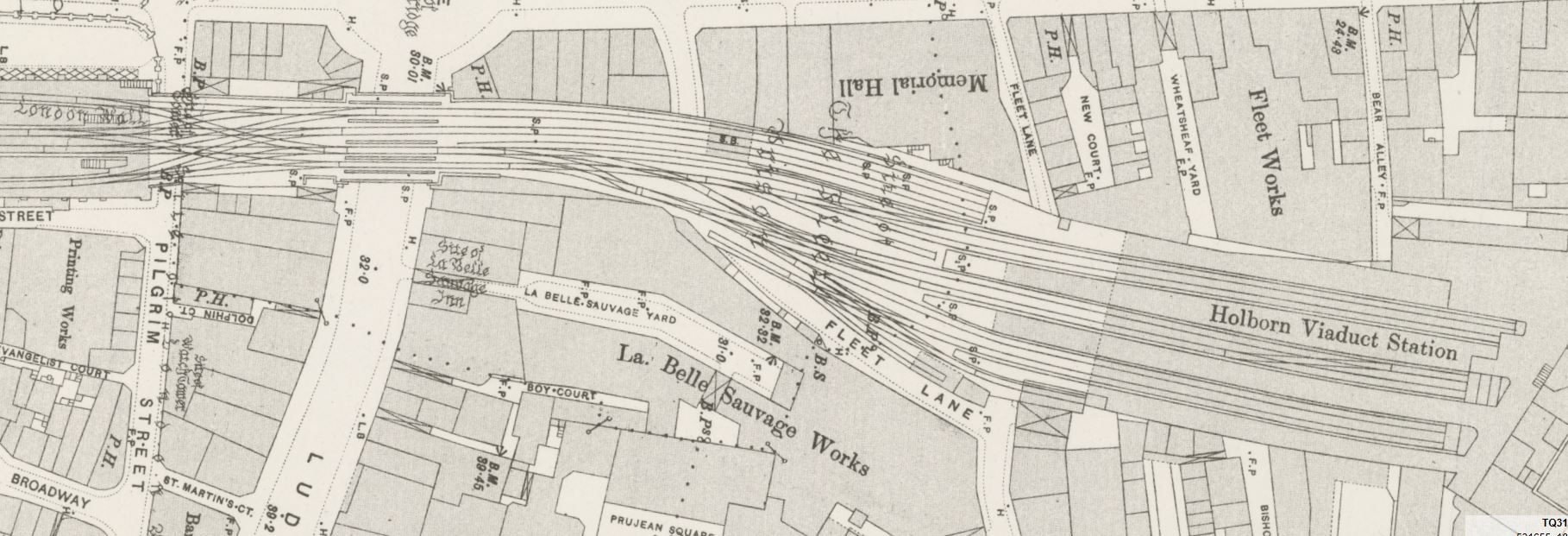
To model this sort of pointwork, one would have to work in 2mm or one of the larger fine scales.  Otherwise, the clearances in ‘N’ for frogs and wing rails would just not work.  Here we see an attempt to draw that complex pointwork in ‘Templot’.  It does show how accurate many of the large scale Ordnance Survey maps are – the map can be tied in very well to the Templot trackwork.

But it’s when you look at the site in the context of its surroundings that one sees the potential of the area for a model.  Here’s the circa-1900 plan.

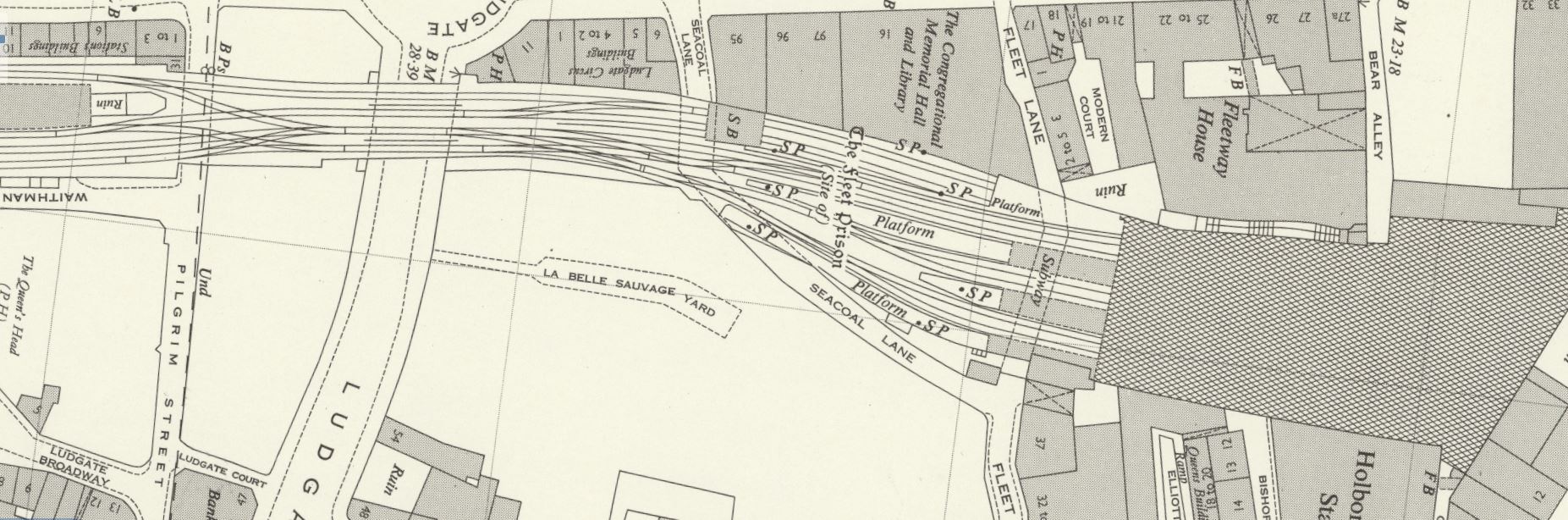
And here’s the circa-1950 equivalent.  The trackwork is noticeably less complex, and with a little further simplification would be buildable in ‘N’.  The track centres might need to be slightly increased, from the absolute minimum 6′ way of the prototype (22.5mm or so) to the PECO standard of 27mm, to fit everything in.  Holborn Viaduct station has lost all its loco spurs, and gained longer platforms for 8-car suburban EMU’s.

It’s when one draws some distances on the maps that one realises how small the station is, and how good a model it could make.  The three lines below are 1m, 4′ and 6’6″ long.  All could make a good layout.  The walls of Ludgate Hill station make a natural scenic break to the left.  For the longer layout, the overall roof does the same job to the right.

I like the idea of a hollow ply half-door forming the basis of the layout, strength being added by the raised railway on the viaduct.  Trackwork would have to be hand-laid – code 40 would be ideal.  A lighting ‘proscenium arch’ a la Iain Rice would limit the views left and right.  Perhaps the foreground could be made more interesting by assuming a few buildings survived the bombing, and the whole area hadn’t become waste ground and car parks.

Operation would be interesting.  There was a busy commuter service into Holborn, and I believe that the platforms at the bottom of the plan were used for non-passenger stock and van traffic.  And the two lines to Snow Hill dropping below the station carried a range of cross-London goods traffic, with a range of locomotives from the Southern and other regions.

Perhaps the most difficult part of the design is the fiddle yard.  For home use, I might leave the Snow Hill lines unconnected, and then add a fiddle yard or loops onto the end of Ludgate Hill station.  For exhibition use, a second set of loops could be added to the Snow Hill lines, but this is becoming a large layout.  Perhaps a continuous circuit, with a double ended fiddle yard would be best, allowing you sit and watch trains running through Snow Hill.  The end curves would have to be a reasonable size, not less than 15″ day, to allow for steam engines to run freely.  I’m still thinking about this question.

The other issue is the size of the boards.  With all those points, it’s difficult to find a natural place for the baseboards to join.  A 6’6″ half door is transportable, but may be a stretch for most cars.  And it might be difficult to get it out of the house – I had enough trouble getting the 6′ x 2′ Kuritu into my loft!

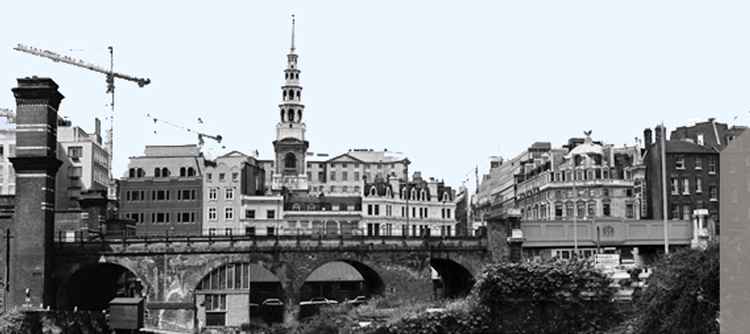
Finally, here are a couple of photographs of the area.  The first, taken in 1953 I think, looks towards Holborn Viaduct with the Snow Hill lines dropping under the signal box to the left.  The second shows Holborn’s overall roof earlier in the century, when there was still a small engine shed to the right.

EPSON scanner image

So there it is – (one of) my (many) dream layout(s).  I doubt whether it will ever get built, but there is a delightful model there for someone.

Posted in Hints and tips, Inspiration, Layout design, Out and about | Tagged , , , | 1 Comment

ESNG meeting – 3 January 2018

First club night of the new year, and despite the Chairman not being there due to anti-social working hours, 13 members enjoyed a varied procession of trains on the layout.  Mind you, Ian doesn’t look too excited by proceedings in the picture below, or perhaps it was the Treasurer’s conversation skills?

There was a strong American flavour contributed by Simon, Ian and Graham.  Here, Simon’s Con-Cor PA-PB-PA set head an express parcels train.

And Ian’s Metra double-deck push-pull rake ran as well as it looked.

Meanwhile, Paul was filling the fiddle yard with Japanese tankers, preparing for the usual long goods train.

Derek was running an Longmoor Military Railway ex-WD 2-8-0 and passenger stock.  The WD looks rather more impressive in blue and red than the more usual BR grimy black.

And Peter contributed, amongst other things, two more early German multiple units.

All in all a good social evening!

Posted in ESNG, ESNG meetings, Out and about | Tagged , , , , | Leave a comment