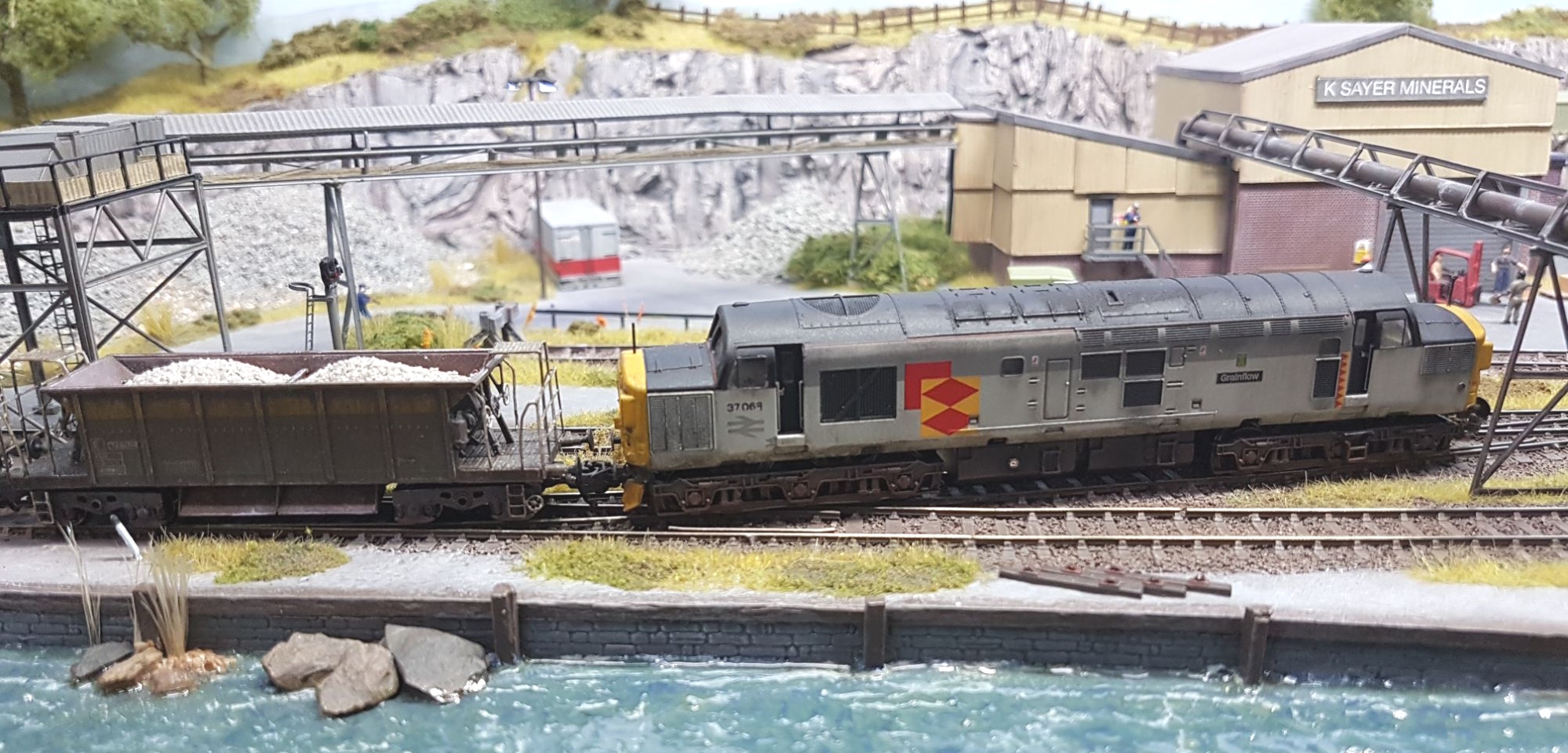
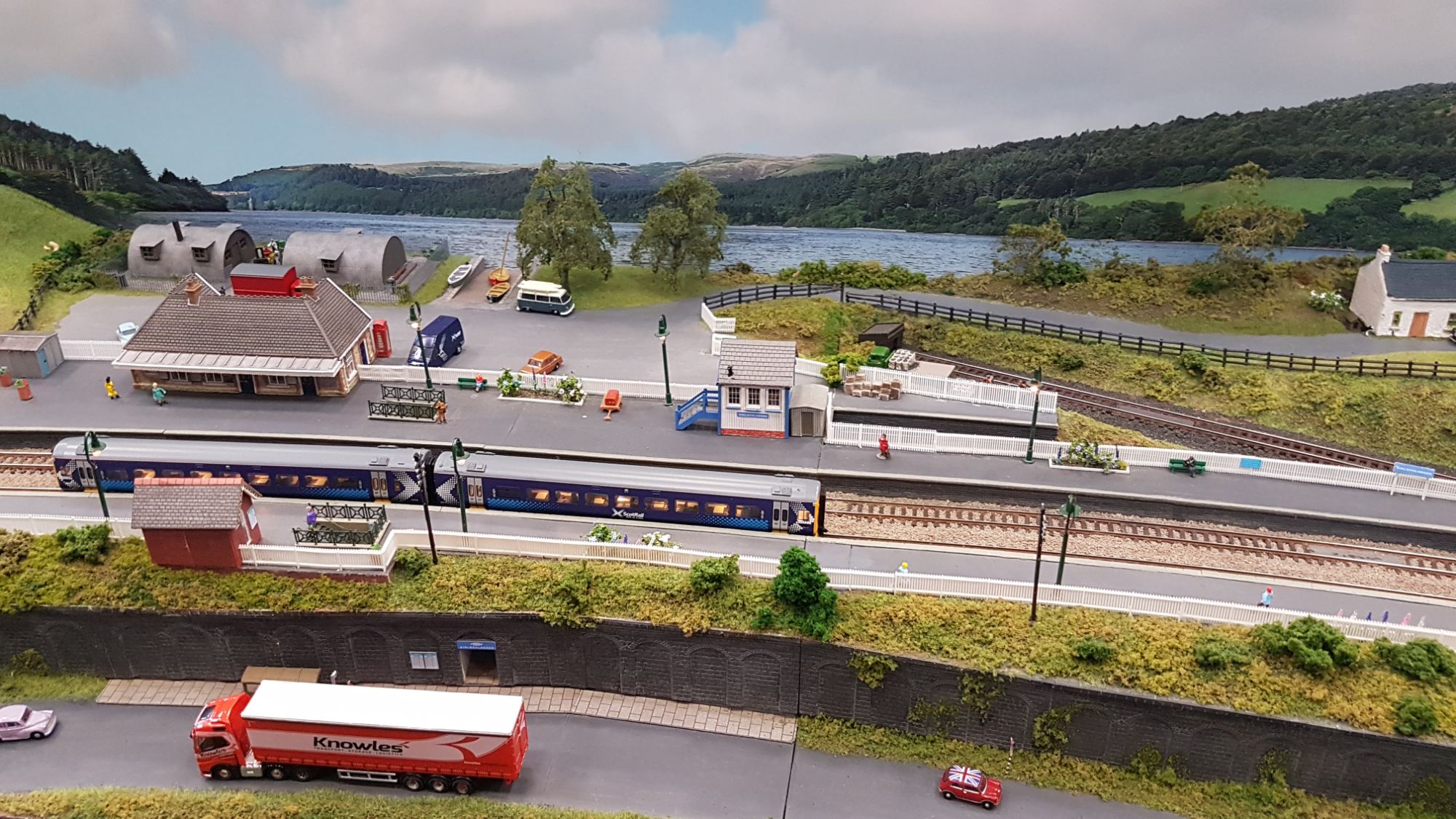
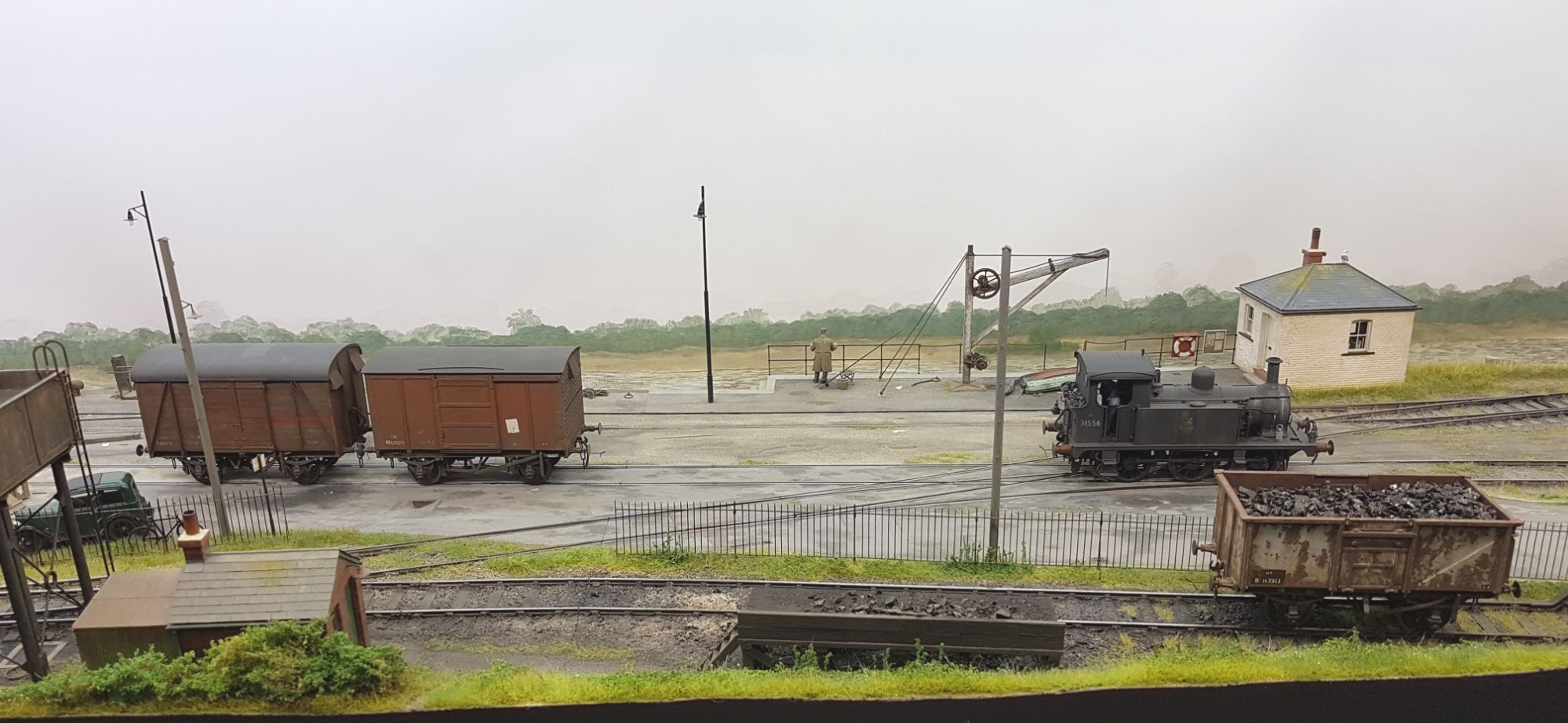
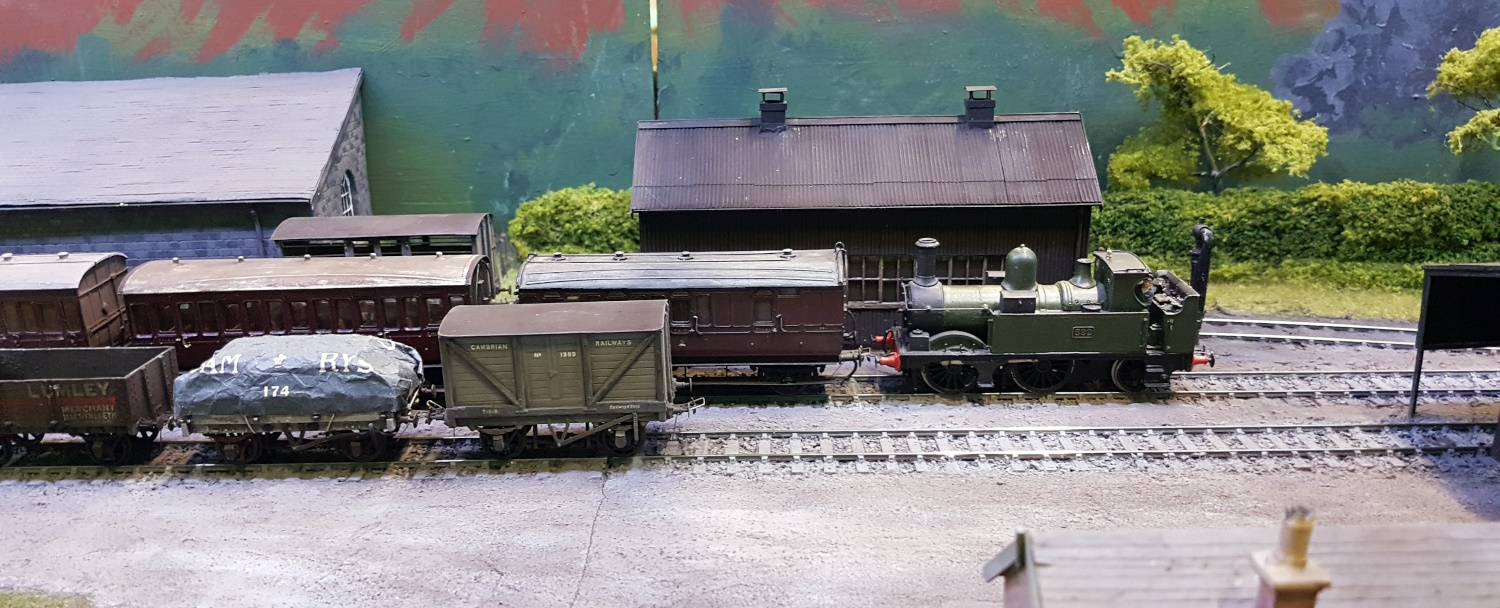
Uckfield MRC exhibition 2023 #1 – Rice railways

The Uckfield show weekend has come around again.  Despite a busy week, I set off south once again to visit a very good show.  A good number of layouts that were new to me, no dross at all, and a wide range of prototypes and scales.  For me, Uckfield is an essential visit – much better than many of the larger shows, as the standard of layouts and modelling is so much higher.

Plus one must add that it’s a pretty drive across Ashdown Forest to Uckfield, even in the rain, and that the Civic Centre cafe does an excellent breakfast.

This year was rather special.  To quote the show guide….

We also have the Iain Rice Extravaganza, a tribute to the well known railway modeller and author who passed away last year. Spread throughout the exhibition, we have five 4mm/ft finescale layouts which were originally constructed by him or in which he was a major contributor. On display will be a selection of Iain’s North Cornwall stock, built for his layout Tregarrick, and various plans and drawings from his publications for your interest.

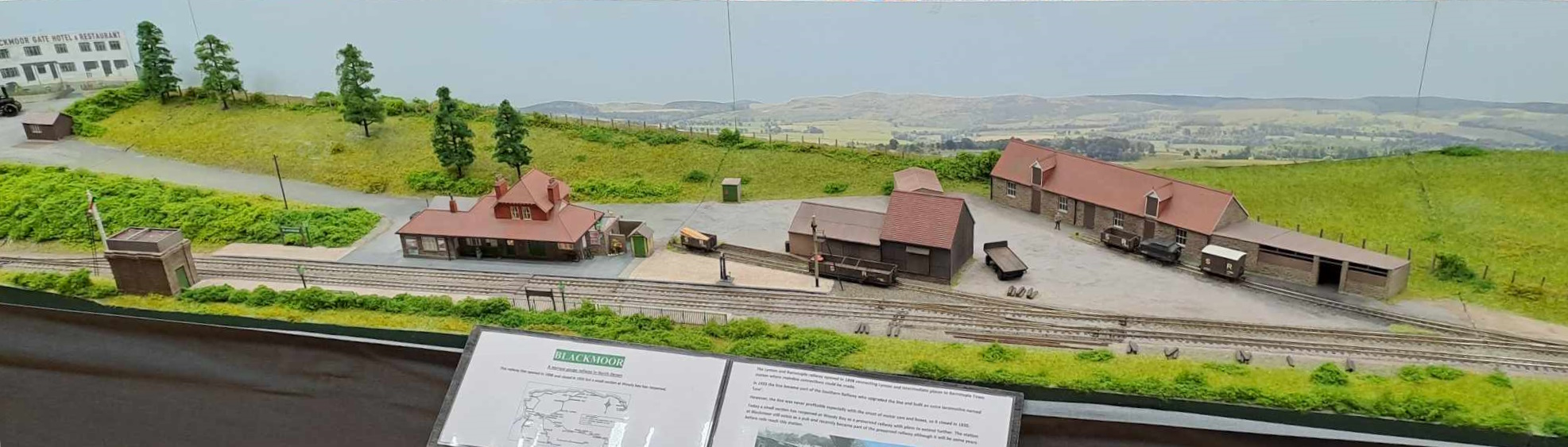
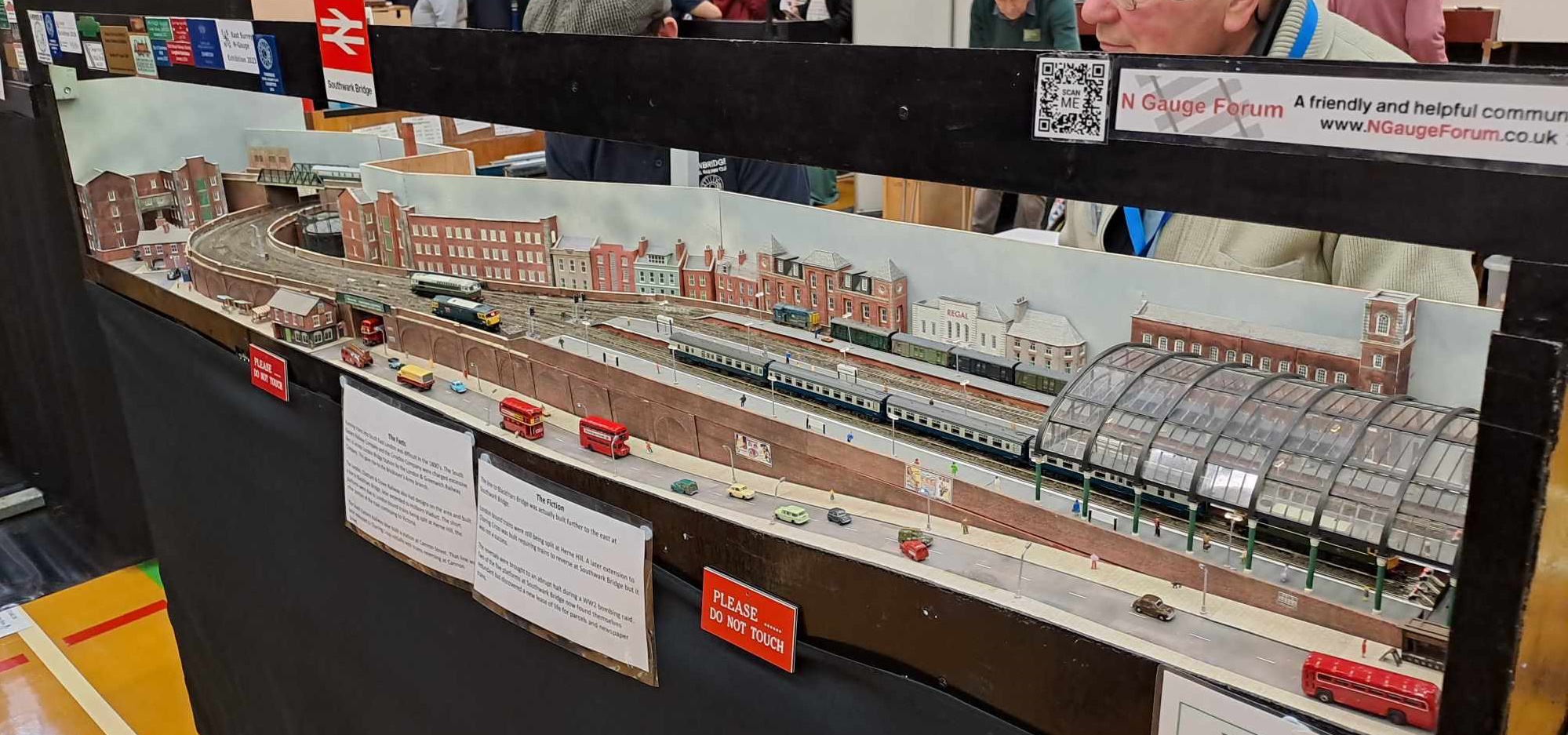
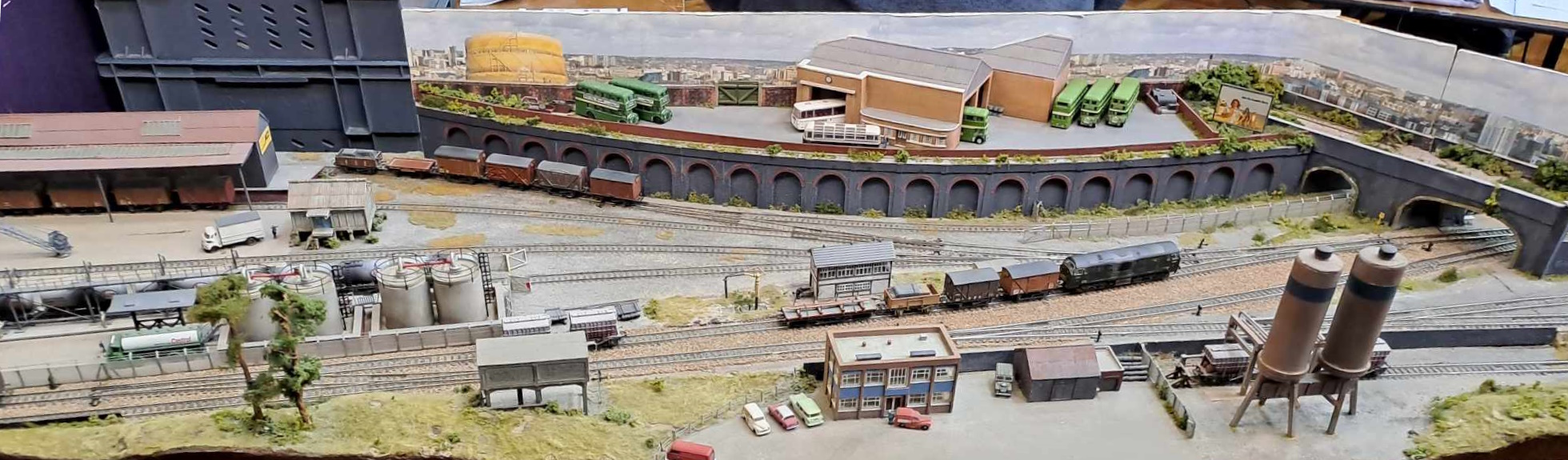
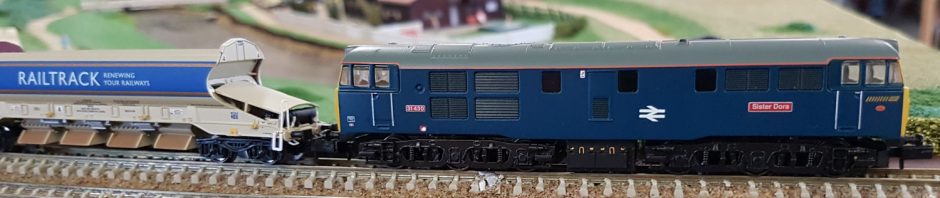
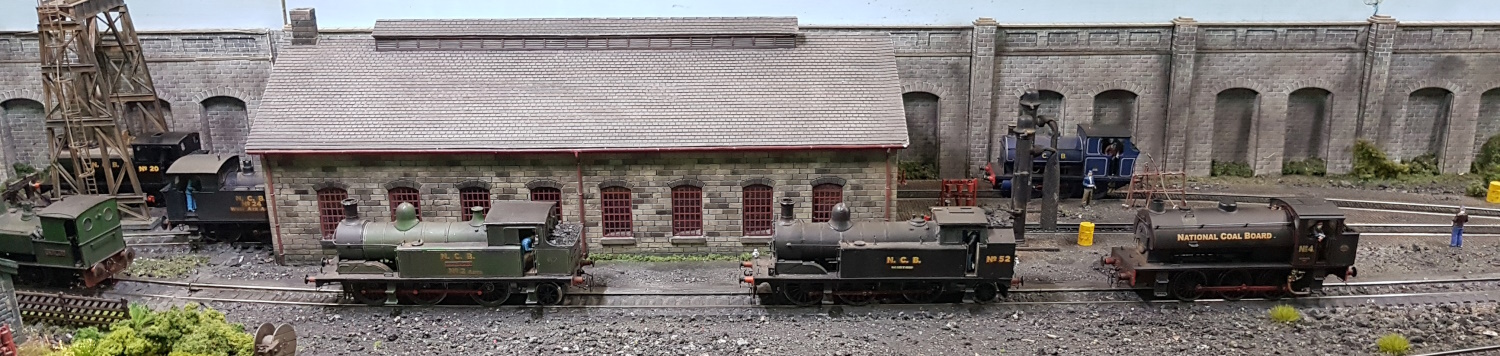
So we’ll start with the Iain Rice layouts, and I’ve also included the track plans from the show guide.  There was a display of stock from his North Cornwall Mineral railways.

Iain Rice’s Tregarrick layouts from the 1970s and early 80s, based around the fictional world of the North Cornwall Minerals Railway, were ground breaking and hugely influential in many ways. The layouts were populated with a motley collection of scratch-built P4 locomotives largely drawn from Iain’s favourite source, the contractor’s locomotives of Boulton’s sidings. Stock was a similar rag-tag collection of largely scratch-built wagonry built and portrayed in various states of decay. All supported by a wonderful cast of characters, the products of Iain’s imagination which he wrote about regularly, in his inimitable style, for the old Model Railways magazine.

20231021_104707

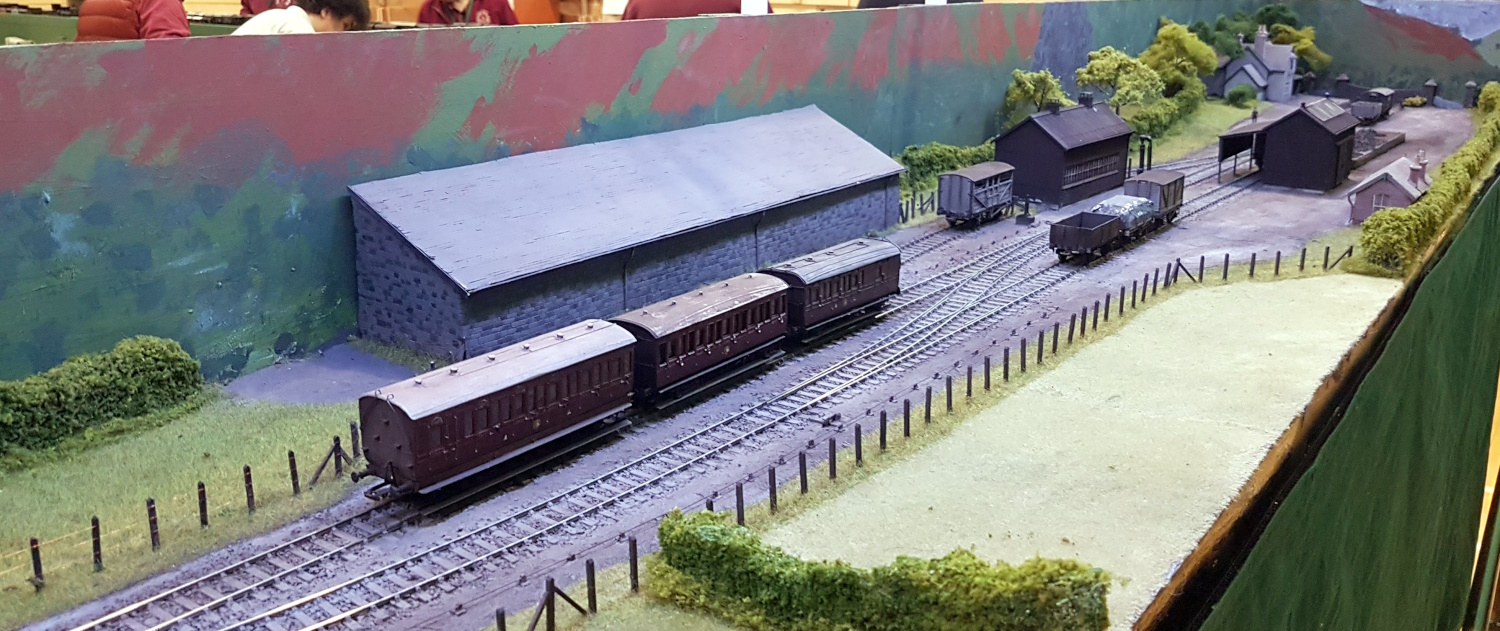
Butley Mills (originally P4, now EM) is a good 40 years old, and is currently being renovated, so nothing was running.  But I was very happy to see one of my favourite layouts.  It captures the atmosphere of an East Anglian freight only branch, served by the occasional short train, and is dominated by the fine mill building and it’s scruffy extension.  These hide the fiddle yard.  It doesn’t have the full Rice cameo layout treatment, but one can see some of his later ideas already in the making.

20231021_10105420231021_101106

20231021_131346

Hepton Wharf (P4) was originally built at a show over a weekend, and is perhaps the original cameo layout.  It’s a mere 30 years old!  It’s a tiny layout, but the scenic detail and backscene convey a much larger layout.

20231021_131332

Trerice is a lovely little China clay works layout somewhere in Cornwall.  As such it can have both a Southern or Great Western air to it.  Best let Iain Rice describe his layout….

This tiny P4 layout depicts a typical set of Cornish ‘pan’ china clay dries and their associated railway facilities as they would have been around 1960. The buildings are all models of originals in the Goss Moor area of Cornwall, and the railway is based on the Wenford Bridge branch near Bodmin. The layout features the two locomotive types most often associated with the Wellford Bridge line, the ex-L&SWR Beattie 2-4-owT and the GWR ‘1366’ class dock tanks. Both these models are largely scratch-built – as are all the structures, which feature hand-scribed and painted stonework. The scenic work incorporates fragments of genuine Delabole slate waste. The china-clay (Kaolin) is also the real thing.

20231021_10151320231021_104642

20231021_131359

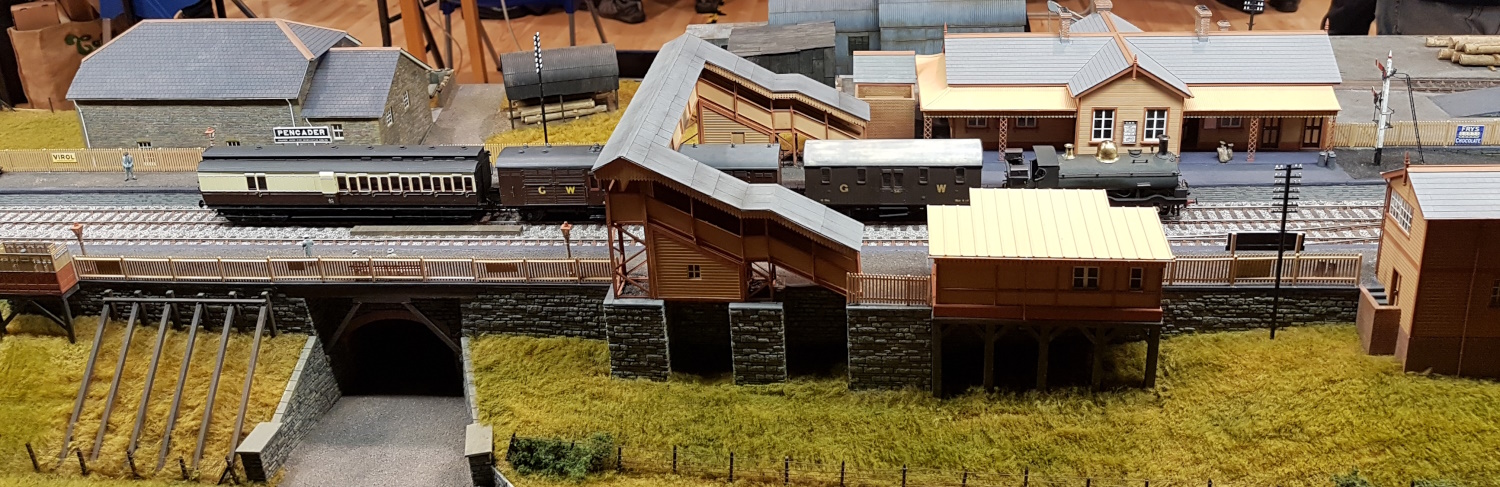
Debenham, Cade’s Green (P4) was Iain’s last ‘home’ layout built as Parkinson’s began to catch up with him.  A group of Iain’s friends have taken on the layout to complete and detail it.  Although not intended for exhibition, it will no doubt make plenty of appearances!  It’s again set somewhere in GER territory.

20231021_131440

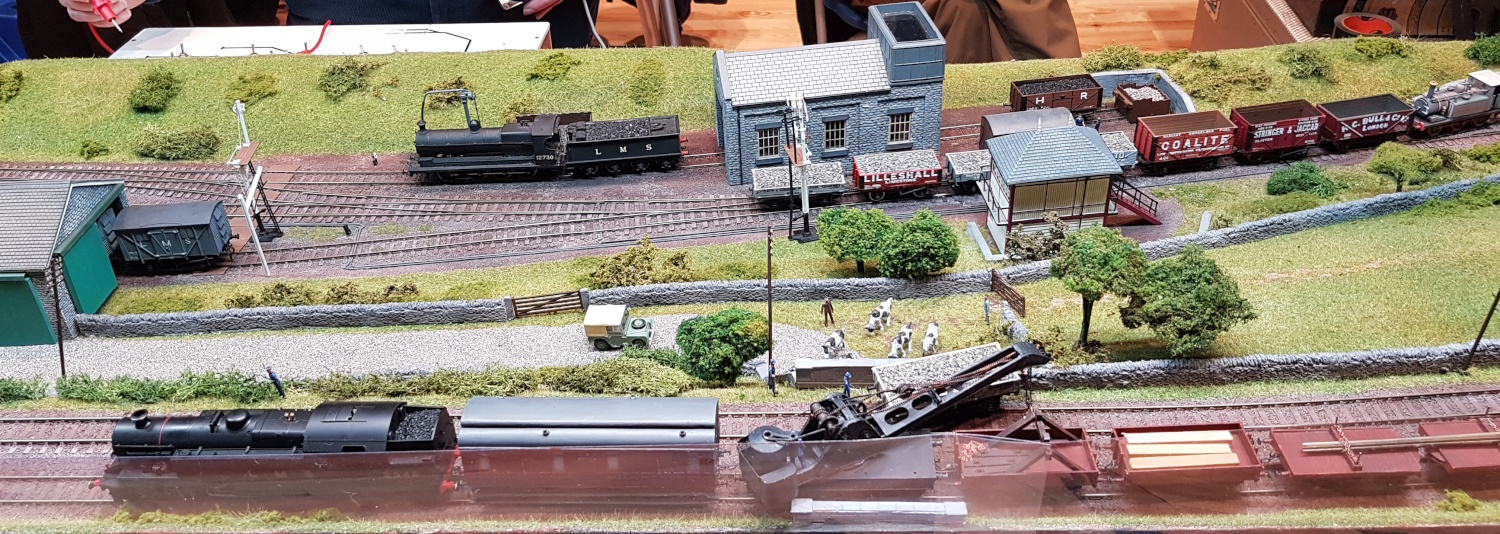
And finally for today, Longwood Edge (P4), a larger ‘cameo’ layout.  It’s a northern town setting, with railways on two levels and from two companies – the LNWR and the L&YR.  Typical Rice design, with a lot crammed in a small space, but not looking overly cluttered.

20231021_131230

An excellent tribute to an inspirational modeller – both in his writing and his actual modelling.  More layouts from Uckfield next time!

Posted in Exhibitions, Inspiration, Out and about | Tagged , , | 2 Comments

ESNG meeting – 18 October 2023

Another non-meeting.  Few members were available due to illness, work and other things.  So we cancelled the meeting – probably a good thing, as it was a foul night.  We’ll have another go on Sunday.

Between all other activities, I’ve begun sorting out the modules for Stuttgart.  A little additional wiring was needed for my junction module.  And I’ve added some underboard switches to enable point switching from both sides of the module.  I’ve also started the ‘joker’ module that I need to build for Stuttgart, that swaps the main line from one side of the modules to the other.

And we have had a message from Paul….

Hello Jon,
An entry for your blog or newsletter, perhaps, from the ESNG Yorkshire Area member.

What’s in a name – The update.

Back in 2008, access to the Internet presented me with opportunity to search for other ESNG meanings. 15 years on, I have again trawled the Internet to look into the murky and mysterious world of ESNG. A number of previous entries have vanished without trace, a Chinese shipping company, a medical treatment which now has a new name and a Russian company which I can only assume incurred the wrath of the incumbent President of Russia.  Pleasingly, there are a number of new entries including some from unlikely sources.

  1. East Surrey N Gauge. A friendly group of railway modellers working to N Gauge standards. Meetings are held in Redhill, Surrey.
  2. ESNG -25AA256ESNG – A type of microchip from Microchip Technology in the United States since 1989.
  3. Electricity Networks Strategy Group. A UK senior industry group including the transmission network operators, chaired by the Department for Energy and Ofgem which produced reports on the potential transmission network requirements to accommodate the large volumes of renewable other generation required to meet targets and security of supply.
  4. Easter Seals North Georgia.(USA). This organisation provides support services for children and families at the most critical times in a childs’ development. Support is provided for academic, mental, physical and emotional growth.
  5. ESNG Lapland Airport at Gallivare in Sweden. There are only two passenger services scheduled, both to Stockholm. In 2018, there were 1,457 flights, all freight. The runway is 5,610 feet long and 48 feet wide.
  6. Eastern Shore Natural Gas. The Interstate Natural Gas pipeline subsidiary of Chesapeake Utilities Corporation. The company formed in 1959 and is listed on the New York Stock Exchange. The pipeline transports 50 Billion cubic feet of gas every year.
  7. Escagenetics Corporation. No further information.
  8. Electronic Systems and Networking Group. Based at the University of Genoa in Italy. No further information.
  9. Elsevier Society News Group. An international medical news group based in Amsterdam.
  10. ESNG A 1.55 Terrabyte Disk Drive for IBM Computers
  11. Eastside Sound N Graffic. A company in the United States that ‘ creates blockbuster rap artists’.
  12. ESNG A component used in fly fishing rods.
  13. ESNG-VellFi. An investment advisory company based in New York.
  14. ESNG Elite Sport Neo Green. Goalkeeper gloves made in Germany.
  15. ESNG An amateur football team from Nouvelle Aquitaine in South West France. Players are drawn from the villages of St.Sornin, Nieulle or La Gua. If you don’t believe this one, check out their Facebook page!

So, there you have it, we are not alone!

Paul did manage an excursion to York for the N Gauge Group meeting. It was a T-Trak set up with a few trains. Thomas had his first run out on Yorkshire metals!

thomas

Lovely weather….

Posted in ESNG, ESNG meetings | Tagged , , , | Leave a comment

Potpourri #1084

Recovery continues…..  I’ve never seen so much rain on a motorway as there was going north.  A horrible six hour drive (plus loo and coffee breaks) turned into an easy four hours in the sun coming home.  It’s a long time since I drove 1000 miles in a week, with our two weekends away.  Still, it was well worth it, catching up with my two daughters and lots of other bits of family.

lois

Allan sent me this video – spot the NCI members.  And some good trains, too….

I’m sure I’ve posted this before, but this is how to put up a modular layout…  quickly!  No old age pensioners were injured during the making of this video.

Brian also sent me this article.  I thought that German trains ran well (except when Ron wants to catch them.)  I’m glad we’re driving to Stuttgart!

A rather poetic view of the Somerset and Dorset.  Lovely stuff!

And an hour’s excellent watching….

Posted in Inspiration, Out and about, Prototype | Tagged , , , | Leave a comment

Potpourri #1083

Just a few photographs, as I recover from a trip up north to my niece’s wedding!

Three of one of the Bulleid 1-co-co-1 diesels.  Photos by John Atkinson.

And the opposite end of the size scale…  A B4 shunter…

b4

And a G6 at Salisbury….

G6salisbury

When the LNWR ran trains to Croydon Central, and to Brighton….

The Sunny South Express would have included some ex-LNWR coaching stock in Southern Railway days.  This is not long after the 1923 grouping, and an LBSCR ‘Gladstone’ 0-4-2 heads the train.

sunnysouthexpress

Another Gladstone.

stroudley

An unusual view of Kings Cross stabling point, and St Pancras.  Note the DP2 prototype on the right.

kings_cross_st_pancras

And to finish, the prototype for everything department.  An APT nose fitted to an AL6 electric for some sort of trial…

al6test

Posted in Inspiration, Out and about, Prototype | Tagged , , , | Leave a comment

Something different, again

Through the summer, and approaching the ESNG show, live has been rather busy, and the railway modelling mojo has been low.  So to get things going again I decided to fish out a couple of my plastic kits from my stash – these being 1/48 aircraft.  Here are the end results….

First, the De Havilland Hornet, one of the fastest piston engined fighter aircraft, that was just too late for WWII service, but saw active service in Malaya.  And it’s one of the prettiest aircraft ever.  Wikipedia says….

The de Havilland DH.103 Hornet was a twin engined fighter aircraft that further exploited the wooden construction techniques  pioneered by the de Havilland Mosquito. Development of the Hornet had started during the Second World War as a private venture. The aircraft was to conduct long range fighter operations in the Pacific Theatre against the Empire of Japan but the war ended before the Hornet reached operational squadron status.

The Hornet entered service with RAF Fighter Command where it equipped several day fighter units and was commonly stationed in the British mainland. It saw combat in the Far East, being used as a strike fighter as part of the British military action taken during the Malayan Emergency. A naval carrier-capable version, the Sea Hornet, had been envisaged early on and was procured by the Fleet Air Arm of the Royal Navy.

My model is in the lovely photo-reconnaissance colours.  It shouldn’t really have red spinners, and the ‘N’ code is wrong (but what I had available.)  But it looks the part.  It’s a Trumpeter kit, and goes together perfectly.  Experts will say that the canopy is not quite right, but it looks like a Hornet to me.

Secondly, the Mitsubishi Ki-46 ‘Dinah’.  Another favourite of mine, this version with the glasshouse nose was again the unarmed reconnaissance version.  The RAF Museum has one, and says…

One of the most elegant aircraft of World War Two, the ‘Dinah’ was so successful that Germany tried (in vain) to acquire manufacturing rights from Japan. Although fighter and ground attack versions were developed, it was in the high-altitude photographic reconnaissance role that the Ki46 excelled. Given allied codename ‘Dinah’, this aircraft combined high speed with long range and was able to cover the entire Pacific theatre of operations with little opposition.

Having first flown in November 1939, performance trials showed the prototype Ki46-I’s top speed to be 64kph (40mph) lower than the requirement, although at 540kph (336mph) it was still faster than the latest Japanese fighters! Ki46s were first used operationally over China, their speed enabling them to avoid interception by the few fighters available to the Chinese.

This is an old Tamiya kit, but despite its age is well detailed and fits together well.

I’ve actually learnt some useful modelling techniques from these builds.  Externally they are spray painted with Tamiya rattle cans.  I bought pre-cut masks for the glazing, that gave a perfect finish.  The Dinah also used a lot of masking tape to separate the upper and lower colours and paint the white and yellow bands rather than use decals.

I improved my seam filling skills, and found how good black superglue is for gap filling.

I also had an accident with one undercarriage leg.  I drilled small holes in the two halves of the leg, used a length of wire to stiffen the join, and superglued the lot together – strong and not noticeable.

Neither model is perfect, but both have been relaxing and fun to build.  Now I’d better get back to railways before Stuttgart looms on the horizon.

Posted in Plastic Kits | Tagged , , | Leave a comment

Bowes incline

And a second set of Dave’s photos.  These are from the Bowes incline, that Dave says is a ‘hidden gem’ well worth a visit.  It’s a National Coal Board site, and the photos show some really interesting locos and wagons.  Again quoting from their website….

Bowes Railway Co, first known as Springwell colliery and railway was built to carry coal from Springwell and other pits in north west Durham to the Tyne at Jarrow. The earliest section was designed by George Stephenson and opened on 17 January 1826, making it one of the world’s first modern railways. It was 15 miles long when completed in 1855. Each end was locomotive worked; the six mile middle section consisting of rope worked inclines with very steep gradients.

At its peak, the Railway handled over 1 million tons of coal per year and remained virtually intact until 1968. Between 1968 and 1974, most of the line was closed until only the last 3.5 miles between Monkton and Jarrow staithes were operated by the National Coal Board. However, the original 1826 section between the Black Fell bank head and Springwell bank head was acquired for preservation in 1976 by Tyne and Wear County Council. This included Blackham’s Hill West and East inclines, which had been operated by a stationary haulage engine, thought to be the only preserved standard gauge rope hauled railway in the world. In 1977, the main Bowes Railway site and collection were added to the preservation scheme.

In 2017 Bowes Railway was awarded Accredited Museum status.

The site is open for guided tours twice a week.  It does indeed look fascinating from the photos.

Engines.

Wagons.

The incline.


The works.

IMG_20230905_102013IMG_20230905_120927

IMG_20230905_121312_HDR

Posted in Inspiration, Out and about, Prototype | Tagged , , | Leave a comment

ESNG meeting – 8 October 2023

We were away for the weekend, so I missed Sunday’s meeting.  I gather that there were 6.5 members present, plus a couple of visitors from West Sussex to talk about Stuttgart.  But Brian faithfully recorded some of the action.

I phoned in from Warwick Services to ask whether there would be a curry after the meeting.  Unfortunately, no, but Maxine and Michael came with me to the curry house anyway.  Just what was needed after driving 200 miles!

Here’s how fish travelled south in 1964, from the north-east to London.  Note the variety of vans in the train.  There’s a few modern ‘Blue Spot’ fish vans, but much of the train is old LNER wooden fish vans.  And there’s what looks like a Southern Railway bogie utility van, and perhaps an LMS long express van (unless it’s a GWR fruit van repurposed.)

As for the loco, an A4 Pacific might seem a bit of a comedown for this train.  However, the original caption to the photo noted that an express loco was needed at the head of the train to keep the driver and fireman ahead of the smell….

More reasonably, this was an express cargo, in the days of limited refrigeration.  After the trawlers came back to port, the fish needed to get to the railway as quickly as possible, and then down to London (Billingsgate) whilst still fresh and ready for distribution to the shops – and the fish and chip shops.

Of course, this train only ran Monday to Saturday evenings.  No self-respecting trawler would work on the Sabbath, so there were no fish to carry south on Sunday – and even today most fish and chip shops are closed on Monday.

fish1964

Posted in ESNG, ESNG meetings | Tagged , , , | Leave a comment

Aln Valley Railway

Dave sent me some photos of a recent visit to the Aln Valley Railway.  Not one I’d heard of, but their web site describes it thus:

The principal objective of the Aln Valley Railway Trust is the restoration and operation of the railway between Alnmouth and Alnwick, providing an additional tourist attraction for the area and to enlarge the district’s tourism offering. This project also aims to develop the railway corridor as a sustainable transport link as well as a recreational and educational resource for the local community and visitors to the area.

Due to the building of the A1 bypass which cut the original trackbed on the outskirts of the town, and the construction of industrial units and a supermarket on ex-railway land, the costs of getting the line to the original station in Alnwick are almost prohibitive.

Therefore a new station has been built on a greenfield site in Lloyd’s Field, adjacent to the Lionheart Enterprise Park just outside Alnwick. The new ‘Lionheart Station’ is aligned parallel to the A1 from where a single track line joins and follows the original trackbed towards Alnmouth Station, near Hipsburn. Ultimately heritage steam and diesel locomotives will haul trains between the two locations. As an integral part of the project, a permissive cycle path runs alongside the railway line, and will link up with the National Cycle Network at Alnmouth and the A1068 road next to the A1. This provides a safe corridor for cyclists, pedestrians and riders, and has also been proposed to form the basis for an educational nature trail.

And here are the photos, with an Austerity tank engine in steam.

The yard, and some other interesting locomotives and rolling stock.

The NCB Austerity.

End of the line (for now.)

IMG-20230903-WA0000

Posted in Inspiration, Out and about, Prototype | Tagged , , | Leave a comment

ESNG meeting – 4 October 2023

Perhaps it was a little optimistic having a club meeting four days after the show?  One regular was away, and two more phoned in sick (not from exhibition-itis), so only three turned up for the meeting.  We chatted for a fair time and went home.

The day after the exhibition, it was the Chesham bus day.  Chris went….

chesham

But how far can you go on a London bus?

And down on the Swanage Railway, something wonderful is moving after 75 years.  A beautiful locomotive, and a wonderful piece of restoration.

Posted in ESNG, ESNG meetings | Tagged , , , | Leave a comment

Ramblin’ Man – 3

Storm Agnes and Douglas Bay.

a1

a4

Port Erin in the rain

Castletown.

Tynwald and St John’s.

Douglas Head.

And to end this adventure, a sunnier Douglas Harbour and Bay.

Posted in Inspiration, Out and about, Prototype | Tagged , , , | Leave a comment