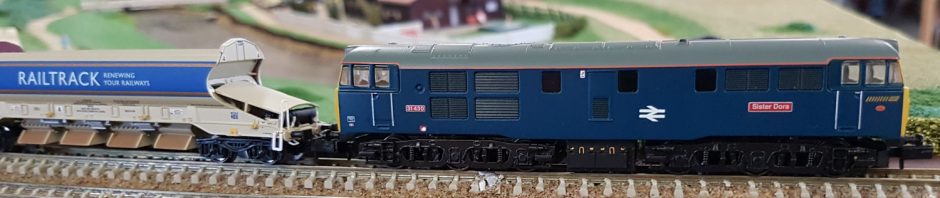
Another interesting voice in the layout design world is Lance Mindheim, who most originally posts at http://www.lancemindheim.com/.
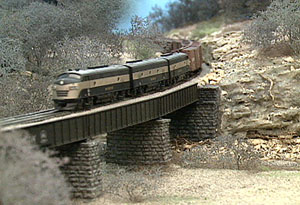
He has built a number of very interesting layouts. The first was a 20×20 foot N gauge layout of the Chicago, Indianapolis and Louisville or as it’s usually known, the Monon in Indiana in 1955.
He then moved to modelling modern-day Miami in HO. The small East Rail was a 10×10 foot L-shaped switching layout. Simple, but lots of operation.
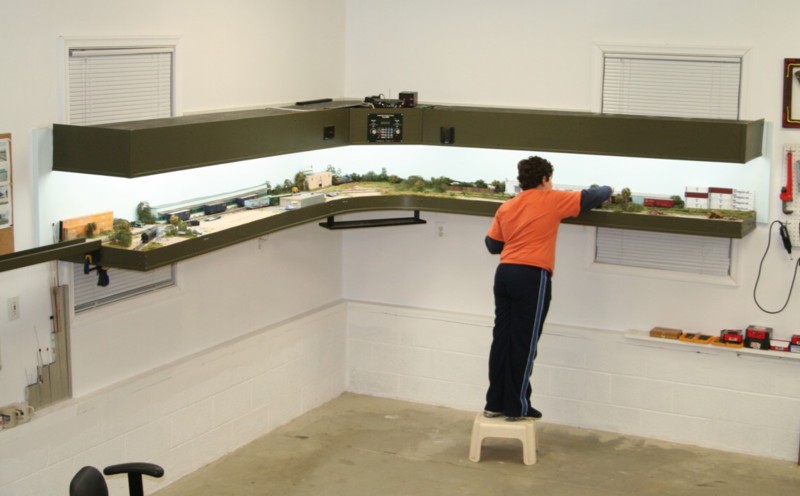

The room-sized Downtown Spur occupies the full 20×20 foot of the railway room. It is wonderful modelling, and a couple of photographs in a recent Model Railroader article really could have been the real thing.
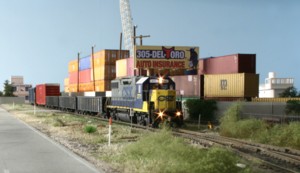

So, what are the design points we can learn from Lance’s brilliant modelling?
- The ordinary makes a good model. It’s better to model a realistic square concrete box of a warehouse, than some fancy, and unrealistic, building.
- Switching takes time. There’s the time at each road crossing. There’s the flares to light at ungated crossings. There’s the time to uncouple or couple the wagons. There’s the time taken to walk from one end of the train to the other. There’s the time taken to unlock points and relock them after switching. It all adds up to a slow procedure if its done realistically.
- One siding can act as three or four, if there are a number of different industries, or different doors on a single building, that need cars spotted in front of them.
Lance’s blog includes a number of deceptively simple switching layouts. But if operated as the prototype, even a couple of sidings can offer an hour or two’s instant entertainment.
(All pictures, from Lance Mindheim’s website)


Thank you very much, I’am really glad that I’m following you. I’m still figuring out. Just wanted to say that you are an awesome blogger, Inspiring and May you inspire more readers essentially perfectly ok. greetings from Gede Prama 🙂
LikeLike
The cars and apartment tower in Lance’s second photo are just a bit too realistic, so I have to wonder if perhaps he posed a HO boxcar in front of a 1:1 scene?
While I can understand what he’s doing, his aesthetic doesn’t work for me. I’m quite visually oriented, and prefer a stronger 3D presence – i.e. structures with more of, and a varied mass, interesting architectural forms and details vs. his minimalist Florida landscape. It’s done very well, but just doesn’t get my juices going.
LikeLike