Victorian Strangeness: The man who hoped to die in a railway crash

You thought model railway enthusiasts were strange.  How about this from the BBC News web site?
_75676949_railway-crash-1868-getty

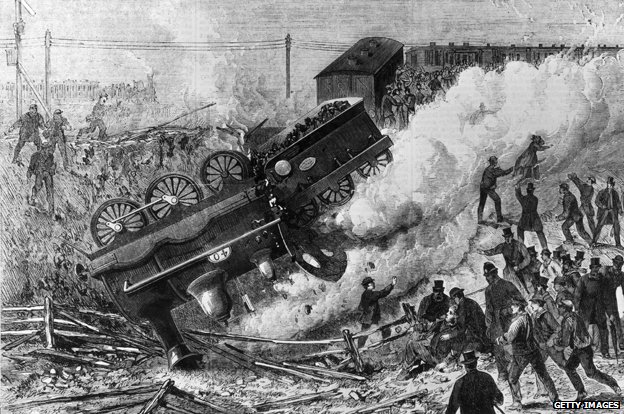
Money. Property. Land. Heirlooms. Whatever the mourners were hoping to inherit when they first gathered for the reading of the will, they were to be sorely disappointed.

Shock. Disbelief. Dismay. Indignation. That’s what they got instead. The man they grieved, who had never given them so much as a penny while he breathed, stayed true to the habit of his lifetime.

He’d left everything – the whole kit and caboodle – to his killer. It wasn’t a ghastly coincidence, nor the tell-tale sign of murderous greed, but a heartfelt gesture of thanks – appreciation for a job well done.

Mr Railing had had a premonition, an unshakeable sense that he was going to die before his time. Not just that, he was tormented by the idea the end would be violent.

Rather than sit and wait for the Grim Reaper, he decided to actively seek him out. And the most agreeable way of finding him, in that calamity-punctuated age, was to catch the train. Repeatedly.

So that’s what he did, according to the reports in the Victorian press. Mr Railing headed this way and that in Britain and the continent, fervently hoping the next arrival at each platform he set foot upon would be the express service to oblivion.

“There was not a station where he was not known,” said the Royal Cornwall Gazette in the autumn of 1854. “All the conductors were familiar with him. He had narrowly escaped death several times. Once he was shut up in a car under water; another time he was in the next car to the one that was shattered, and he described with the greatest enthusiasm those terrible accidents, when he saw death so near without being able to obtain it.”

Discouraged by these frustrating shortcomings of British and European railways, he made for America, which had developed a promising line in lethal mishaps too.

“He made excursions on the Ohio, the Mississippi, the Ontario, the Niagara,” said the paper, “but notwithstanding their frequent explosions, he returned with whole skin.”

A disheartened Mr Railing – who was either aptly named or a gin-soaked journalistic flight of fancy – came back home. And it was here, somewhere in the south of England, on an unspecified date, where he finally got his wish. He was crushed under a railway carriage.

After the funeral, his will was opened, along with a can of worms. “I give and bequeath all my goods, present or future, moveable or immovable, to that railroad company on whose road I have had the happiness to meet with death, that blessed deliverance from my terrestrial prison,” his ashen-faced relatives heard.

And that’s where the story ends. His family were going to appeal against the will on the ground of insanity, added the Gazette, “but it is probable that the railroad will win the suit, in spite of the proverb that the murderer never inherits from his victim.”

And here’s another one to watch.  An epic journey across Mexico.  And how about a model of their critter?


Posted in Prototype, Weird and wonderful | Tagged , | Leave a comment

Jon’s modules – the staging

I’m beginning to make some model railway time again.  The first part of the year was hectic, with my mother’s demise, my wife’s hip replacement, the ESNG exhibition, and a number of panics at work.  It’s a bit quieter now.  The new hip seems to be going very well, and the hospital has given the all clear for Maxine to more-or-less go back to normal, except for heavy exercise.  So good news – I’m losing most of my house-husband duties.  Bad news – I’m losing my monopoly on the car, that has made me very lazy for two months.

Many moons ago, I discussed staging for my Lehigh Valley N-club modules.  At the time, I decided to settle for staging parallel to the main line on the modules themselves (option 3 below).  On reflection, I’ve decided to go back to option 1, with staging at right angles to the main boards.  I do like the sharp, and prototypical 90 degree bend into the yard.

lvr_fiddle

The next question is whether to have staging on the main line?  If (or when, I hope) I take this layout to the Stuttgart meet, no staging will be necessary, as my boards will fit within a larger modular set up.  At the other extreme, in my loft, there’s only room to operate the branch.  But for ESNG shows, staging at both ends of the main line would give a loop for running, and also allow other N-club boards to be added.

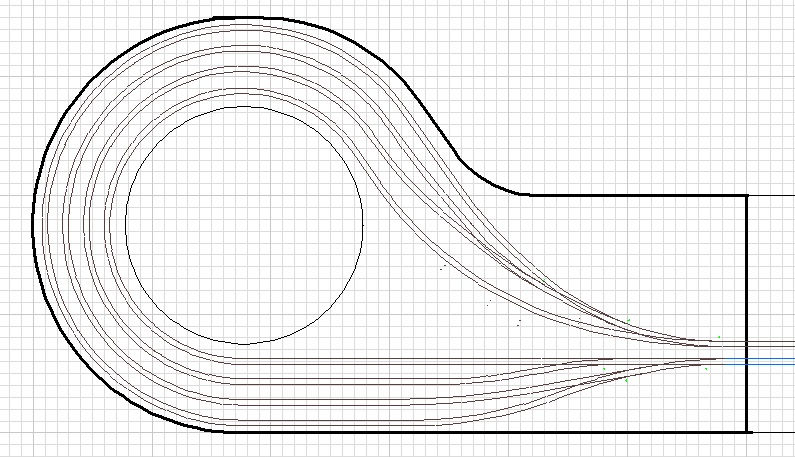
What form should this staging take?  The most compact approach would be a traverser or sector table.  But unless I build a train turntable with a centre pivot, there will be a lot of shuffling of locomotives and cabooses.  So I played with 3rd Planit for a while and came up with the end loop layout below.

loop

I wanted something that would hold several trains, but would be reasonably light and transportable.  The above module is 1200 x 700mm, about the size of an N-mod module, but will be lighter due to the cut out sections.  I could start with a simple loop of track at one end of the layout, but one of these at either end of an N-club set-up will allow six trains to be stored, and leave one line free for running.  The curves on the left are drawn as the four PECO Set Track radii.  The inner 9 inch curve is a bit tight, but most shorter US and UK stock will be OK on it.

An early task will be to get some plywood cut to make a basic kit of parts for two of these.

I’ve also had thoughts on simplifying wiring and operation of the points.  But that will be a future post….

Posted in Jon's layout ramblings, Layout design, N Club International | Tagged , , , | 1 Comment

ESNG meeting – 18 June 2014

I was a bit late getting to the meeting tonight.  Thank you SouthWest trains for stranding me at Kew Bridge Station for half-an-hour.  The problem – not just a broken down train at Mortlake but a dodgy level crossing at Chiswick.

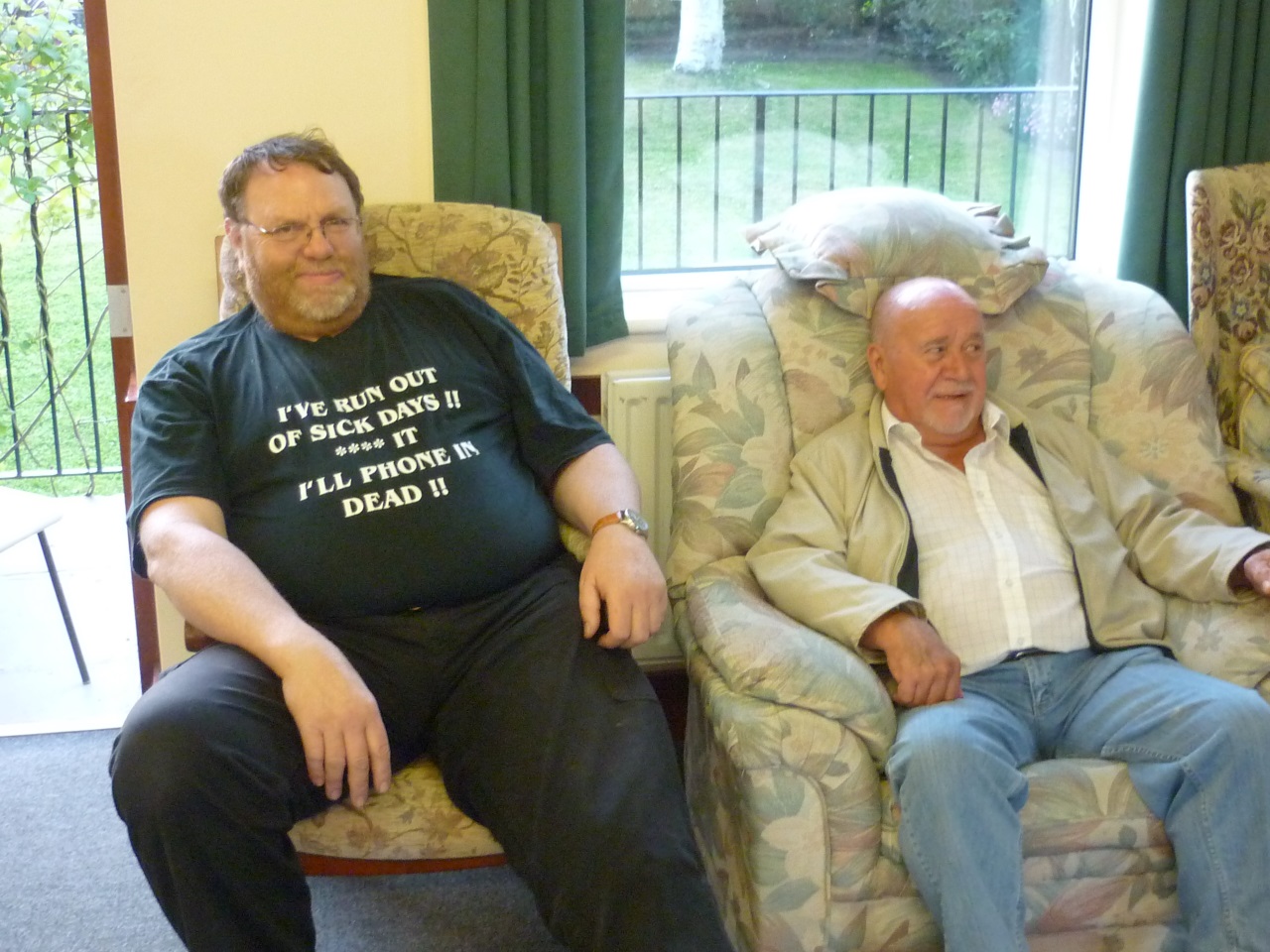
Having got down to the hall, and expecting to see a circuit up and running, all I found were a few gentlemen in armchairs.  So by mutual consent, it became a tea and talk evening.  Chairman Allan is on the mend, as you can see from the T-shirt….

P1030936 

Derek went home and came back with his test track, so those who had brought some stock could give it a run.  Paul produce his usual Japanese goods train, that turned out to be a push-pull train – of sorts.  Are the locos pulling, pushing or just mid-train helpers?

P1030935 P1030933

Posted in ESNG, ESNG meetings | Tagged , , , | Leave a comment

(Rail)road runner

Next real post tomorrow with the ESNG meeting tonight.  However, here’s a bonus post.  Combining bird-watching and train-spotting would be ideal.

I think the poor critter looks a bit confused.  It’s a road, Jim, but not as we know it….

rail_roadrunner_large

(Picture from Armchair Modellers Blog via Yahoo Small Layout Group.)

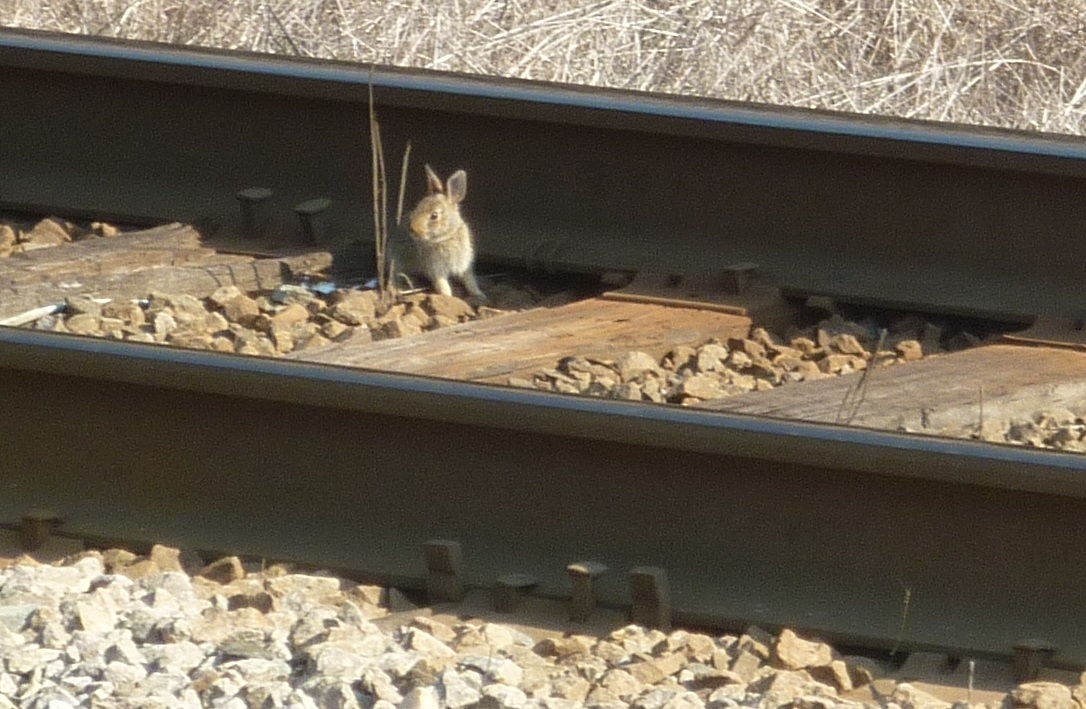
When we visited Charlotte, I tried to go and find some trains, but the best I could manage was this rabbit…..

rabbit

Posted in Prototype, Weird and wonderful | Tagged , , | Leave a comment

Is it a bird, is it a train?

Here’s an irresistable snippet from the BBC (bold text mine).

In 1970, the British Railways Board filed a patent for a spacecraft powered by “controlled thermonuclear fusion reaction”.

The original patent application said the reaction would be “ignited by one or more pulsed laser beams”.

A patent document reads: “The present invention relates to a space vehicle. More particularly it relates to a power supply for a space vehicle which offers a source of sustained thrust for the loss of a very small mass of fuel. Thus it would enable very high velocities to be attained in a space vehicle and in fact the prolonged acceleration of the vehicle may in some circumstances be used to simulate gravity.”

Patent

British Railways running flying saucers?  The mind absolutely boggles.  The possibilities are endless….

“All interplanetary services leave from Kings Cross High Level”.

“The saucer on platform two will not call at Mars due to ongoing engineering works.  Please use the replacement bus service that may add several years to your journey.  Unfortunately there are no buffet facilities or toilets on this replacement service”.

“British Railways catering announce their new interplanetery restaurant car menu.  New items include the weightless curling sandwich and the fusion grilled glowing toasted sandwich”.

I’m sure you can think of better ones…..

Posted in Out and about, Weird and wonderful | Tagged , , | Leave a comment

A crafty idea

Following on from a method for panelled coaches, here’s another approach to complex cutting-out exercises.

I know a number of ladies who are very keen on card making and scrapbooking.  One tool they make use of is a mechanised cutter, to create letters, shapes and even fluffy bunnies.  However, these things have suddenly made an appearance as modelling tools, to cut card or plastic.

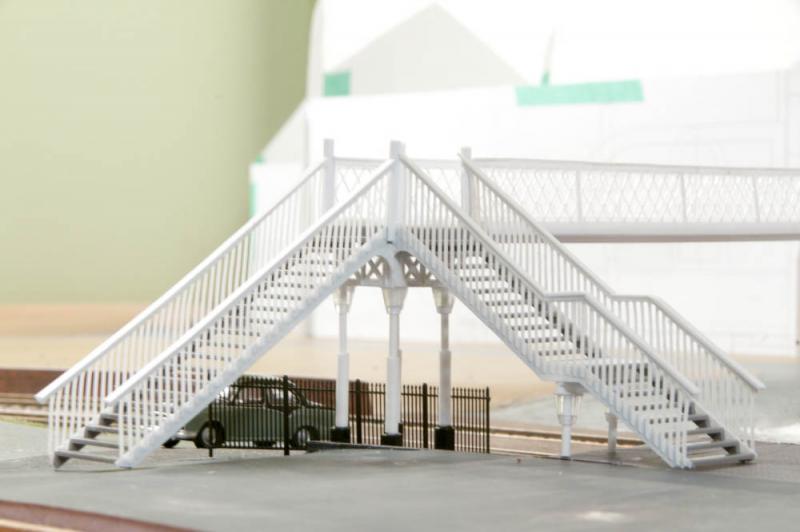
I’d recommend this  Thread on rmweb, all 29 pages of it, with lots of examples of modelling applications.  For example, how about a lattice footbridge:

post-14192-0-05676000-1383982152_thumb

Or coach panelling:

post-3717-0-54109800-1387059981_thumb

For details of the Silhouette Cameo (cheapish) and the Silver Bullet (more expensive) try this web-site (usual disclaimer).

How does this compare with etched brass or 3-D printing?  I suspect it’s cheaper, after the initial investment in the cutting machine.  It looks easier to create artwork compared with that for etching, and you don’t have to master 3-D graphics for 3-D printing.  It’s really a scratch-building aid rather that something for kit creation (etching) or a near complete model (3-D printing).  And as such it is an attractive option.

I’m sorely tempted to get one.  I love panelled coaches, and made quite a few in my younger years.  I still have an unfinished Trailee & Dingle 3′ gauge coach built in a hotel room on Java.  Perhaps this would be an easy way to build some accurate interurbans or real Lehigh Valley coaches?  But would I ever use it???  Maybe the fun would be trying…..

Posted in Hints and tips, Inspiration | Tagged , , , | 2 Comments

Panelled coaches

Here’s an excellent idea for making panelled coach sides in small scales. I recall the tedious ‘fun’ I had marking out sides in my ‘OO’ and ‘EM’ days.  This method may work well with the ‘craft cutter’ approach to cutting out panelling. I’ll follow up with a post on this, not wanting to steal the thunder of an excellent piece of modelling…..

Nick Salzman's avatarYeoton Wharf

I needed some early LSWR 4 wheel coaches to run on the ‘narrow’ gauge part of the layout. There are no kits available so it was down to scratch-building. I decided to build them in plasticard but use computer labels for the panelling. I initially scanned the plans from a book on LSWR coaches and reduced the scale to 3mm. I then printed out the sides and ends on an A4 label. This was then stuck to 20 thou plasticard and the panelling was cut round and peeled off and windows with drop-lights as necessary were cut out.

DSC_1647

The body was then put together and the chassis made using etched W irons and Mansell wheels. The roof was made to fit after painting and the fitting of the glazing. The completed coach is shown below.

DSC_1649

The thickness of the panelling is just right and the labels cut very neatly providing…

View original post 98 more words

Posted in Hints and tips, Inspiration | Tagged , , | Leave a comment

Only one owner, never ralleyed or raced….

There seem to be a lot of good railway items in the news recently – so here’s another, from the Daily Telegraph.  Not quite ‘N’ gauge, but a lovely piece of machinery, combining good points from both European and American design.

Calling all train buffs with a spare £800,000

The SNCF 141R 568 is up for sale at just over £800,000. The train is one of two 141R engines in working order, and helped rebuild France after the Second World War

A SNCF 141R 568 train
During its 24 years of service with SNCF, locomotive 568 clocked up nearly 900,000 miles

The Swiss-based owners of 141R 568 have decided they can no longer justify keeping the 136-ton locomotive and tender, and have put it on the market, hoping to find a steam buff with money to spare and a rather large sidings in which to park it.

Andrew Cook, the chairman of William Cook Holdings, owners of Swiss Classic Train , which is selling the 568, said: “It’s a fantastic buy for anyone with that sort of money. It really is a wonderful machine with so many gadgets and it is one of the last of its kind. It also has a great history.”

Indeed, behind this particular engine lies an intriguing story of how the United States helped the French railways get back on their feet after the Second World War.  Six years of occupation and war had reduced much of the rolling stock and engines owned by SNCF, the French national railway system, to ruin and there was a desperate need for a large fleet of new engines to aid the post-war recovery effort.

With French industry so badly damaged, SNCF looked to the US, which was already providing aid to rebuild western Europe as part of the Marshall Plan, and a team of SNCF engineers crossed the Atlantic to agree specifications.  Mr Cook said: “What emerged was the 141R class. It was based on an existing American Mikado design but substantially modified for European use. These [trains] were an immediate success because of their rugged construction, low maintenance and immense power.”

Both coal and oil-burning versions were produced and it took four American locomotive builders to fulfil the orders, with locomotive plants in Lima, Ohio and Philadelphia, Pennsylvania, along with one in Montreal, Canada, working flat out. By 1948, the fleet was complete – although 12 ended up at the bottom of the Atlantic when the ship carrying them sank.

Six decades on from when their exploits helped rebuild France, only six 141R engines remain in working order, with two of them, the 568 and the oil-fired 1244, owned by the Mikado Association, operating in Switzerland.

During its 24 years of service with SNCF, locomotive 568 clocked up nearly 900,000 miles.  It was initially based at Belfort where, among other routes, it worked the line to the Swiss frontier station of Delle; hauled heavy car sleeper expresses on the first leg of their journey as far as Amiens; and serviced the coal and steel centre of Sarreguemines, in Lorraine, until the early Seventies.

In later life, 568 found its way to the historic French junction of Capdenac, in the southern Auvergne, where it was going to be used to pull tourist trains. But the project failed and in 2006 the engine and tender were moved to Schaffhausen, north of Zurich, where they were lovingly restored by Swiss Classic Train. The 568 was then used as a tourist train.  The 568’s tender [i.e. the carriage]is a former French “Postes” mail carriage, complete with the bunk beds used by postal workers in between sorting shifts, a mess room and a workshop.

There is, however, just one hitch to any British owner’s dreams of firing up the boiler, blowing the whistle and heading down the track.  Unfortunately, 141R 568 is too wide to be used on most British railway lines, which have less space on either side of the track on corners than Continental railways. In Britain, it could run only on short stretches of “heritage” track.

That might be just as well. When running under steam, loco 568 needs 11 tons of coal for a journey of 250 miles. At a cost of £350 per ton just to refuel, that makes it a rather pricey train set.  The problem was it was so expensive to run,” admitted Mr Cook. “But if you have the money, or just want to put it on display, it really is a wonderful machine.”

Posted in Out and about, Prototype | Tagged , , , | 2 Comments

ESNG meeting – 5th June 2014

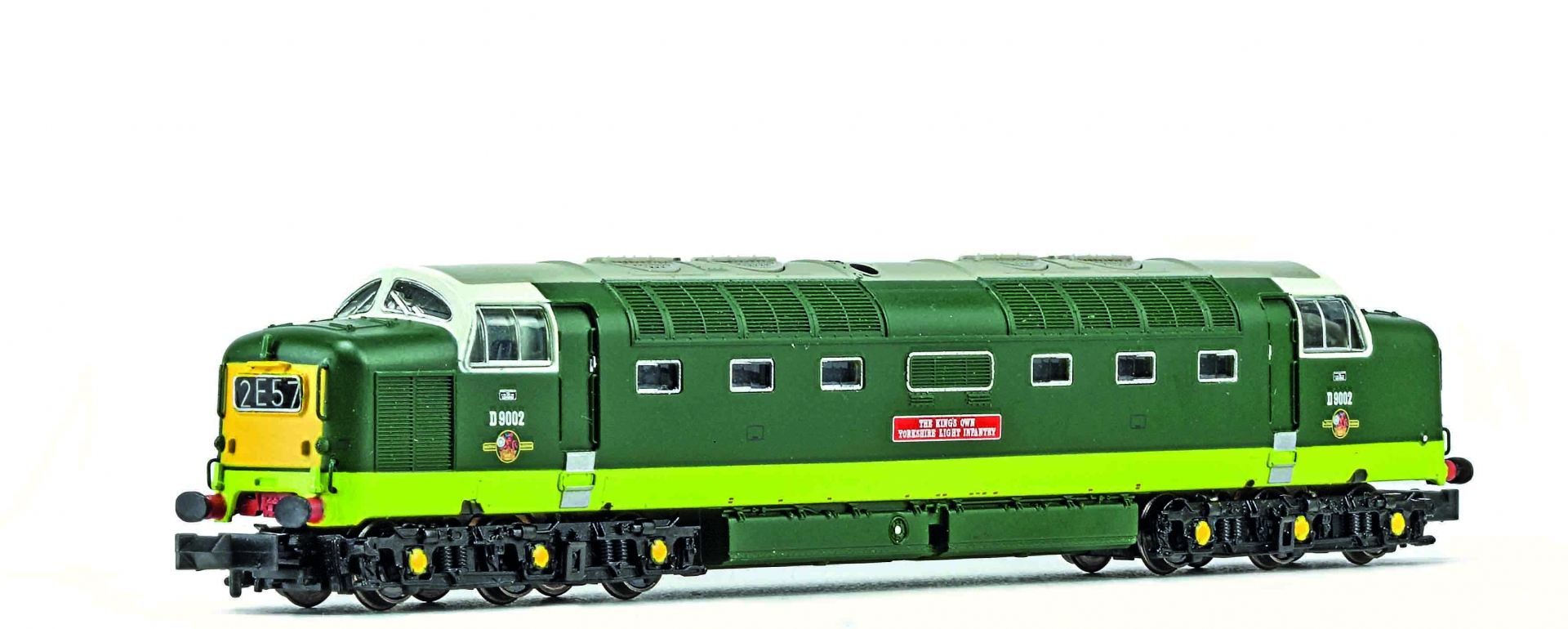
Not much to report on this meeting.  A good turnout and an interesting variety of trains running.  Pick of the bunch was the new Bachmann ‘Deltic’.  They have retooled this already good model into something special.  The end curves on diesels are always tricky to get right, even with 3-D scanning and suchlike.  This model just right.  I understand that the wheels are slightly undersized, to keep the body low on the bogies.  Looking at the model, this looks a worthwhile compromise, as it looks low and mean, just like the prototype.  As a teenager, I spend some happy hours at Kings Cross station spotting Deltics.  They were in British Rail blue, but made even corporate blue look good.

gallery_22012_3233_749275

My model should arrive today in the post – I have chosen the version with the early all green ends.  I suppose I shall have to buy some coaches for it to pull…

Apart from the Deltic, Ted was running a Norfolk and Western SD70 plus a long train of Coalporters.  All Kato, and thus running impeccably.   And Paul had one of the longest Japanese goods trains I have ever seen.  It was nearly catching up with its own tail.  Derek was running another Terrier, dwarfed (just like the real thing) but two coaches.

And get well soon to Cha(I)rman Allan, who is suffering from a nasty abscess on the neck.

Posted in ESNG, ESNG meetings | Tagged , , , | Leave a comment

Is our hobby art?

A blog post I was reading recently asked the following question:

Is our hobby a creative art form?

And added a quote from John Updike:

“Any activity becomes creative when the doer cares about doing it right or better”

I was mulling this over, and it occurred to me that the quote doesn’t really support the question.  As far as Updike is concerned, ANY activity can be creative.  By this definition, it certainly is creative for some people to sleep, drink (a lot), walk the dog, or hoover the carpet.

There is no doubt that our hobby is creative.  But is it art?  Well, perhaps the bar is set very low….  From the news this week:

British artist Tracey Emin wasn’t the first to spend a week in bed after a bad breakup.

But she could be the first to sell that bed — with its vodka bottles, cigarette butts, pregnancy tests and pantyhose — for upwards of £1 million when the installation that first premiered in 1999 goes on sale through Christie’s auction house later this year.

If that’s art, what isn’t.  Buy a book on art theory from Amazon, and you may find that:

In today’s art world many strange, even shocking, things qualify as art. In this book, Cynthia Freeland explains why innovation and controversy are valued in the arts, weaving together philosophy and art theory with many fascinating examples.

She discusses blood, beauty, culture, money, museums, sex, and politics, clarifying contemporary and historical accounts of the nature, function, and interpretation of the arts. Freeland also propels us into the future by surveying cutting-edge web sites, along with the latest research on the brain’s role in perceiving art.

This clear, provocative book engages with the big debates surrounding our responses to art and is an invaluable introduction to anyone interested in thinking about art.

The more I read about it, the less I want my hobby to be art!  But surely, by any definition, model railways must be art.  An effective piece of artwork fuels the imagination, and takes you to a different place.  How true that is of a well built model railway.  Our imagination takes us to a different place and a different time, and generates a response.  It may be appreciation of the scenic work that frames the trains.  It may be excitement at the trains in the landscape.  There may be an element of awe and wonder at the skills involved in making it all work.

“She discusses blood, beauty, culture, money, museums, sex, and politics”.  Well, we do blood (see two posts ago).  We definitely do beauty.  Culture, yes, as our model railways offer a social history of a selected time and place.  Money, that disappears fast enough, the price of model trains these days.  Museums, yes, too, each model railway is a museum exhibit in itself.

Politics – just you go to any model railway club AGM!

And sex – well I’m just not going there.

So, ladies and gentlemen, what is our conclusion – YES, model railways are art!


Posted in Inspiration, Layout design, Weird and wonderful | Tagged , , , | 3 Comments