Hints & tips – Use templates for drawing turnouts

Most overly optimistic track plan sketches result from underestimating the length and overestimating the angles of turnouts. Templates preclude cheating and subsequent disappointment. They can be homemade or commercial.

CAD software ensures precision and produces high-quality printouts. There are several commercial design programs available for those who are willing to invest the time required to become proficient. Modelers who have personal computers may want to consider using CAD software, as the layering, ease of making changes, printouts, and 3-D rendering capabilities make it well worth climbing the steep learning curve.

The second most frequent cause of overly optimistic track plan sketches is improper alignment of the straight (tangent) track with the curves. Again, this can be corrected by using templates that ideally include transition easements between the tangent and constant-radius curve or by using CAD or layout design software.

Posted in Hints and tips | Tagged , | Leave a comment

Pigeons, Sir??

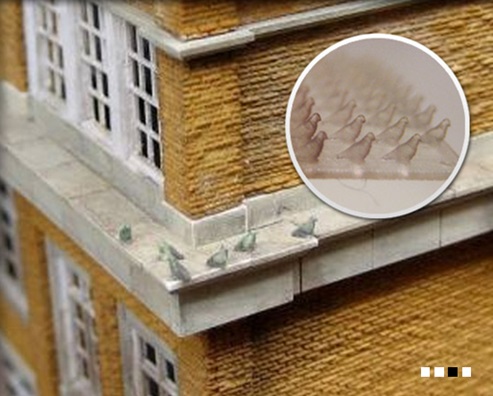
pigeons3-D printing is quite the up and coming thing at the moment – although smooth surfaces are still a bit of a problem.  But you can buy some potentially useless items for your layout.  How about N-gauge pigeons?  They come in packs of 121 or 484. (Why 121?  11 x 11 on a sheet, I guess).  Perhaps Duncan could add some to the Houses of Parliament, though these don’t look fat enough for a London pigeon living on a diet of ham sandwiches and crisps.  See http://www.shapeways.com/model/499052/n-scale-1-160-pigeons-set-of-121.html

UPDATE – Only 3 pigeons were recorded on the Houses of Parliament…..

Posted in Inspiration, The trade | Tagged , , | Leave a comment

Back from Stuttgart….

I went for two of the four days. The show finishes Sunday afternoon. Impressions below, and photos to follow…..

The show was up to the usual standard.  The N-gauge modular layout had its usual mix of very good, and perhaps more average, modelling.  There were some interesting HO and HO-m layouts as well, but perhaps not as good as last year’s, when two Dutch layouts really stood out.

The good:

  • Set up was very quick, as we weren’t on the end of a long line of modules and having to wait for everyone else.
  • Operation was fun, as we had control of a major junction.  It got a bit lively at times, with trains coming from three directions.
  • The Thursday night social was very good.

The bad:

  • The barrel of Sussex bitter ran out half way through Thursday night.  I guess we had too many vistors through the day testing it (to say nothing of the ESNG members). 
Posted in ESNG, N Club International | Tagged , , , | Leave a comment

Hey ho, hey ho, it’s off to Stuttgart we go

On a plane later to a very cold and possibly snowy Stuttgart.

I haven’t got the technology to ‘live-blog’ it, so I’m signing off till Saturday!  Remember, no ESNG meeting tonight, but one on the 27 November.

But here’s a picture to remind you what it’s all about…..

pint

Posted in ESNG, N Club International | Tagged , , , | Leave a comment

Layout design – different voices – micro-layouts

For a lot of layout planning fun, try http://carendt.com/ . Here you will find the late Carl Arendt’s site, “Micro layouts for model railroads – Creative concepts for getting the most bang out of the least space.”

There are nearly 500 micro layouts on this site. Some are not worth a second glance, really, but many are excellent and could be expanded (yes – expanded) to make a module. The “Micro-layout Scrapbook” contains some of the best ideas, as these are often slightly larger layouts.

What is a “micro layout”?  Micro layouts are defined as “small model railroads, usually less than three or four square feet in area that have a clear purpose and excellent operating capability.” The layout size is more a state of mind than a rigid dimension, although “four square feet or less” (“under 3600 square centimeters”) has become the canonical size for a micro, regardless of scale. What distinguishes these layouts from simple dioramas is the requirement for “excellent operating capability”. These are working railroads, not just display scenes or tail-chaser loops.

Why would anyone want to build a micro layout? They do have advantages, including:

• They’re small enough to complete in a reasonable period of time;
• They’re reasonable in cost;
• They’re small enough to permit detailing to the nth degree; and
• They need little space to run and store.

Planning an ultra-small micro layout is slightly different from traditional model railway design methods. It has a lot in common with theatrical stage set design, where you carefully pick a single location then figure out how to squeeze the illusion of it into an extremely small space. Like stage designers, you’ll find yourself using a lot of special tricks including backdrops, low-relief and flat models of structures, forced perspective, behind-the-scenes fiddle yards, and carefully chosen rolling stock.

Carl Arendt also produced three books of micro-layout idea. These can now be bought as PDF e-books from the site for a very reasonable price. Recommended!
Below are some micro-layouts – hi-jacked from the web site.
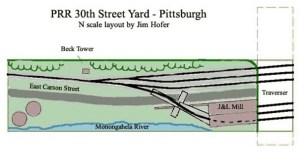
PRR

Based on a real location, and modelling traffic in and out of the steel mill in the foreground. The traverser is the key to moving wagons around.
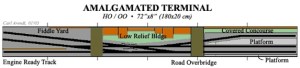
amalg

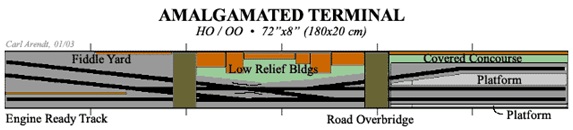
Designed for passenger stock, the two overbridges convince you that 2 coaches are really 10. I fancy building this as an interurban line, so that one or two car trains are prototypical.

BOX STREET

boxst

Box Street is a modern classic. Reasonable shunting and operational options in a tiny space (this is 5½ feet in HO) and one point and a single/double slip. The sector plate completes the loop. A number of people have built this, and it works well.
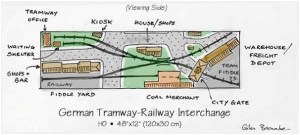
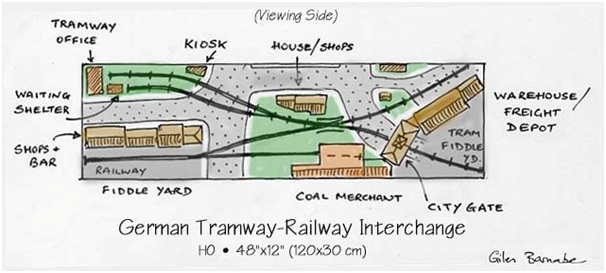
tram

This would work well in a similar space in ‘N’.
Posted in Layout design | Tagged , , | 1 Comment

Meanwhile, back in Earlswood….

From the Surrey Mirror:   Train passengers angry at having to wade through ankle-deep water

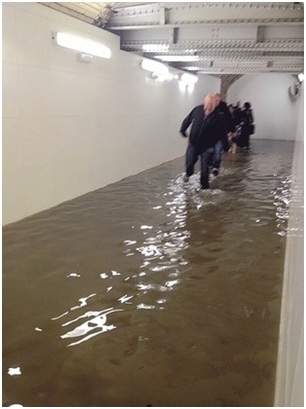
earlswood flood

Passengers were forced to wade through ankle-deep water after heavy rain swamped a train station underpass.  Dozens of people were left without any alternative after getting off the train at Earlswood Station and making their way down to the subway at platform two.

Many passengers took to Twitter on Saturday to vent their anger, claiming no warning had been given about the problem, and saying more should have been done to solve the issue.  Passengers were eventually advised to continue their journey to Gatwick Airport and return to Earlswood on the opposite platform.

According to a Southern Rail spokesman, the problem occurred due to a technical problem with a pump, installed to deal with flooding. The spokesman added: “Heavy rain fell and the subway was flooded.

“The pump down there wasn’t working and it was closed that day. Now it’s working again.

“Because it [the station] is located on the bottom of the hill, we’ve set the pump up to remove the water, but a small problem with the pump on Saturday meant it didn’t clear like it was supposed to.”

Posted in Prototype | Tagged , , | Leave a comment

Jon’s modules – track at the end of the world

track_end

End of the line on the board.  The track is soldered to the copper clad plate, and power is fed to the plate by telephone wire.

Posted in Jon's layout ramblings | Tagged , , , | Leave a comment

And even better….

From the China Daily, 14 November….

Toilet walls net complaints

A men’s bathroom at the Suzhou Railway Station has been the target of a host of complaints because it uses transparent glass walls, people.com.cn reported on Wednesday.  The station’s property management company promised to cover the glass with frosted stickers as soon as possible.

Now, there’s a modelling challenge for ‘N’!!  Perhaps the wrong sort of glass?

Posted in Prototype, Weird and wonderful | Tagged , | Leave a comment

Train runs late after one hits boar

From the China Daily, 13 November….

A train on the Quanzhou to Jinjiang line was held up for more than an hour after hitting a wild boar on Monday evening.  The incident created multiple delays on the line with seven high-speed trains in Quanzhou stations running late.

Would our train operators call this the “wrong kind of pig”?

Posted in Prototype, Weird and wonderful | Tagged , | Leave a comment

Model this in ‘N’

magnet_1

magnet_2

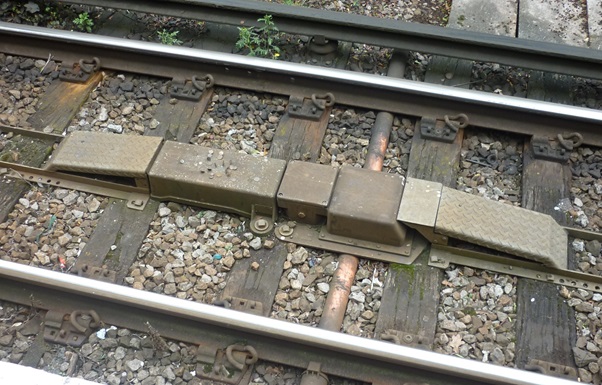
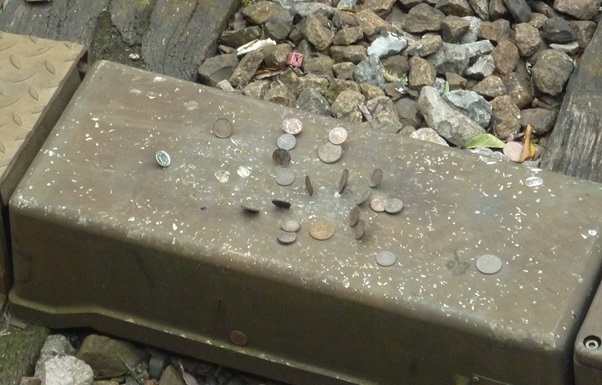
This looks like just another track magnet for train detection…. (Surbiton platform 1).  But look a bit closer at the magnet – try this in ‘N’ gauge if you dare! There must be too many rich people in Surbiton…. (Photos by Jon).

Posted in Prototype | Tagged , | Leave a comment