Off my trolley – Pacific Electric to Watts – 3

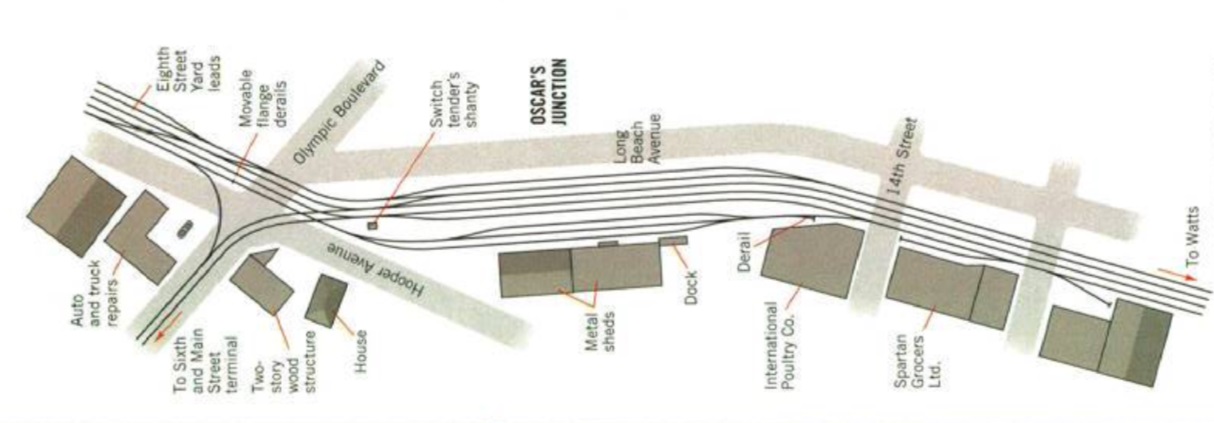
Finally, could one model the northern end, at Oscar’s junction, or the southern end, at Watts, of the four-track main line?  The prototype track layouts below are taken from the Model Railroader article.  Both have real potential as stand-alone layouts, but may need some adaptation for modular use.  I haven’t drawn these up, as yet, but just suggested a few modifications for modular use.

Oscar’s Junction

Perhaps Oscar’s Junction is the easier of the two.  There are four tracks all the way through from the Watts end to the Eighth Street Yard leads.  One would, however, have to accept trains running through the small yard on the opposite side of the tracks to Long Beach Avenue.  Incidentally, the metal sheds in the yard were still standing just a few years ago.

If building this for N-mod, it might be best to flatten out the gentle S-curve of the prototype.  The double track lines leading to Main Street Terminal could provide an N-club link, provided an extra link was added between the double track section and the small yard.  Perhaps there is indeed potential for Oscar’s Junction and modules?
oscar_plan

Watts

Watts is rather more difficult.  The station itself and the single freight road would be easy to model.  The slips and crossovers leading from all four tracks into the car shed and yard would also be easy to model, although care might be needed in track laying with the slips on the main lines.

The main modular challenge is the triple junction, as the main lines scatter to various destinations.  One option would be to simply run four tracks past the car shed and keep the linear modules.  This would look good, and make an interesting model, but it would loose something of Watts’character.  A better option would be to modify the track layout slightly, so that one of the three lines (probably the one to Long Beach) becomes a dummy junction.  The other two double-tracked lines could then link up in a loop and form an end loop for an N-mod linear layout.  Looking more closely, the links are actually already there – the Santa Ana line can run from tracks 1 and 3, and the Torrance line from tracks 2 and 4.  This would need an operator in charge, as there is a diamond crossing where lines 2 and 3 cross!

Yes, Watts is difficult, but it still has potential for an N-mod layout.

watts_plan

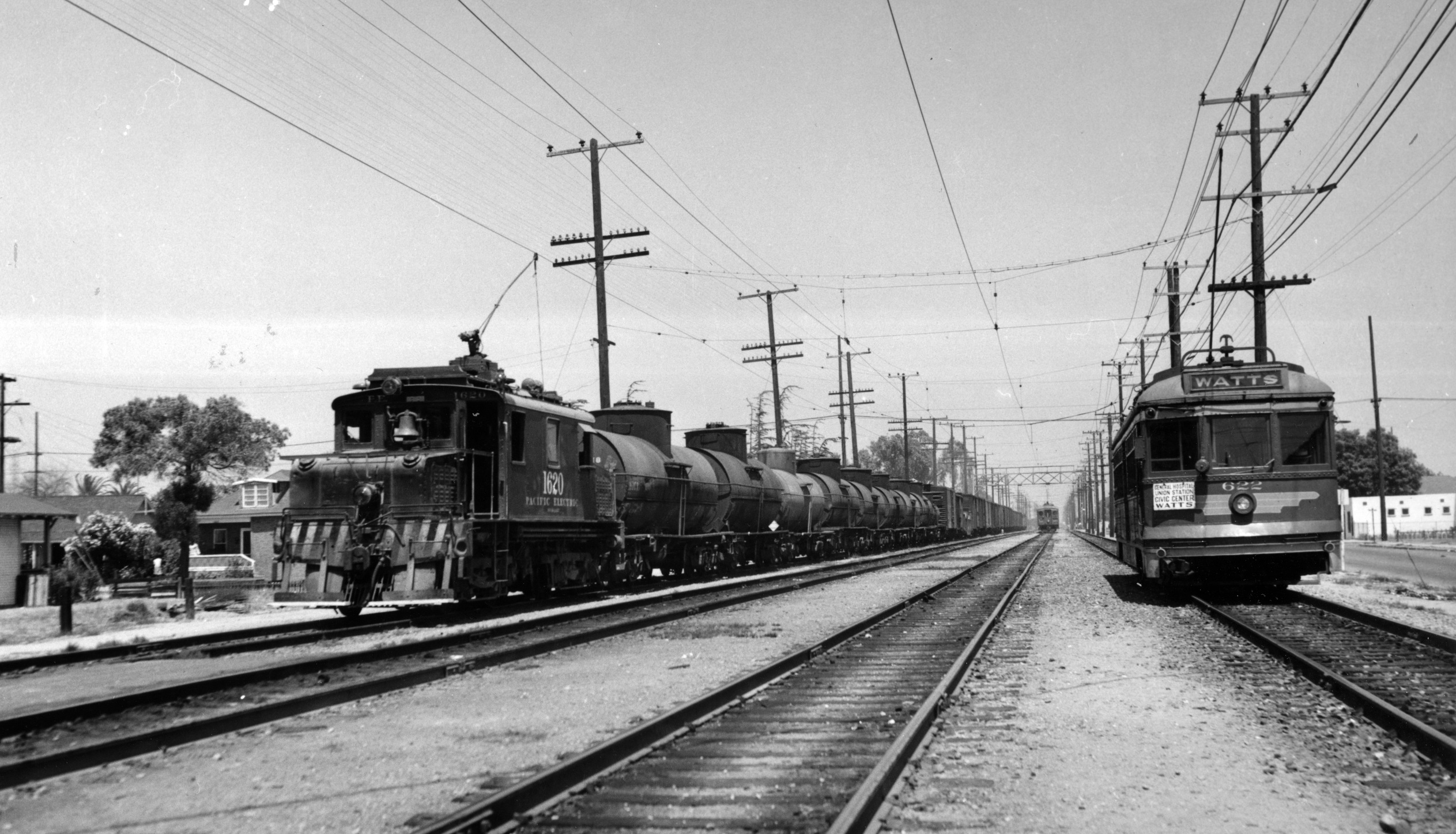
And here’s a final photograph, taken just north of Watts in 1948 (by G. Krambles) showing the character of the main line.

Maxine and I have just had a long weekend in Berlin seeing our eldest daughter.  Hopefully, I’ll have been allowed to look at a few trains or trams, and there will be photos to follow….


Posted in Inspiration, Layout design, Prototype, Traction | Tagged , , , , | 3 Comments

What would you change?

Mike Cougil contributes another thought provoking post.  He starts with….

If you had a blank slate to begin again in the craft, would you change anything? Would you switch scales, stick with the same theme, explore a different one or, do nothing different at all?

And goes on to list some of the things he might do differently.  I’ve summarised a few of them here….

It truly is a journey
My interests are not what they were twenty years ago when I returned to the craft.  The recent changes reflect a maturity that I didn’t have then. I’ve been active in this craft for a number of years now and have done most of the things I thought I wanted to do with it, though there are still  avenues I would enjoy exploring and pushing my own ideas of what a layout can be is one of them….

Size is not the only criteria
I’m very aware of the arguments and the bias against smaller layouts….  What I personally find so compelling is the discipline required to effectively design one.  You have to be disciplined in your choices and expectations and not everyone is willing to do that or understands how to exercise such restraint.  I think it’s better to frame the conversation around thoughtfully considered and well crafted design principles rather than square footage.

Everyone can have quality
What many of us really want is a layout that truly satisfies our vision.  This is a quality in which the actual square footage involved is irrelevant….  My route to a satisfying layout has been to eliminate the compromises that assumed or seldom used features usually require, such as the toy train character of my curve….  All of these ideas represent a relaxed approach to the craft that has brought me to a satisfying place.

Lighting
I’ve never been happy with the lighting of my layouts over the years….   Properly lighting a small object like a model is an art form in its own right that few of us understand well.

Lighting commands our attention
In his comments on a recent post, reader Simon Dunkley offered an analogy from the theater of the lights dimming at the end of a scene.  I think that would be an interesting way to actually end an operating session.  With the ever growing number of options (including dimmable) now available for LEDs, poor lighting can be a thing of the past….

Presentation
I’ve touched on this subject before and by presentation, I’m referring to the entirety of what one sees, from the actual modeling and how the layout itself is introduced and presented.  I have seen examples of exhibition layouts that would rival any museum display in their interpretation, signage and lighting….  I find this style of modeling very intriguing, because it speaks to the artistry and craft that I enjoy.  I also think there is a wonderful opportunity in layout presentation to help the public understand our craft beyond the stereotype of toy trains….

Read it all HERE.


Posted in Hints and tips, Inspiration, Layout design | Tagged , , | Leave a comment

Off my trolley – Pacific Electric to Watts – 2

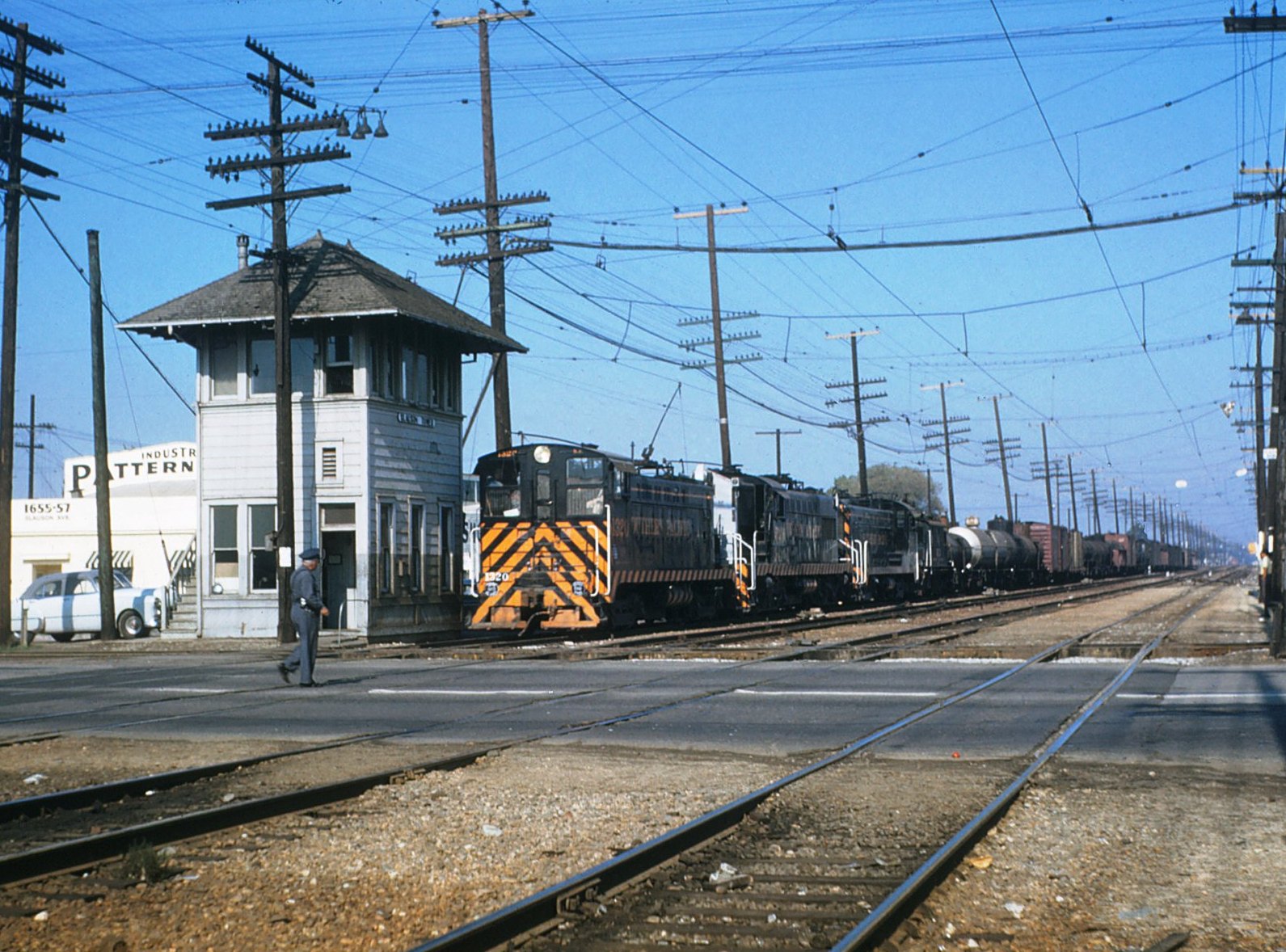
Now for a couple of simple ideas for Pacific Electric N-mod modules.  I’ve selected two places where other lines crossed the four-track main line.  The first of these, nearest Watts, is at Slauson Tower, where the ATSF Harbor branch crossed the PE.  The ATSF paralleled Slauson Avenue, as can be still seen today on Google Earth, even when the rails are all gone.  The delightful picture below shows a PE freight at the tower.  Yes, the diesel units heading the train do have trolley poles – they were fitted to trip the train detection equipment.  The junction from the PE to the south-east of Slauson Avenue was the junction to the PE Whittier and Yorba Linda line.  It could be included as a dummy junction, but I would be tempted to leave it out and focus on the crossing.

slauson_mapslauson_1

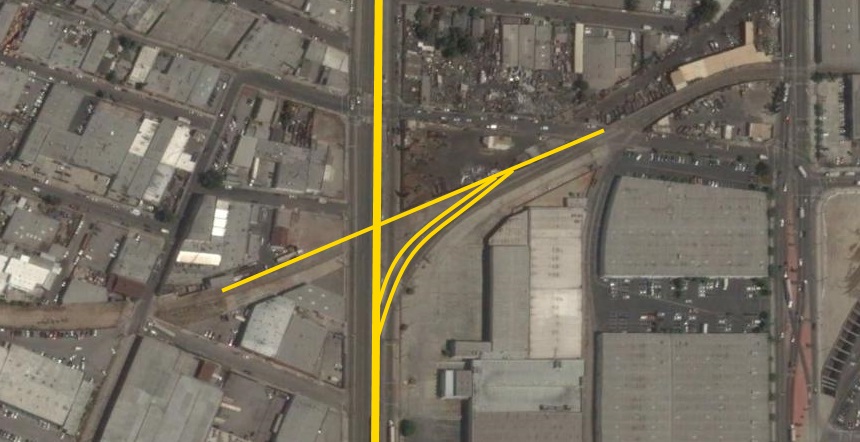
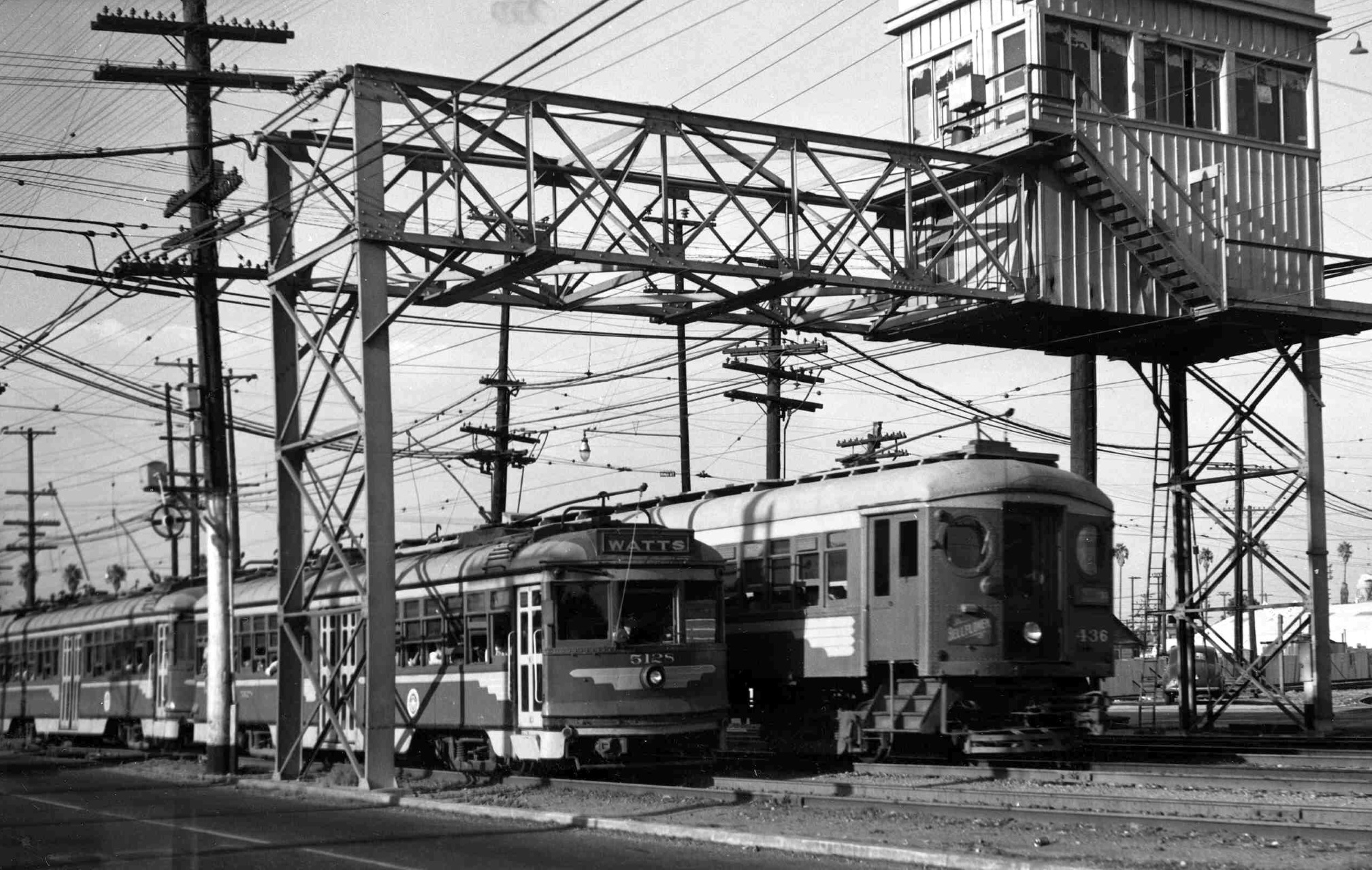
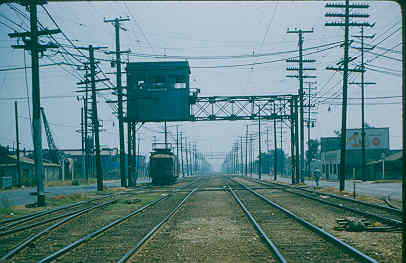
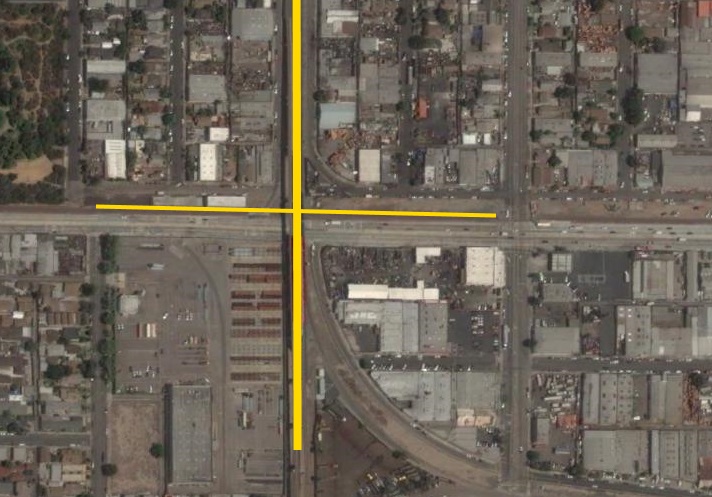
To the north, not far south of Oscar’s Junction was Amoco Junction and tower.  The distinctive lattice-built tower spanned all four tracks and watched over the crossing and junction to the major PE Butte Street Yard (to the east and fully redeveloped on the aerial photo below) and the PE Santa Monica freight branch to the west.  The scene is made more interesting by the roads (Long Beach Avenue) lying both sides of the tracks.  Long Beach Avenue extended (and still extends) all the way from Oscar’s Junction south to Slauson Avenue).  Here, the interesting junction layout would have to be modelled, although it would again be a dummy.

amoco_map amoco_1 amoco_2

As can be seen from the photos and from Google Earth, Long Beach Avenue is flanked by light industrial structures and residential bungalows.  A chance for some good scenic modelling, and there are plenty of photos of the area available, although one might aim for ‘typical’ structures.

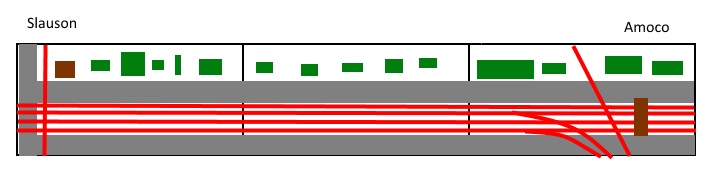
Finally, what would the modules look like.  Here’s an idea.  I’ve used 4′ modules to suit N-mod, but reduced the width to the N-club 400mm – it’s more portable and better suited to a linear scene like this.  I’ve also moved the tracks in from the edge of the board closer to the N-club locations.  This gives more room at the front of the layout and allows one to model the roads both sides of the track.  One further idea would be to have three 2′ 8″ modules rather than two 4′ ones.  This would still tie in with N-mod geometry, but the modules will fit easier in the small cars we have here in the UK.  I’ve drawn it all like this below.

modulesDo you think it would work?

Posted in Inspiration, Layout design, Prototype, Traction | Tagged , , , , | Leave a comment

What do you care about?

Another short, but excellent post by Mike Cougill on the OST blog

What do trains help you to care about?

For what it’s worth, here’s my answer: trains help me remember times and events that are meaningful. Memories that I can only revisit in my mind.

Trains help me express a level of creativity in ways that other mediums don’t. Trains provide a theme and purpose for exploring what craftsmanship is to me and a way to view the work through an artistic lens rather than a technique or product driven one.

Trains help me understand that I have something to say and a distinct voice with which to say it.

You don’t have to understand, like or agree with any of this and I’m not on a crusade to convert anyone to my way of thinking. I’m gratified when others add to the conversation but I write about these things because I enjoy writing about them and, if I have anything to offer at all, it’s simply a different point of view.

So, ponder this week: what do trains help you care about? Maybe blog about it on your own or you’re welcome to comment here. Thanks for reading.

Regards,
Mike

Perhaps I’ve lost the creativity and craftsmanship that I was developing 40 years ago? Maybe it’s time to try and find it again!


Posted in Hints and tips, Inspiration, Layout design | Tagged , , | Leave a comment

Has Rolls-Royce created the train of the future?

From the Daily Telegraph….

A new generation of more efficient, quieter and greener trains could be coming to Britain’s railway lines, driven by a new hybrid power system built by Rolls-Royce.The company – best known for its aircraft engines but which also has creates engines used on land and at sea – is developing a combined diesel-electric system that also incorporates batteries.

The system also utilises regenerative braking systems first seen in Formula 1 cars. These store energy in the batteries that is created by slowing down, and which would otherwise be wasted.

MTU, which comes under Rolls’ power systems division, has been testing the new design on a Siemens train for four years in Germany, in partnership with rail operator Deutsche Bahn.
The new system has been found to be 25pc more fuel-efficient than current trains and much quieter.

Rolls believes that its hybrid system could help Britain regain the leading role the country once held at the forefront of rail technology, and said its sees the UK as a “key” market.

I did like one comment on this article….

With the amount of slowing down our trains seem to do the adoption of regenerative braking systems will surely mean that they will run for next to nothing.


Posted in ESNG, Inspiration, Out and about, Prototype | Tagged , , | 1 Comment

Off my trolley – Pacific Electric to Watts

Once again, it’s been a long time since I posted on traction and trolleys.  But I’m still thinking about modelling ideas, and while I wait, more interurbans and trolleys keep appearing on the Shapeways site.

One of my issues with N-mod is that I have had difficulty thinking of designs with a 4-track main line.  Why, I don’t know, as I was brought up near the SE commuter line to Orpington, all 4-track, with two fast and two slow lines.  But an interurban 4-track mainline?  Surely not??  In fact the Pacific Electric had two such stretches out of central Los Angeles.  One was on the northern district, but over the past few months, the other one, going south into the southern district, has been of interest as a possible N-mod basis.  This line is Pacific Electric’s well known 4-track expressway from LA to Watts.

The Model Railroader in September 1999 had an excellent article by Tom Wetzel with a layout plan and some prototype information.  I have refrained from using much of this for copyright reasons, but will probably reproduce the prototype track plans included.  The photographs in this and subsequent posts mostly come from the fascinating Metro Transportation Library site.

Travelling on this line, you would start on the elevated part of the Pacific Electric building, now converted to flats, but easily found on Google Earth.

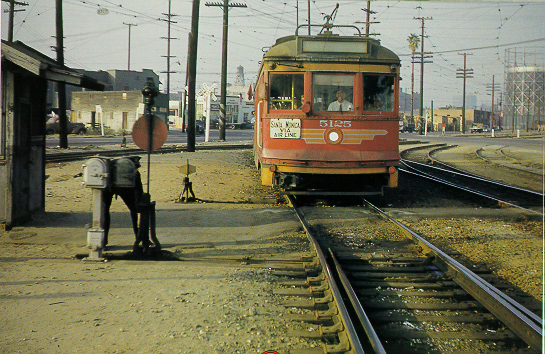
Leaving the station, trains followed a raised trestle / viaduct and then down a wood trestle ramp at 3.89% grade to street level at San Pedro Street, near 6th Street.  The line then ran along San Pedro Street and Olympic Boulevard to Hooper Avenue.  This street track was about one mile in length.  At Olympic & Hooper the line entered a private right of way paralleling Long Beach Avenue, and was joined by the yard leads from the 8th Street freight yard.  This point was called “Oscar’s Junction” by PE crews after PE president Oscar Smith).  In the following photo (from “Pacific Electric in colour volume 1”) the tracks curving to the right are the yard leads to 8th Street freight yard.

w_2_oscar2

The line then passed a small three-track yard on the west side of the main line and headed south.  San Pedro and Long Beach passenger trains used the center “express” tracks of a four-track mainline as far as Watts — 7.45 miles from 6th & Main Streets station.  The outer tracks were used by Watts local trains and freight trains.  The photos below give an idea of the dead straight, N-mod like, main line – the first being early last century.

w4

Watts is often better known for the riots in 1965.  The station was one of the few building in the area not burned out – and is still there, as Google Street View shows.  Watts recovered from that mad time, and has now evolved into a largely Latino area of LA.

w6_WattsPacificElectricdepot

Watts street view

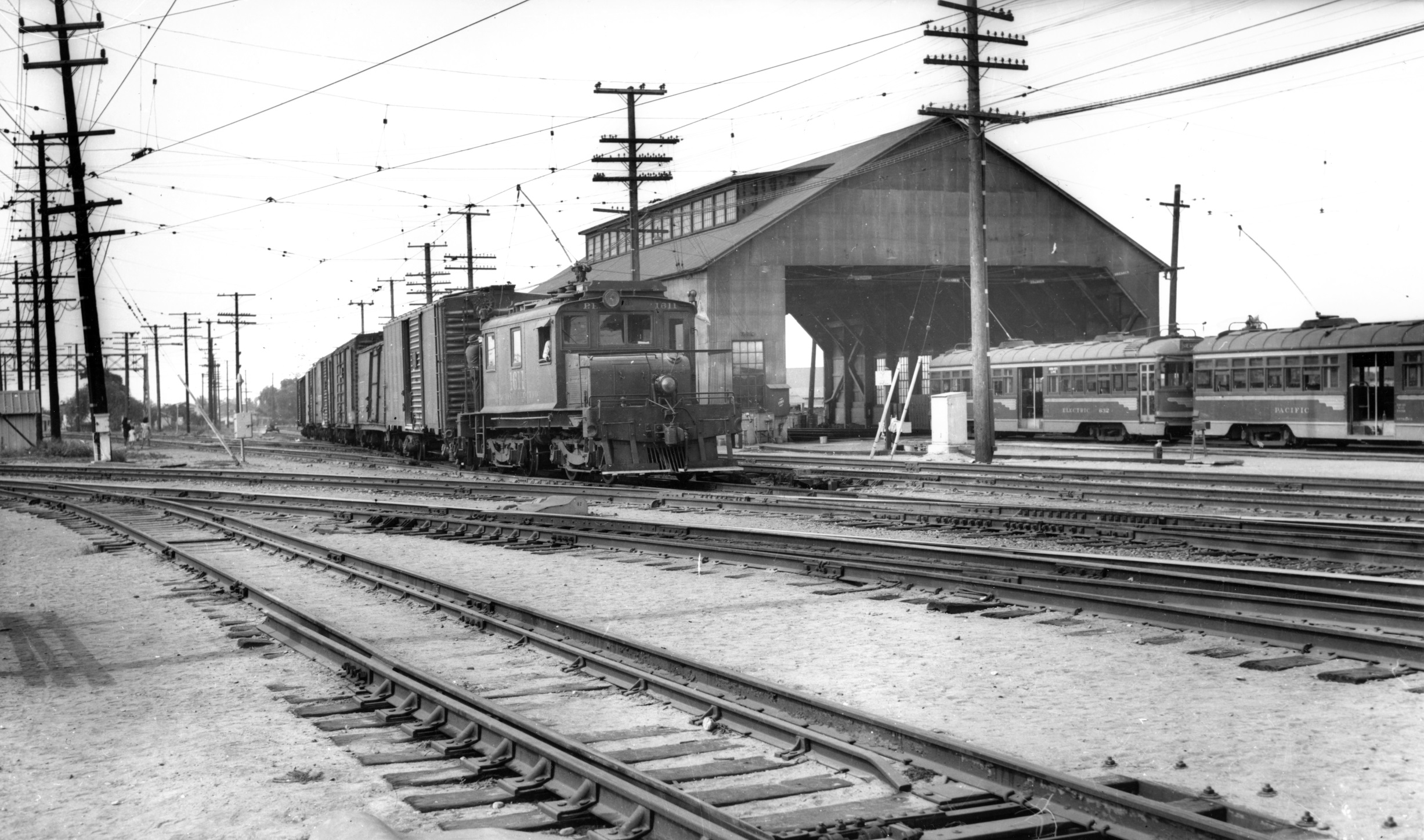
South of 103rd Street was a maze of slip switches and diverging tracks of a three-way junction. Watts included a passenger station, separate freight station, brick substation, interlocking tower, and four-track carhouse. Lines diverged here to Long Beach-San Pedro, Santa Ana and El Segundo-Torrance.

The main line from LA to Watts is still in use, reduced to double-track as part of the LA metro Blue Line.  Unlike the UK, even urban areas in LA are slow to gobble up unused tracks for development, and the old track bed and the crossings and branches along it can still be identified.  The old lines can still clearly be found on Google Earth – although the yards and car-house have gone.

amoco_3

w5_watts_map

That’s enough for this post.  How could we build an N-mod module of two from the Watts racetrack?  Next time….


Posted in Inspiration, Layout design, Prototype, Traction | Tagged , , , , | Leave a comment

Now ESNG N-mod baseboards?

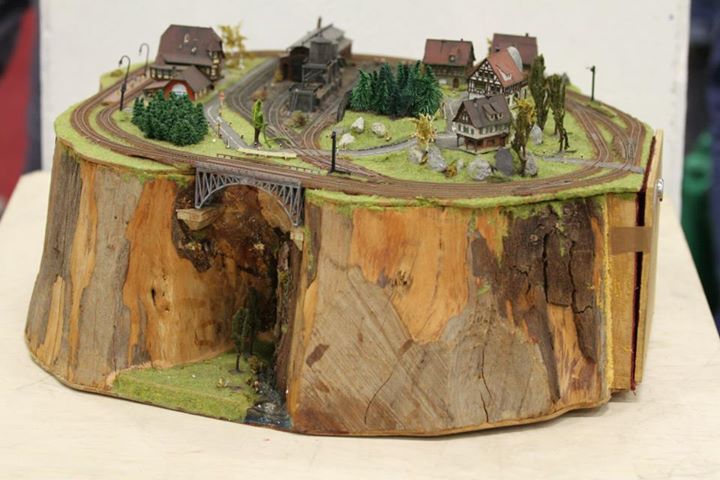
Having found a picture reminding me of N-mod track, here’s one that reminds me of our baseboards (at least for the corners and fiddle yard).  Thanks to David Bromage on Small Layouts Group for this….

Found this by accident.  A remarkable Z gauge layout built on a section of tree stump.

Original is here.

Kj7KXx5 - Imgur

There may be potential for larger scales with different tree species.  Maybe and ‘O’ gauge version on a Giant Redwood?

Perhaps there is a serious message from this.  We need to think of the presentation of our baseboards.  A neat fascia, painted to complement the predominant colours on the layout can really set off the layout.  Bare wood, dodgy looking screw heads and poor construction does not help the rest of our modelling.

On a slightly associated note, I learnt this about Disneyland:

If you’re walking through Disneyland (presumably in a state of Smellitzer induced bliss), one thing you probably won’t notice is … anything painted grey or green.

The company has apparently apparently created two deliberately  dull paint colours, known as “Go Away Green” and “No Seeum Gray”, to draw the eyes of guests away from any objects that they want to hide, or blend away. These can range from utility buildings, to fences and walls, to the door of the famous Club 33.

Surely this paint has many modelling applications, starting with those enormous couplings!

Posted in ESNG, Hints and tips, Inspiration, Prototype, Weird and wonderful | Tagged , , , | 1 Comment

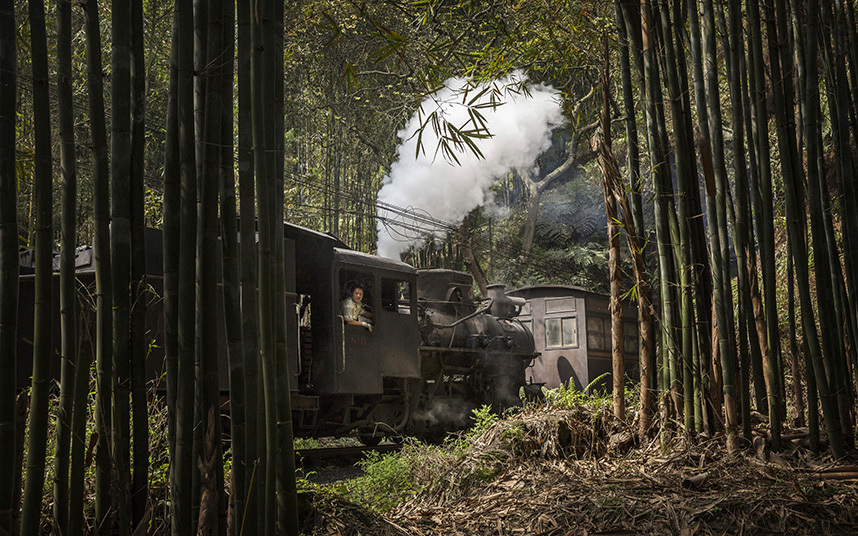
Wonderful photographs of Chinese stream railway

Another gem from the Daily Telegraph:

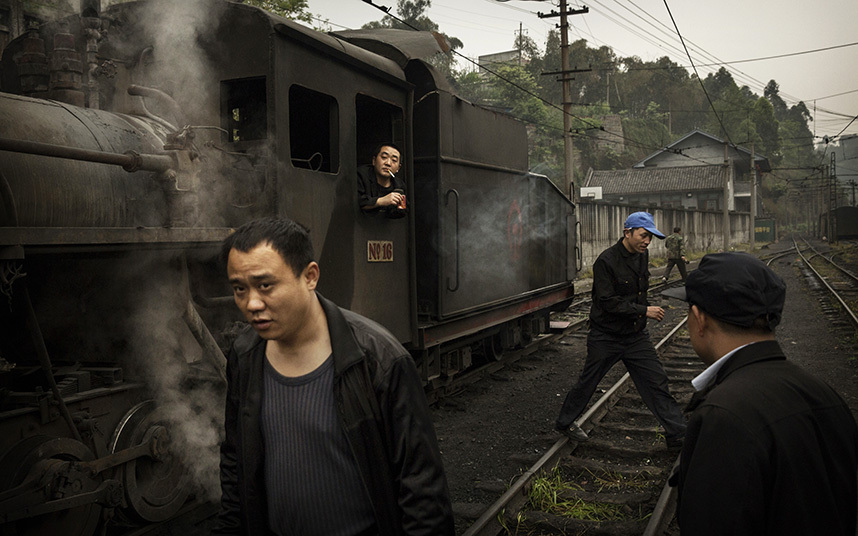
While China boasts the world’s most extensive high-speed rail infrastructure with over 16,000 kilometers of track, the Shixi-Bagou railway is still a primary connection for local villagers between towns and is kept alive by tourist cars carrying passengers for ten times the price. The rail line came into service in the late 1950s and the train was initially used to transport coal from a now-shuttered mine before passenger carriages were added.

Two photographs from the set are below, and the rest here.  A lot of modelling challenges here, from the grimy yard, to the bamboo and paddy fields.

china-train_3308603k china-train-bamboo_3308806k

Posted in Inspiration, Out and about, Prototype | Tagged , , , | Leave a comment

ESNG meeting – 21 May 2015 – and AGM coming

Nothing to report from tonight.  I arrived to join Derek (with the beard and glasses), soon to be joined by Derek (with the beard and glasses).  No-one else turned up, not even the Cha(i)rman who is recovering from a bad back.  Paul arrived at 7:45pm and Peter and Roger after 8.  So we had a chat and went home….


Hopefully, we’ll get a better turnout for the AGM, on Thursday 2 July.


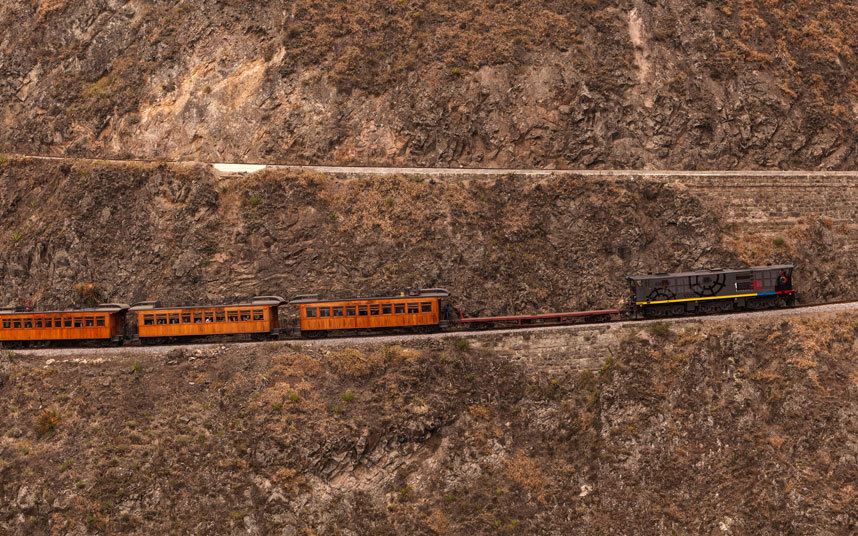
Perhaps a few ideas for a model here?  I would not travel on this scariest of switchbacks!

scary-trains3_3311443k


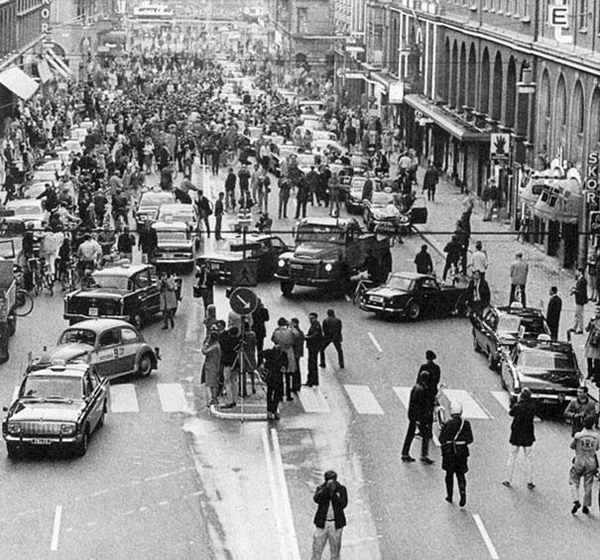
Mind you, it might be safer than the morning after Sweden started driving on the right of the road (in 1967).  Even the new Redhill road changes couldn’t rival this.

40-First-morning-after-Sweden-changed-from-driving-on-the-left-side-to-driving-on-the-right-1967


Posted in ESNG, ESNG meetings | Tagged , , , | Leave a comment

The fear factor

One of my regular blog reads, ‘Motorised Dandruff’, has been very quiet recently.  However, I found I could identify with this recent post:

The major problem I have is one of perfectionist block (I think that’s what its called). I can have a vision of what I want to achieve, but lacking the skills (or confidence in those skills) to get to that vision means that it doesn’t get past the starting post. Or that the order of the steps is crucial, and a lack of confidence in a future step can scuttle the current one.. I guess it might be a hangover from my current professional career. This involves every step being planned in advance, and nothing happens until every step to the final one is visualised. OK its not quite like this, but in chemistry if things go wrong, they can go wrong very fast and people get hurt (or at least have to fill in lots of paperwork discussing what went wrong).

In some ways working on the house has been good for this. I’ve now learnt to push a small project through till its either finished, or won’t leak during winter. I can leave it there and go and do something else. I’ve also been dabbling in another prototype / scale which allows me to build without worrying about whether its prototypical or not (since I’m making it up). Its also nice to be “mostly” working with RTR models for a change.

This is so ‘me’ too!  I hesitate to take the plunge at some modelling task in case I get it wrong.  But what does it matter?  Usually you can rescue your mistakes or just throw it away and start again.  I can also identify with the comments above in that modifying ‘Earl’s Wood’ has really helped my modelling juices (and I must finish the new fiddle yard now I’m home).  And just taking some RTR models down to ESNG and giving them a run – and watching everyone else’s trains go by – has kept my interest in the hobby going.

The remedy – just get on with it!!  Mental note – must do just that.


Posted in Hints and tips, Inspiration, Layout design | Tagged , , | Leave a comment