‘OO’ Locos – Jon’s old trains #4

Last of my old ‘OO’ stock packed away were a number of Southern Railway locomotives.

l_1

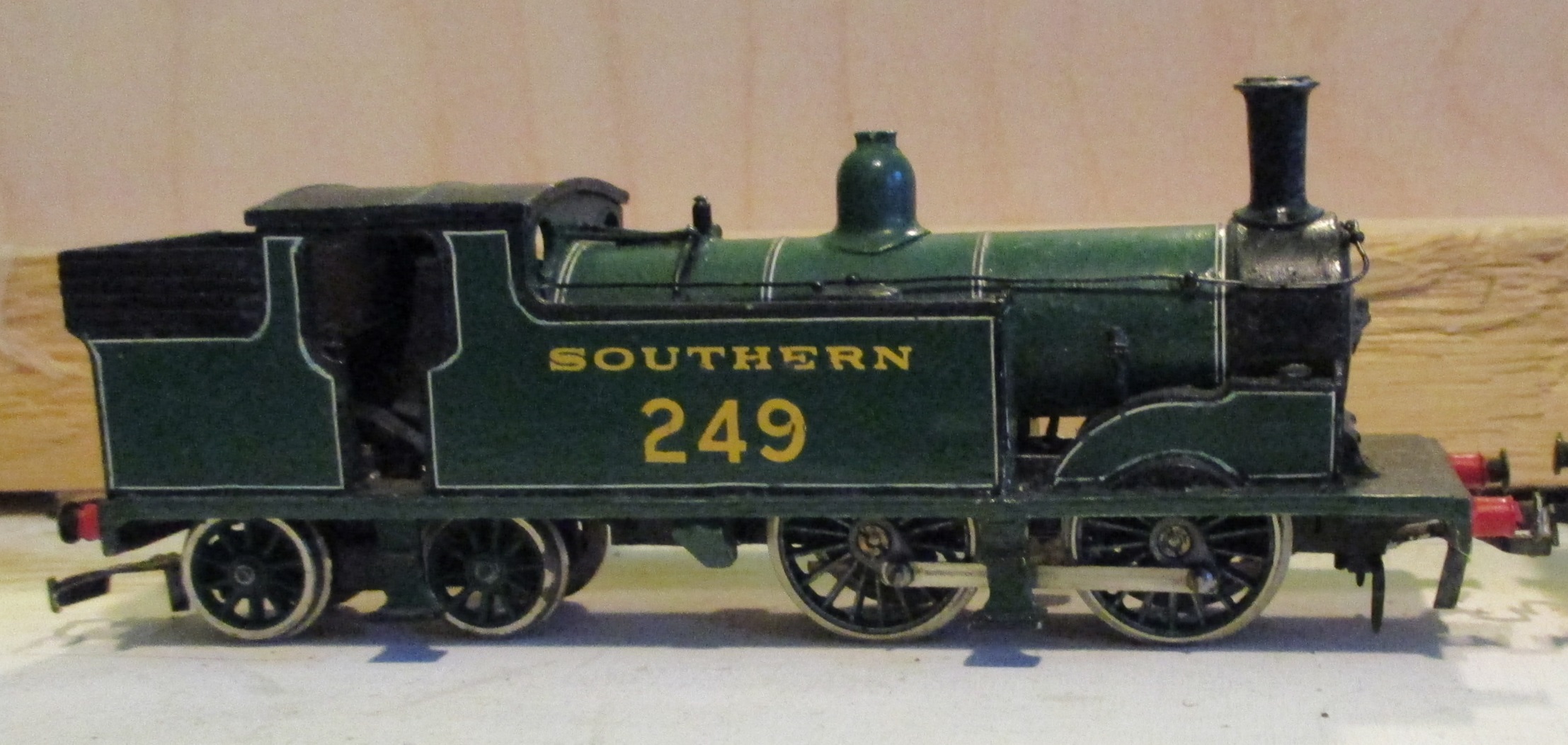
The two tank engines both run on the old Hornby ‘R1’ chassis.  The ex-LSWR  ‘G6’ on the left was my first cast kit (by Wills).  It has had several liveries, and the chassis is just about worn out after running for many real miles.  I was obviously trying to spruce up the body when I packed all these engines away, as the boiler seam had been refilled, and I’d added a shunter’s handrail to the bunker.  I have a nearly finished ‘O’ gauge G6 upstairs, and I’d like to build an ‘N Brass’ 2mm version.

The loco on the right is an ex-LBSCR E5, another Wills kit.  A later model, that still looks quite smart in Southern green.

l_2

An early modelling success was my upgrade of the Triang Southern Railway ‘L1’.  One of Triang’s better models, it has had scale wheels fitted to loco and tender, new handrails and pipework, and a fair effort at a fully lined livery.  It looked the part, but despite the new wheels, could hardly pull the skin off a rice pudding, and tried to do it at 100 mph.

l_4

Another Wills kit, the Southern ‘Q’ goods locomotive.  This was originally in lined green, but I’ve slopped some black over it at some time.  The loco has again been converted to run with ‘Romford’ scale wheels.  This wasn’t quite such a good job as the L1, as I think I bent a coupling rod slightly, and it wasn’t very free running.

l_3

My perennial failure was this Wills LSWR ‘T9’.  It’s had several chassis, new coupling rods, several liveries, and never really ran properly.  All this was in the days before compensation, transferring weight from tender to locomotive through the draw bar and the like.  I might do a little better now (or probably just buy the excellent Hornby model).

IMG_0333

My father had all the same problems with his Wills LSWR ‘M7’, but managed to get it going rather better than I did.  He always was much more patient than his son….
IMG_0334

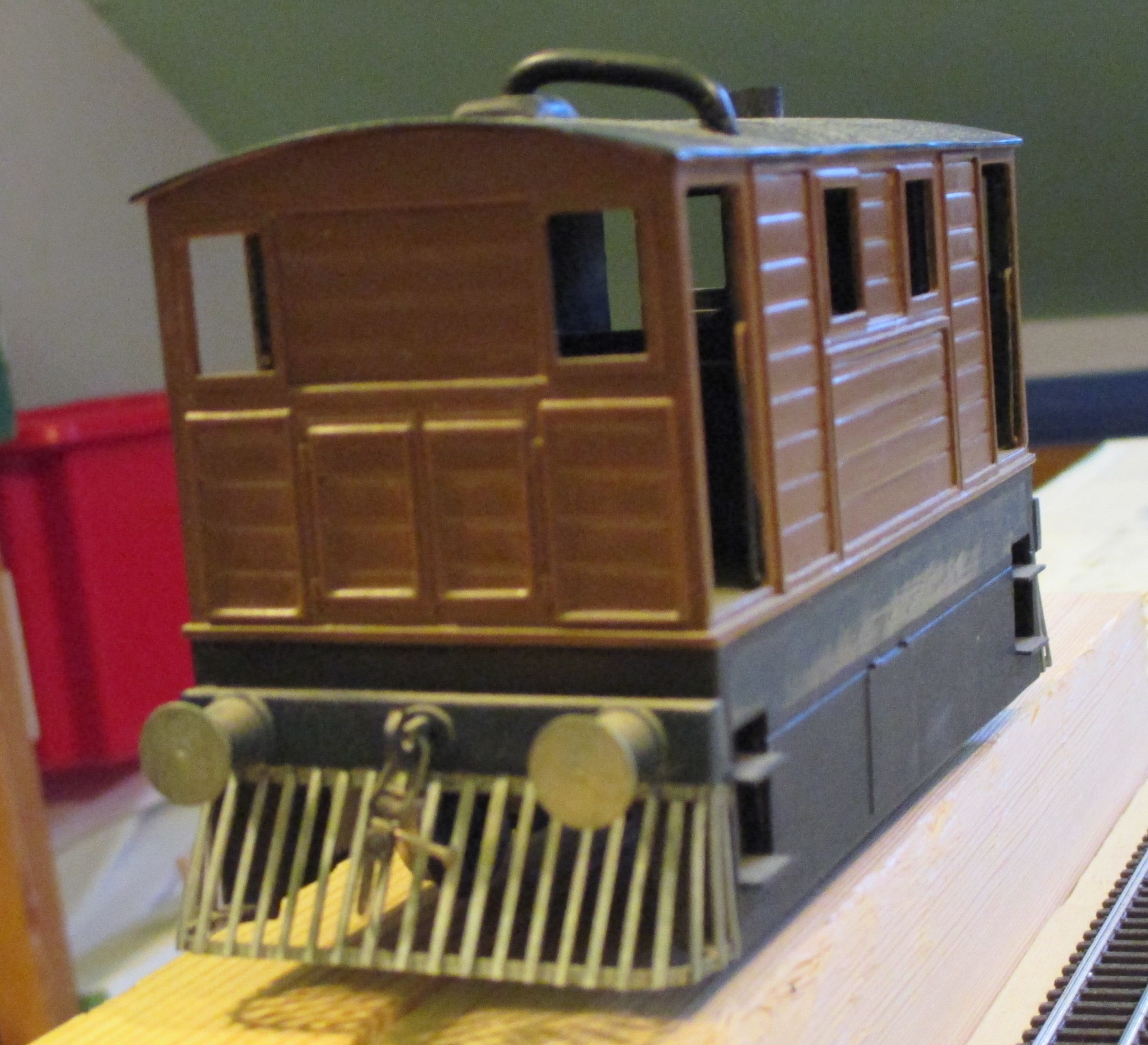
And after this came a dabble in EM gauge, then on to ‘O’.  This GER tram engine, dating from the early 1970’s, was a pre-formed plastic kit, with some added detail, running on a Lima motor bogie.  It goes like a rocket, quite unlike the original.  The plastic cowcatcher is broken at the far end, and the plastic roof is quite brittle, but it still looks the part.
l_5


Posted in Inspiration, Jon's layout ramblings, Weird and wonderful | Tagged , , | Leave a comment

ESNG meeting – 18 February 2015

A genuinely quiet evening.  Only seven members turned up, maybe the school-half term holidays cut numbers a bit?  However, we quickly got a small circuit up and running.  Derek and Allan were both running the new Dapol Maunsell coaches.  A train of 2 coaches, a Southern utility van and an M7 0-4-4 all in Southern Railway livery looked very smart.  I’m still holding out for the Maunsells in BR livery.

Derek Apps changed the chassis in his GWR  0-4-2, as the original one had the wheels at different levels, that didn’t aid smooth running.  It was soon happily running around the circuit, but we rarely saw it, as it was mostly hidden behind Paul’s 73 wagon Japanese goods train.  This ran very well, with few derailments, providing a gap was left between the brake van and the train loco chasing its own tail.  You wouldn’t need a radio link between driver and guard – they could just use hand signals.

I tested my Bachmann ‘Doodlebug’, that is an Ebay purchase.  It runs well, and just needs repainting in Lehigh Valley colours.

We also had a look at a small layout, some stock, and other bits and pieces kindly donated to the club by the family of Michael Partington, an old member sadly no longer with us.  We’ll see what we can sell at the show, proceeds to the Stuttgart travel fund.

Posted in ESNG, ESNG meetings | Tagged , , , | Leave a comment

A little more Photoshopping….

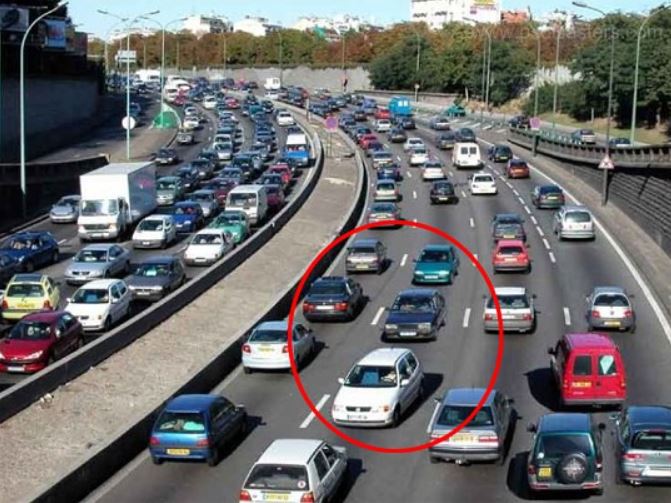
After yesterday’s non-competition, I can’t resist a bonus post of this photograph from today’s Daily Telegraph.

Paris

This image was used to show how heavy the traffic is on the ‘peripherique’ in Paris.

In case you didn’t notice…..

Unfortunately someone photoshopped some road users driving on the left hand side of the highway

I’m not sure what the modelling moral of this story is – but lane discipline can be equally bad on an ESNG running night!

Posted in Inspiration, Jon's layout ramblings, Out and about, Weird and wonderful | Leave a comment

Today’s competition

No prizes, but what is wrong with this extremely festive Christmas card, sent to me just in time for Chinese New Year by Cha(i)rman Allan?

.facebook_1424020245678

Yes, the Routemaster on the left looks like it’s an export model and it could be a little bit dangerous alighting in the middle of the road.  But how many other errors can you see?

It’s easy to be critical of an artist with no heart for public transport, but it also raises a few questions as to our hobby. For example, the picture ‘looks’ right, as to the place and atmosphere.  It’s the detail that lets things down.  If you looked at my model railway, how much incorrect detail will you find?  (Actually, none, as it’s still bare baseboards – but I suppose the track is not to scale?)  And does it matter?

So when does valid critique of a model turn into rivet-counting and then into petty criticism of another’s work?  We’re all prone to it!

Posted in Inspiration, Jon's layout ramblings, Out and about, Weird and wonderful | Tagged , , , | 2 Comments

Adventures in time and place #1

No, this is not a review of the latest episode of ‘Dr Who’.  Rather, there have been some interesting posts recently on how ‘time’ and ‘location’ work when we are building a model railway.  I’m a sucker for these ‘philosophical’ posts.  That’s probably as if I keep it all in the mind, I won’t have to build anything.

First, Chris Mears’ ever reliable ‘Prince Street Terminal’ on ‘Seven minutes and fifty-three seconds’.  He writes…..

The above video was shot on the Claremont-Concord at West Lebanon. The video runs just under eight minutes in length. It has been edited from its original length but is a terrific record of just how long each movement takes and the pace of working a simple yard. Why not use the video itself as a measure of what can be accomplished in that same period of time on the model?

There are some interesting comments, as well.  I’ve reposted the video below, as it’s a good view.

Our American (and Canadian) cousins are much better than us in the UK at timing our shunting / switching.  I think this is a different hobby perspective.  In the UK we are often exhibition orientated, and the idea is to keep things moving and entertain the public.  Nothing wrong with that, and we also see some prototypical shunting on other layouts at a show.  In North America, they seem to be discovering how a simple shunting operation becomes more interesting if you think what actually needs to happen.  For example, there’s the pause to let the ‘man on the ground’ drop off the engine without too far to walk.  And the wait to let him walk back.  There’s the pause before buffering up to stock so you don’t hit them too hard.  There’s the time to couple, to connect brake hoses, to through point switches….. and so on.  It might need a little research to realise what ought to be happening at each stage of our model shunting operation, but this will fill out our operation – and make our small layouts seem a lot bigger.

If you enjoyed this video, try these other posts by Chris,  “Allowing Time” and “It’s like a dance of sorts” (with another good video).

As a PS, progress in the railway room continues.  Several years ago, I bought a carrying case with a number of trays for ‘N’ gauge stock.  I have transferred all my USA stock to this case and found that a draw full of Atlas and Microtrains boxes are compressed into a smallish case.  Only the cabooses (or cabeese) reside elsewhere, in their own box.  I do have some stock left over, that will get sold off.

Posted in Hints and tips, Inspiration, Layout design | Tagged , , | Leave a comment

Southern Railway Coach formations

With the advent of the excellent Dapol Southern Railway Maunsell coaches, we’ll need to know how to put together a realistic formation.  I came across this useful information on the Worsley Works etched ‘scratch-aid’ and kit site (originally from the Southern e-group, I think):

The Southern Railway built many of its coaches to run in sets as follows:-

Five Coach Sets
Semi-Open Brake Third
Corridor Third
Corridor Composite
Corridor Third
Semi-Open Brake Third

Four Coach Sets
Semi-Open Brake Third
Corridor Composite
Corridor Third
Semi-Open Brake Third

Three Coach Sets
Semi-Open Brake Third
Corridor Composite
Semi-Open Brake Third

Maunsell Coaches ran in the same formations as above with a Corridor Brake Third replacing the Semi-Open Brake Third.  The following additional formations were also used:

Six Coach Sets
Corridor Brake Compo or Brake Third
Corridor Third
Corridor Composite
Corridor Composite
Corridor Third
Corridor Brake Compo or Brake Third

Five Coach Sets
Corridor Brake Compo
Corridor Third
Corridor Composite
Corridor Third
Corridor Brake Compo

Four Coach Sets
Corridor Brake Third
Corridor Composite
Corridor Composite
Corridor Brake Third

Two Coach Sets (Introduced 1959)
Corridor Brake Compo
Open Second

The Corridor Brake Composite used in the two coach sets was designed for loose working with as many as seven included in the Atlantic Coast Express.

No excuses for incorrect formations now!

Posted in Hints and tips, Inspiration, Prototype, The trade | Tagged , , , | Leave a comment

The railway lines alarmingly close to the sea

The quantity (and quality) of railway articles on the BBC website is a pleasant surprise.  There must be a few closet ‘gricers’ somewhere the organisation.  This latest one is about those stretches of railway in danger from the sea.  We all remember Dawlish last year but there are other high risk site as well.  The  BBC article concludes with a letter to the Times newspaper, dated 1 January 1853, written by someone calling themselves “A Lover of Truth”:

Sir, Observing a very slight notice in your valuable journal of this occurrence, which is calculated to mislead the public as to the extent of damage done, and to the probability of the reopening of the line, I beg to send you the facts as they are, and the probabilities of impending accidents.

Previous to the opening of this coast line – which for 20 miles runs beside the water, and 16 of which are subject to the wash of the tide – it was well said by a contemporary of the press that “Old Neptune would always claim his share” before the proprietors could receive their dividend. For the last three weeks a number of men have been employed in removing the fallen earth and watching the impending slips of the cliffs between Dawlish and Teignmouth. On Wednesday last a slip of the side of the cliff between the above-named towns took place (about 4,000 tons), which completely broke up the rails and forced the sea wall into the tideway.

I guess the route was always a high risk one.

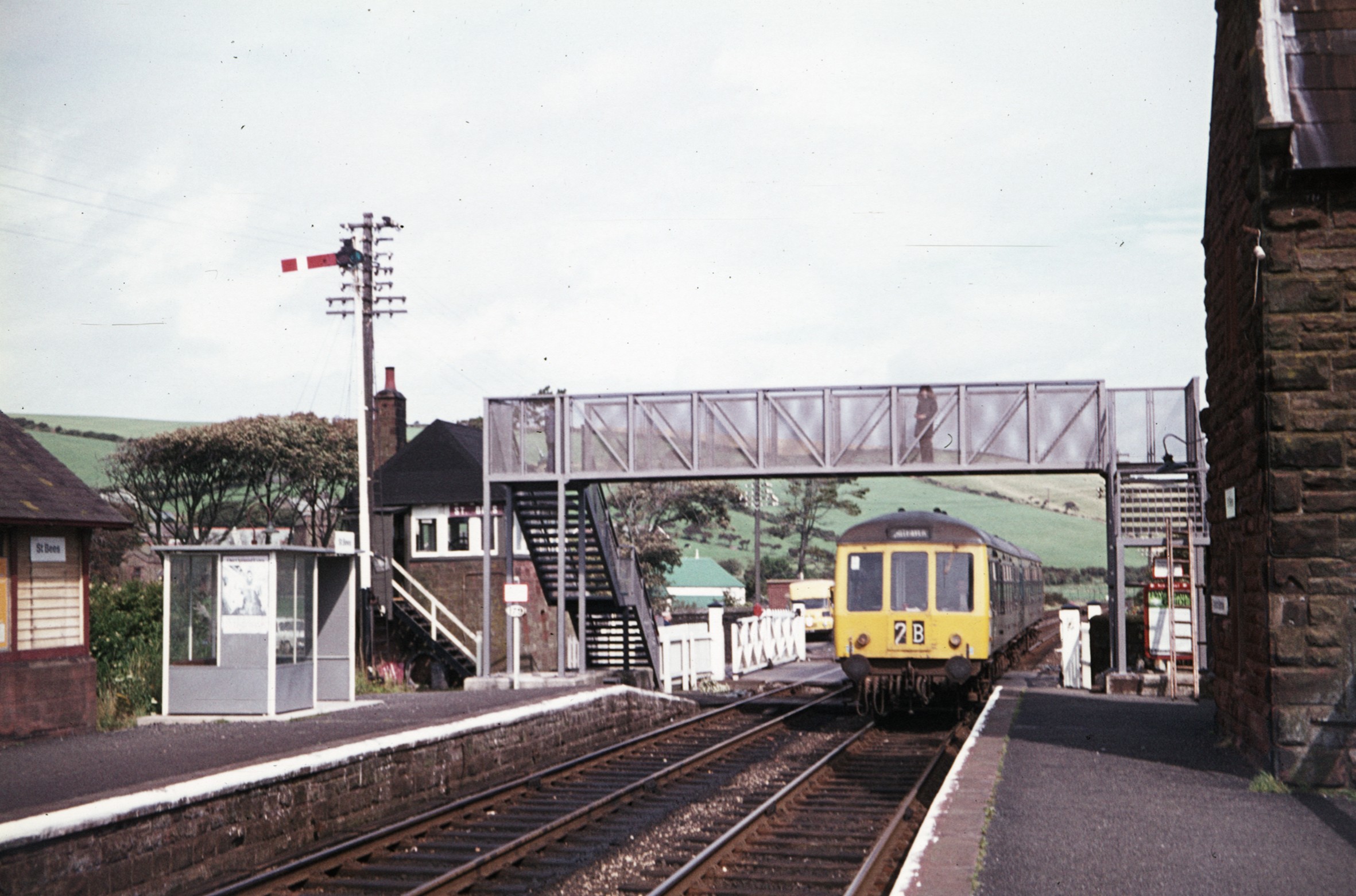
Is it just some quirk of the alphabet that two lines most at risk are the ‘Cambrian’ and the ‘Cumbrian’?  I’ve stayed near both.  I recall a family holiday in Barmouth, where the Cambrian line literally passed within inches of the hotel lounge window before crossing the road on an overbridge.  Both hotel and railway were built up the side of the hill.  A later holiday took me to St Bees in 1974, and here is a photograph of the station, with train arriving.  An interesting mixture of period details here – the new footbridge and ‘bus shelter’ contrast with the semaphore signal.

b8

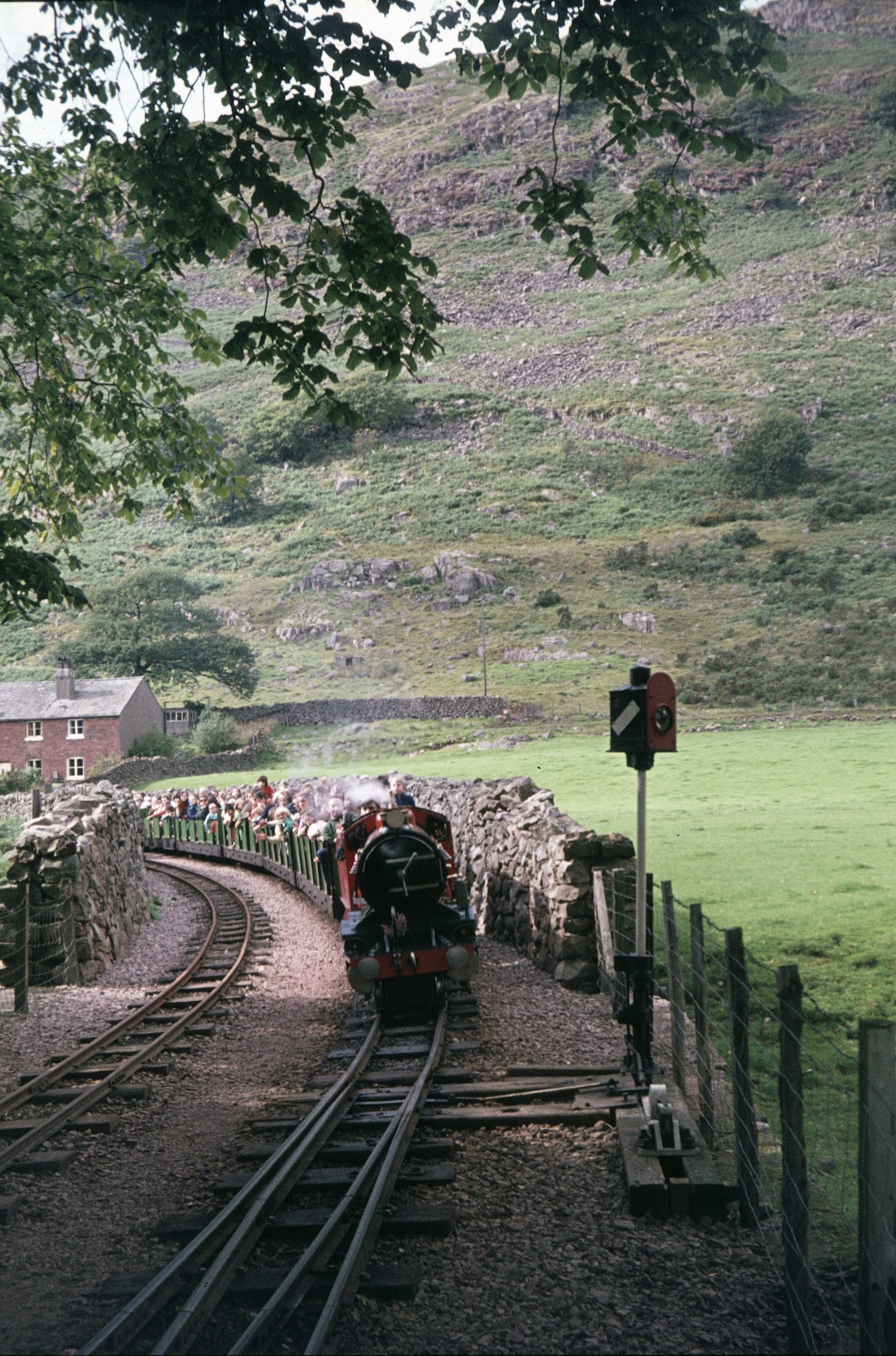
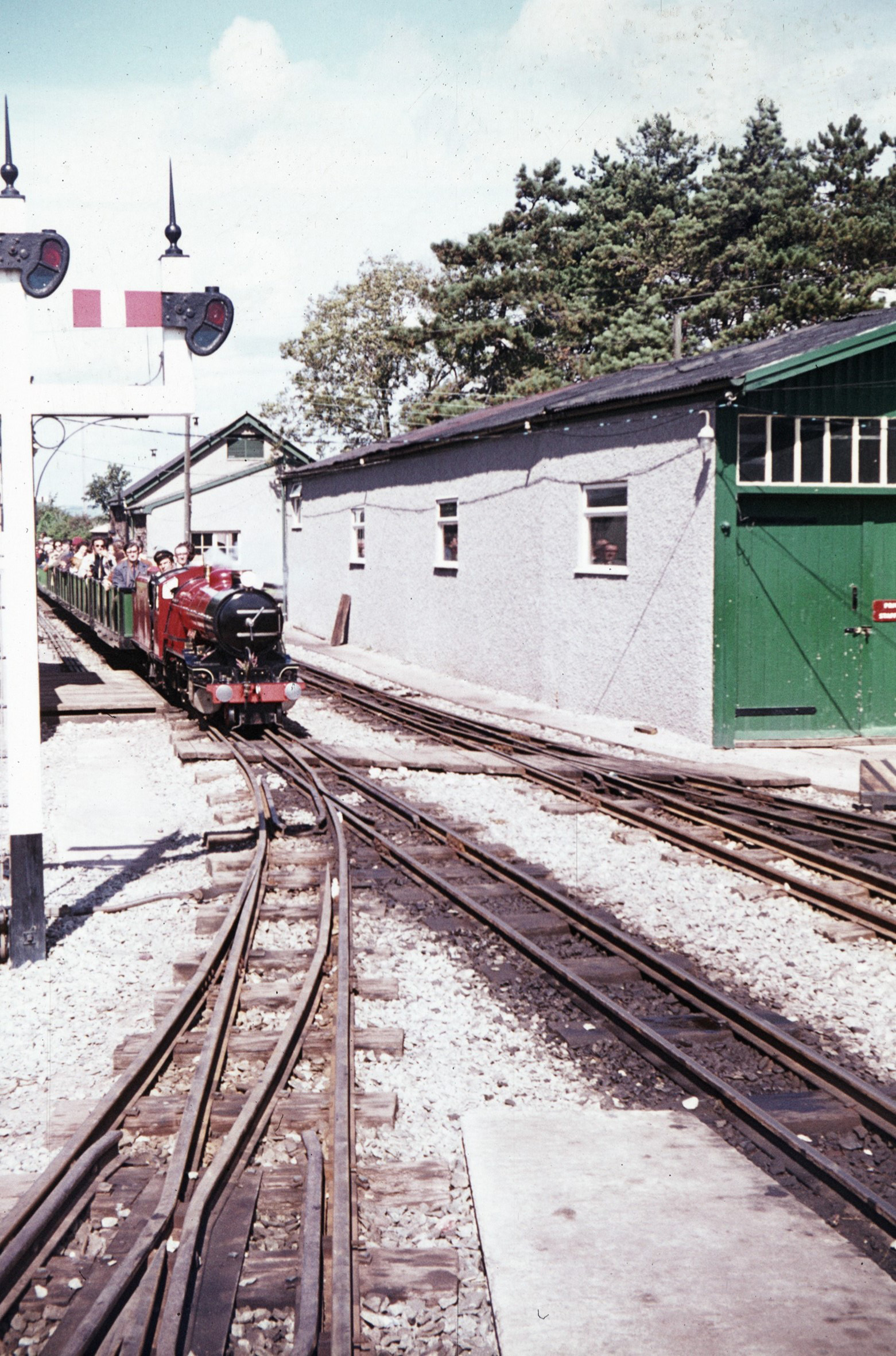
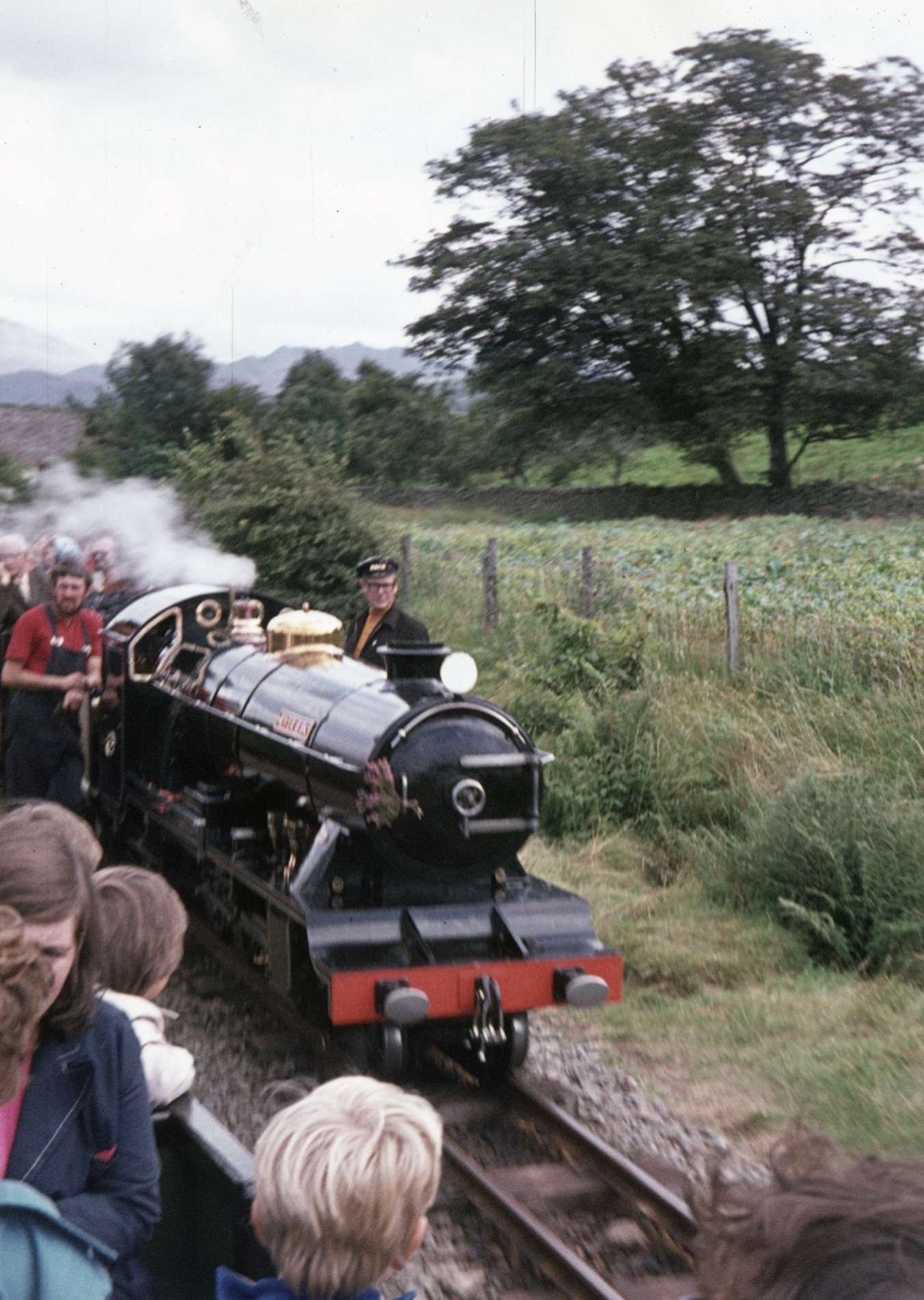
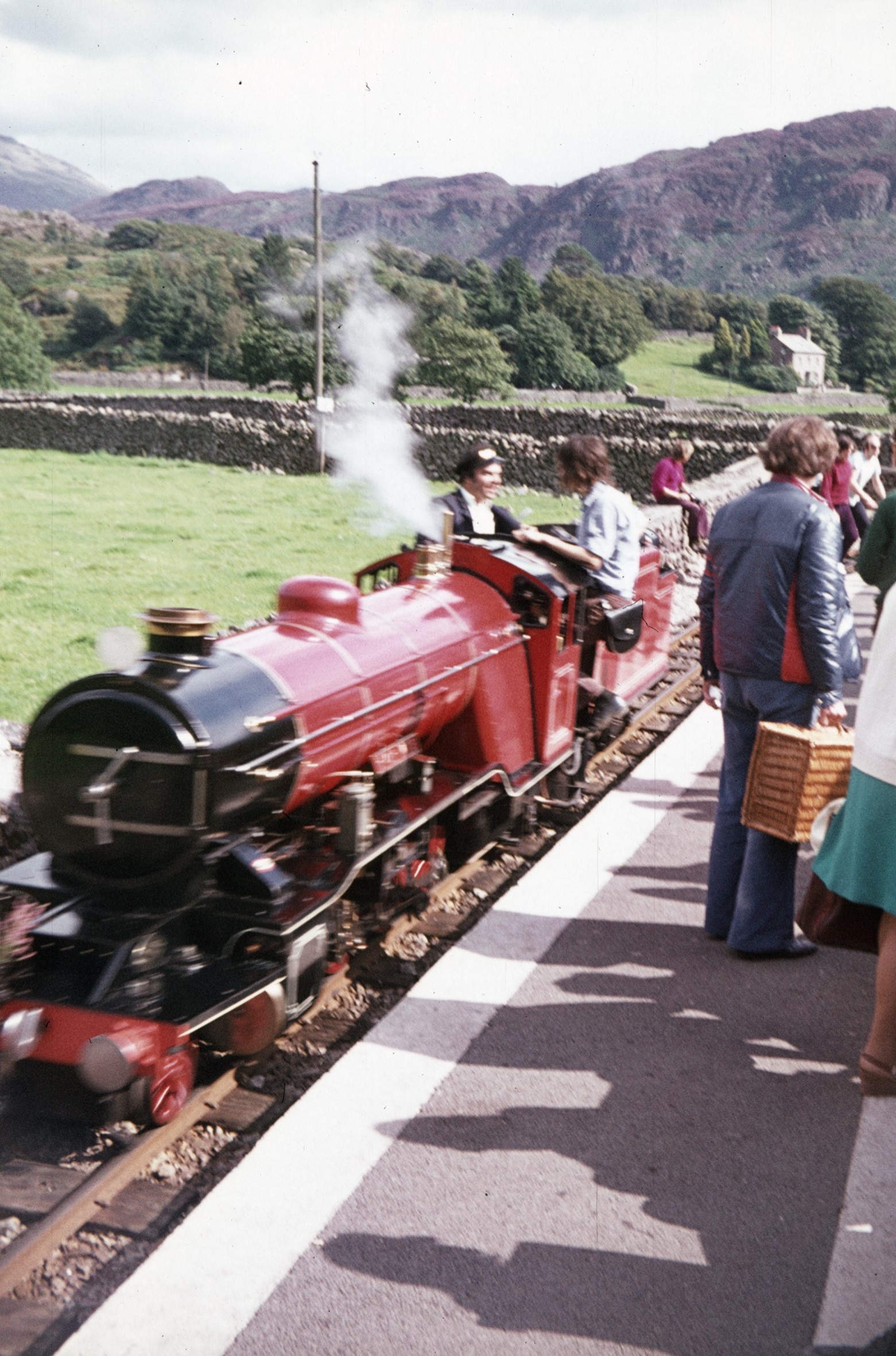
The Ravensglass and Eskdale miniature railway was nearby, and I paid it a visit that day.  This line is also at risk from the sea – providing climate change and sea level change goes to plan.  Here are my photos of the day….

b10 b9 b7 b11

Posted in ESNG, Inspiration, Out and about, Prototype | Tagged , , | Leave a comment

Is this Google’s fault?

It continues to amaze me that one of the most read posts over the last 18 months is a little item called, “Jon’s Modules – Peco lash up”.  I don’t know what people expected to read??

And I pre-dated ’50 Shades of Gray’ by a year or so!

peco lash up

Posted in Inspiration, Jon's layout ramblings, Layout design, Weird and wonderful | Tagged , , , | Leave a comment

Signal problems at Redhill

The Sorry Error, whoops, Surrey Mirror reported yesterday that….

Signalling problems causing delays of up 30 minutes for Redhill commuters

COMMUTERS are facing delays of up to 30 minutes this morning due to signalling problems around Redhill railway station.

Southern Rail tweeted to say: “Signalling problems in the Redhill area are creating delays of up to 30 mins, with short notice cancellations & alterations”.

And a statement on the company’s website says that vandalism over the weekend has disabled thirty of its carriages, which has added to the cancellations.

I was trying to get to Kew Bridge via Clapham Junction on Monday morning, and was caught up in the above delays.  If I hadn’t been trying to get somewhere, the half hour spent on Redhill station would have been most interesting.

First, the First Great Western DMU from Reading (through Reigate) came in.  Instead of the driver immediately walking from one end of the train to the other to reverse direction down to Gatwick, he took the train into the headshunt at the north of the station.  A platform announcement said that the next train to Gatwick would be in about 15 minutes time.

Next a Southern EMU came down from London, bound for Reigate (the end of electrification, just two miles from Redhill.)  Instead of stopping at platform 3 and taking the double junction onto the Reigate branch, the train crossed over onto the up line just north of the station, and did a little wrong-road running to enter platform 2.  Obviously, the signal failure had taken out platform 3.  After a few minutes, it left for Reigate.

Another EMU came up from the south and Horsham, headed for East Croydon and on to London Bridge.  It stopped in platform 1.  I was hoping for the advertised Victoria train, but the announcer suggested changing at East Croydon, so I joined this train.

No doubt, after I had left, the DMU would have pulled back into platform 1 or 2 and headed south for Gatwick.

And all this gave an idea for operating a model station.  How about ‘modelling’ a signal failure?  Like Redhill yesterday, assume one running line and platform is non-operational, so you have to keep the timetable moving, as much as possible, on the available track with some careful planning of moves and a little wrong-road running.  This would work better with the American operating techniques, with a dispatcher, than with our usually timetable based operations, but I’m sure it could work.

If a signal failure isn’t obvious enough at an exhibition, perhaps a broken down train or a minor derailment could provide a more obvious reason for the games on the other line?

As for my day, I got to East Croydon and then changed trains to get to Clapham and on to Kew.  Once on a train, there were a number of seats marked off by black and yellow tape.  No doubt more, if less serious, vandalism.  Fortunately, coming home was easy, if crowded, with everything absolutely on time.


Posted in ESNG, Inspiration, Out and about, Prototype | Tagged , , | 1 Comment

‘OO’ Coaches – Jon’s old trains #3

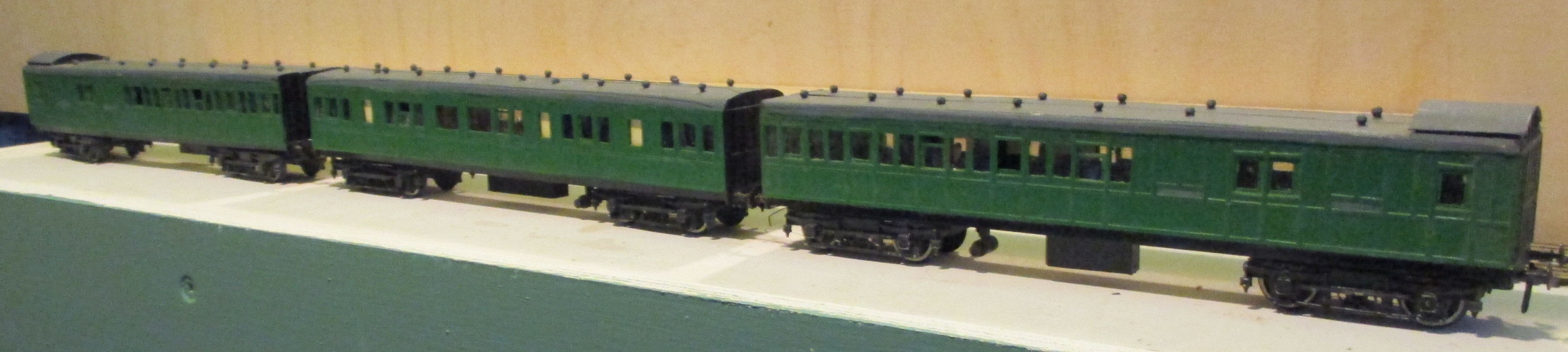
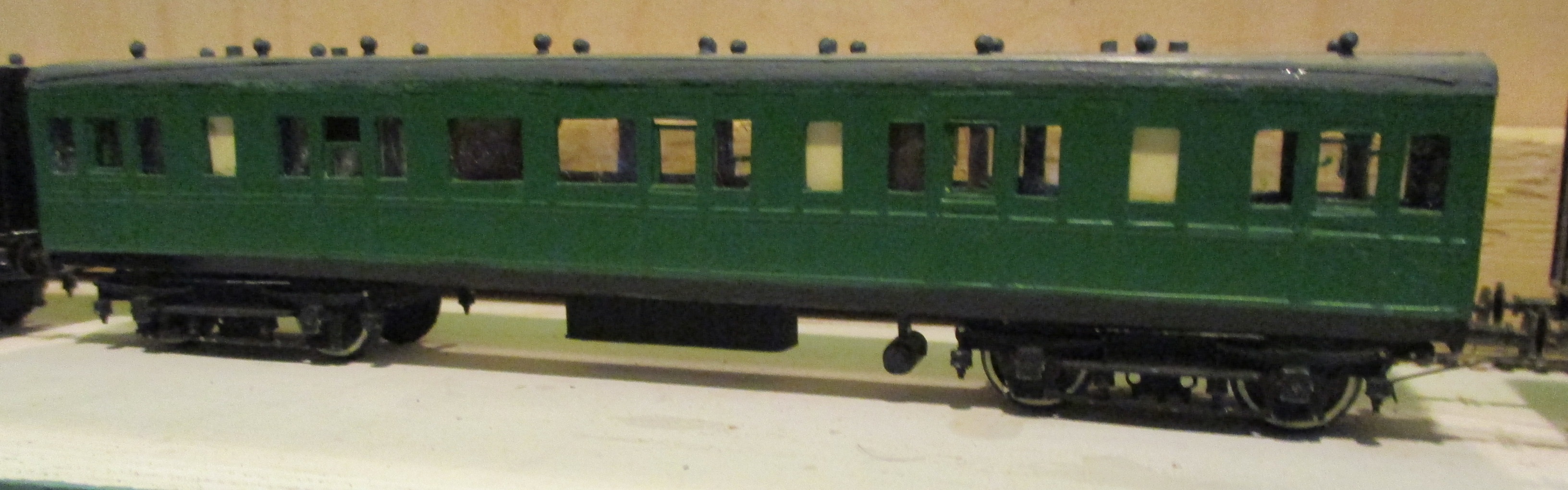
From Irish narrow gauge to Southern coaches.  Here are a few of my early efforts.  Some of my first successful scratch built models were this SECR ‘Birdcage’ rake.  They never got lettered or lined, but weren’t bad at all.  Note the open drop-lights in places.  I could have done with a bit more detail on the underframes, and some of the beading is a bit rough.  Not quite as good as the Farish ‘N’ gauge versions will be, I’m sure, but a whole lot cheaper and a lot of fun to make.

s_1 s_2

Next a BSL Maunsell brake coach.  This was from a BSL kit (later Phoenix), with aluminium sides and cast ends, and a plastic roof.  This made up into a very nice model, that I am going to keep.  I was very proud (and probably still am) of the window frames in brown, masked on the body and added after the green base was painted on.  Not as much lining as the new Dapol version, but, hey, who’s worried, as I did it!

Next to it is an LSWR restaurant care, used on Southampton Boat Trains, I think.  Not appropriate for our little branch line, but I fancied building it.  It was all put together from Plastikard, and still looks OK, but I think didn’t come out as well as my Birdcages.

s_3

And finally two parcels vans.  The right hand one comes from the LCDR and is homebuilt from Plastikard.  I think I built this as there were not many windows to cut out, and it had a simple arc roof profile.  The left hand on is a ‘K’s kit of a GWR 40’ brake, and was one of the first plastic coach kits on the market.

s_4

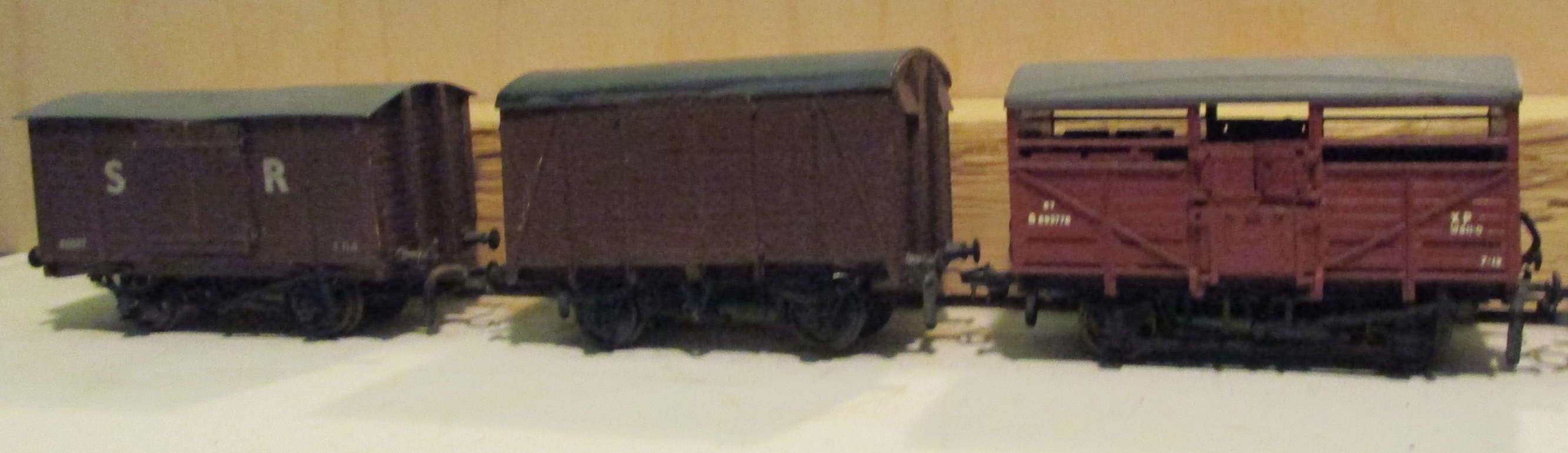
And as a PS, here are some wagons.  A ‘Kenline’ printed card kit of an LBSCR van, an early Ratio plastic kit of the characteristic unequal planked Southern Railway van, and an Airfix BR cattle wagon.  These early Airfix kits look very good, even by today’s standards.

The second row is four Peco ‘Wonderful Wagons’.  Very innovative kits for their time, with a cast body for weight, plastic (nylon) underframes giving very free running, and an embossed cardboard body to stick over the cast on.  The end result lacked a little relief on the strapping, but was effective and a good way to add some colourful private owner wagons to your goods train.

s_5 s_6


Posted in Inspiration, Jon's layout ramblings, Weird and wonderful | Tagged , , | Leave a comment