A question of gauge

In March 1995, ‘Back Track’ had an interesting article on the gauge of railways, with particular reference to the GWR broad gauge and the 4′ 8.5″ ‘narrow’ gauge.  Railway history is often thought of as a battle between these gauges, between Brunel’s masterpiece and the width of a Roman horse’s rear and its attached chariot.

But this does not seem to be the case:

In the totality of the applications of railways to transport both in the UK and the rest of the world, the variations in railway gauge are remarkable.

In 1983 the Industrial Railway Society published a list of National Coal Board underground flameproof locomotives that had operated since nationalisation on 1st January 1948.  In that short period of approximately 35 years, such locomotives had been supplied by outside industry to 30 different gauges, at every inch increment between 1′ 6″ and 3′ plus 3′ 6″ and many 1/2″ increments…..

The author goes on to examine how units of measure dictated gauge.  I was unaware of units such as the Castillian foot (6′ = 1672mm) and Swedish feet (4′ = 1188mm).  Britain could have used metric gauges, but it was anathema to the British government because of its revolutionary (and French) origins.

And to support the fact that there was no ‘standard’ gauge in the early years of the railways, here is a list of some gauges used – although the total mileage shown here is probably only a few hundred miles.

  • Date     Railway                                    Gauge
  • 1826     Redruth & Chasewater         4′ 0″
  • 1832     Saundersfoot                           4′ 0″
  • 1831     Garnkirk & Glasgow             4′ 6″
  • 1826     Gonkland & Kirkintilloch    4′ 6″
  • 1825     Stockton & Darlington         4′ 8″
  • 1830     Canterbury & Whitstable    4′ 8″
  • 1830     Liverpool & Manchester      4′ 8.5″
  • 1832     Leicester & Swannington    4′ 8.5″
  • 1840     London & Blackwall             5′ 0″
  • 1839     Eastern Counties                   5′ 0″
  • 1838     Arbroath & Forfar                5′ 6″
  • 1839     Ulster (Ireland)                     6′ 2″
  • 1838     Great Western                       7′ 0″
  • 1841     Bristol & Exeter                     7′ 0″

This list puts some perspective on us modeller’s arguments over HO, OO, EM and P4.  The above list has them all…..

Technically, the broad gauge was superior to the standard gauge adopted in 1846.  And Brunel would have probably won the battle if he had expanded the network northwards, rather than consolidating the railways in the south-west.

America was no better:

… in the United States it was a case of anything goes for many years in spite of the fact that the Stephenson gauge had been introduced very early on.  Most of the railways in the south-eastern states were built to the 5′ or Carolina gauge, resulting in major problems in the Civil War.  The Erie Railroad was built to a gauge of 6′ and possessed some splendid locomotives built to take full advantage of it. [See here] Over 3,000 miles were built to 4′ 10″ and there was a compromise of 4′ 9.25″ in some places to allow both 4′ 10″ and 4′ 8.5″ to use the same tracks.  Wider wheels were used, but derailments were common. When the Niagara Bridge was opened in 1855, it could accommodate trains of three gauges: 6′, 5′ 6″ (running in from Canada) and 4′ 8.5″.

And in Europe there were inexplicable variations:

France for example used 1.45m (The Est, PLM and Midi), 1.44m (the Nord, PO and Etat) as well as some 1.435m.  Rationalisation to the latter has been relatively recent.

And if history had turned out different, and very much for the worse, Brunel’s lines would have been distinctly ‘narrow’ gauge:

The most bizarre railway project of this century was Hitler’s Breitspurbahn, a broad gauge railway of colossal proportions.  The gauge was to be 3 metres and that would achieve speeds of 250km/hr.  Monstrous locomotives of 30,000hp were planned, weighing over 1,000 tons each.

That would be some model!  2mm scale on S4 track would be about right????
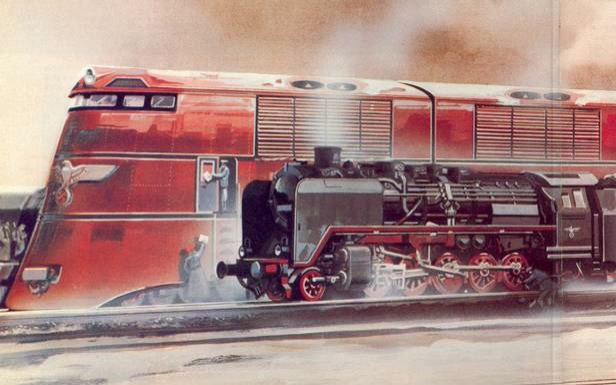
breitspurbahn1-305302-02df857082

Posted in Out and about, Prototype, Weird and wonderful | Tagged , , | Leave a comment

What’s in a name?

A good article from the BBC, exploring how ten London Underground stations got their peculiar names:

How tube stations got their unusual names

Scan a map of the London Underground for the first time, and you’ll likely notice that it is more than the ground-breaking design that seems imaginative. The names of the stations, too, can seem curiously, even bizarrely, whimsical. Some seem suited better to a medieval fantasy (Knightsbridge, Queensway) or a children’s book (Piccadilly Circus, Elephant & Castle) – and others still make Londoners giggle (Shepherd’s Bush, Cockfosters).

But these names weren’t chosen simply to give city-dwellers an alternate world to imagine as they hurtle beneath the capital. Some of their origins, in fact, date back millennia.

In summary, the stations are:

Covent Garden: The name for this Tube station would be almost self-explanatory – if it weren’t for the ‘n’ that went walkabout at some point since the Middle Ages. By the 13th Century, the site was a walled-off area of orchards and gardens which belonged to the monks of Westminster Abbey. They referred to it as “the garden of the Abbey and Convent” and then, of course, as “Convent Garden”.

Elephant & Castle: This one in south London, oddly enough, most likely comes from the Worshipful Company of Cutlers – a medieval guild of craftsmen who made swords and knives. Granted in 1622, their crest included an elephant… carrying a castle.  (But I’d always thought it was named after a Cockney corruption of ‘Infanta Castille’ a venerable Spanish princess from somewhere in English history.)

Cockfosters: Cockfosters was once the location of Enfield Chase, a royal park home to nearly 8,000 acres and 3,000 deer – as well as to foresters, who protected the park from would-be poachers or woodcutters. The word for the chief forester? Cock forester.

Tooting Bec: The name goes back more than 1,300 years.  Tooting is Saxon in origin, and first recorded in the 7th Century, as belonged to Tota or his friends.  The Bec comes from Bec comes from Bec abbey, in Normandy, who grabbed the land after the 1066 invasion.

Knightsbridge: The word ‘bridge’ comes from Old English ‘brycġ’, of the same meaning. Here, it refers to a crossing over the West Bourne River – one of the ‘lost rivers’ of London, which was re-routed through an underground sewer in the 19th Century. A ‘knight’, on the other hand, meant a boy or young man, particularly one in someone’s employment.

Maida Vale: The dip in land is indeed a ‘vale’. But Maida was a town in Calabria, Italy that became famous when the English crushed Napoleon’s allies in an 1806 battle.  A pub called the Hero of Maida, named in honour of the battle, has vanished, but not before lending its name to the street.

Aldgate: Around 190, when London was Londinium, the Romans walled the city; they also built six gates, including one here. Versions of these gates (and of the wall) existed into the 1700s. This one was known as Aldgate.  Why ‘Ald’ – that’s more difficult.

Piccadilly Circus: The alternate meaning of ‘circus’ refers to a round junction where several streets meet. The other half of its name, is from ‘piccadill’ a large, ruffled collar that was the height of fashion in the late 16th and early 17th Centuries.

Queensway: Of course, named after Queen Victoria. But Queensway has an especially sweet story: named in her honour soon after she ascended to the throne, the road was where she rode horses as a child growing up in nearby Kensington Palace.

Shepherd’s Bush: Once a rural byway, a ‘shepherd’s bush’ referred to the shelter that a shepherd would make by pruning a hawthorn bush.

Read the full article here.

It does mean you can call the stations on your layout absolutely anything, and still be prototypical.  I’ve always rather liked ‘Queen Camel’, a village just off the A303.  Wikipedia tells me that:

The name “Camel” derives not from the animal but from “cantmael”, the name of the place in the 10th century. “Cantmael” possibly derives from the Celtic words canto “district” and mael “bare hill”.  The “Queen” in the village’s name is probably Queen Eleanor, the wife of Henry III, who owned land in the area in the 13th century.

Now I know – I wondered every time we drive past the signpost!

Posted in Uncategorized | Leave a comment

Shunting ad infinitum

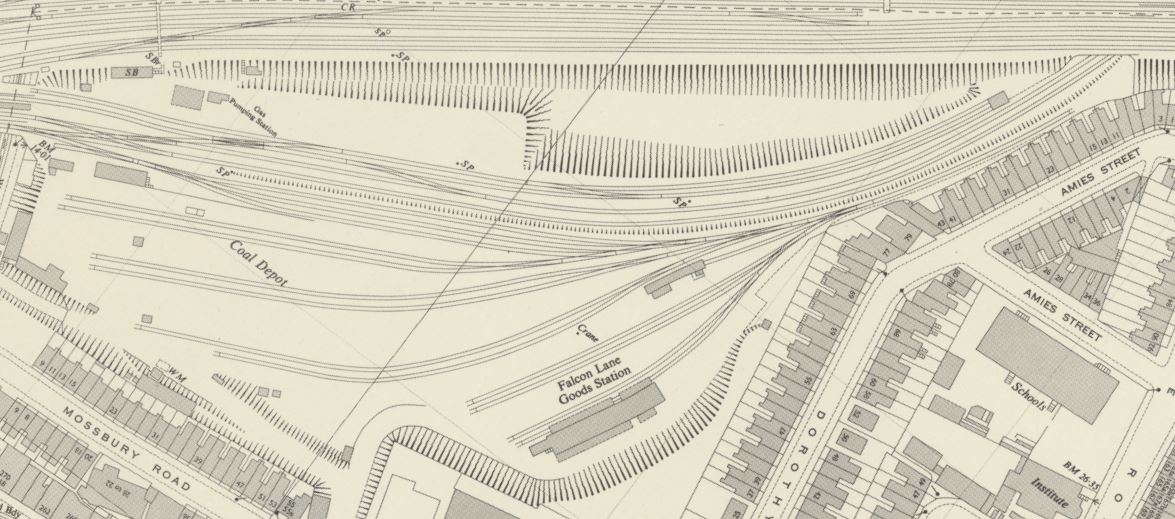
You may recall that I found this plan of a small urban goods yard in Brighton, and commented on its suitability for a model. (All maps from the National Library of Scotland site, under creative commons.)

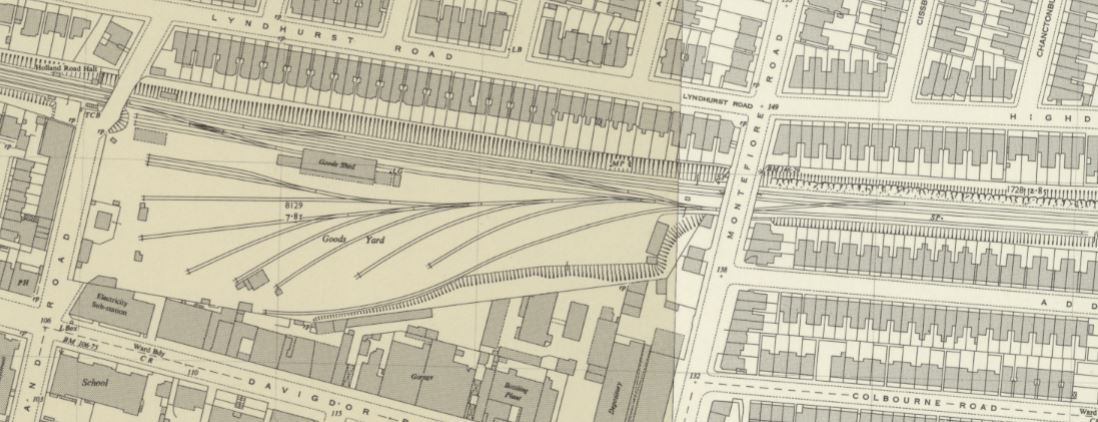
Wandering around south London, I have come across a good number of other small yards.  My interest started as I noticed the number of north London railway companies – such as the Midland or LNWR – with coal yards south of the river.  Coal trains from the mining areas of the midlands and north were run south of the river to provide domestic and industrial coal – and smog.

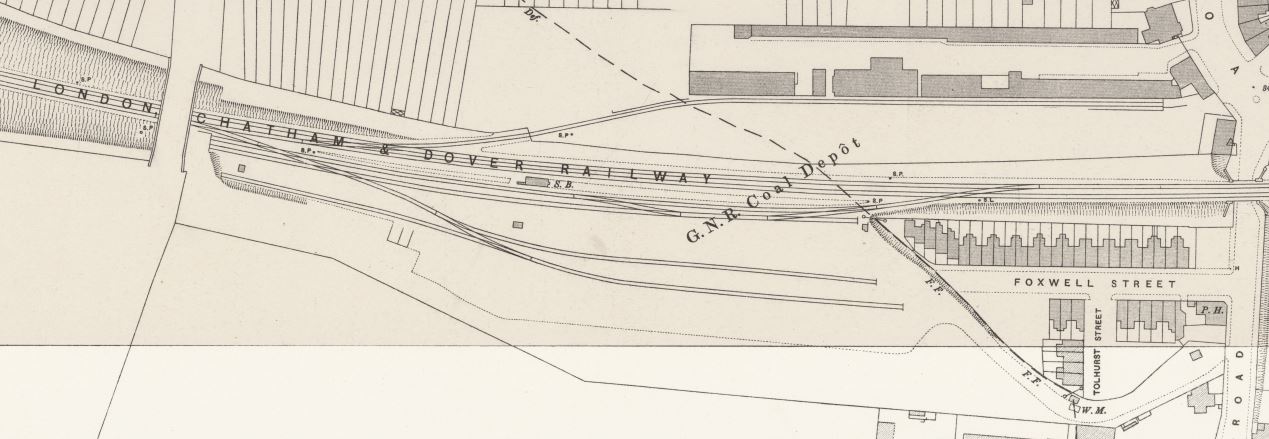
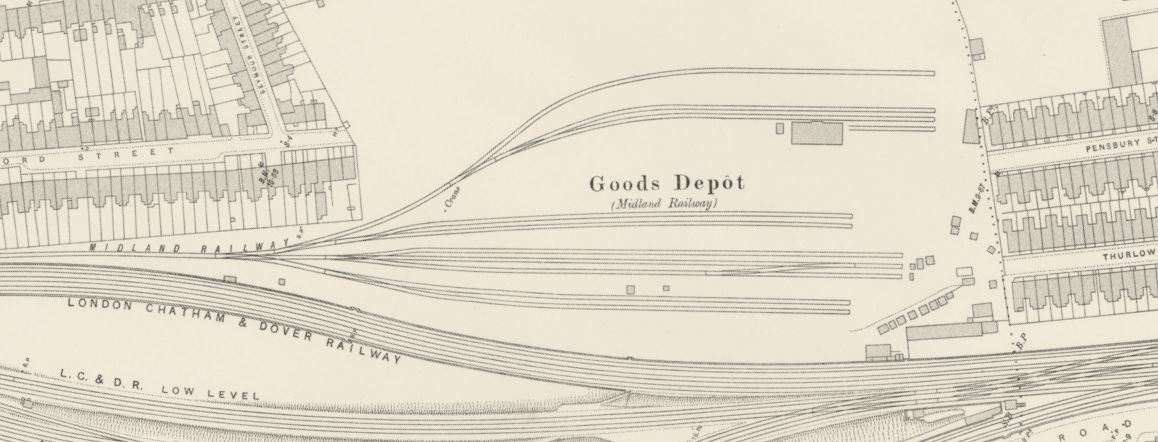
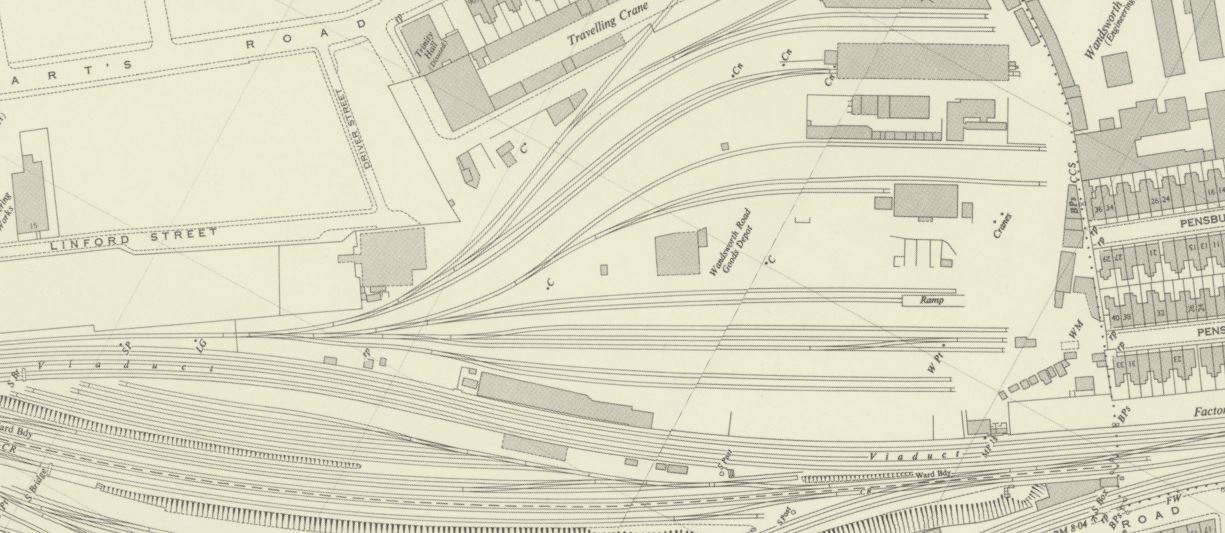
I’ve presented a number of these yard below, mostly both as they were in 1900 and in 1950.  I think they provide some interesting yard layouts, though modelling them purely as a coal depot may lack a little operating interest, despite the interesting private owner wagons that could be modelled.

We’ll start with Knight’s Hill, not far from Crystal Palace.  This appears to belong to the London & North Western Railway.  It would make an interesting model, with the tunnel and steep slopes down to the road bridges.  The yard could be straightened up a bit to make the scene a little narrower.

The growth of suburbia is obvious in the second plan – but both would make good models.

Nearby at Nunhead was the Great Northern Railway coal depot.  A far simpler design, but including some complex pointwork.

Moving in towards central London, Wandsworth was home to the Midland Railway.  It was already largely urban in 1900.  It is interesting to see how the yard has grown by 1950, and the war damaged streets to the west.

The Midland Railway depot in Brixton was very compact, using wagon turntables, but had all but disappeared by 1950.

And finally the LNWR depot at Clapham, on the end of the West London Extension Railway.  The multiple main lines into Waterloo are to the north of the depot, and Clapham Junction is just to the west.  Everyone seems to have a yard around Clapham – there was even a Great Western Railway broad-gauge yard prior to 1900.

I might try and find some yards further afield – there are some amazing places in East London, but hopefully those above will provoke the designer’s juices!

Posted in Hints and tips, Inspiration, Layout design, Out and about | Tagged , , | 4 Comments

Commuter spots seven nuns at Seven Sisters

Something special from the Daily Telegraph….

A commuter was astonished when he saw seven nuns waiting for a train at Seven Sisters Tube station in London.

The entertaining coincidence appeared not to have been noticed by the nuns as they sat and chatted in a group.

Ben Patey, 33, said: “I had just had a long day and I was waiting to jump on the train when I looked across and saw the nuns and the sign. “I had to do a double-take. It was one of those strange but amusing moments.”

Seven Sisters is believed to take its name from a group of seven elm trees that were planted around a willow tree in the 14th century.

Can anyone suggest any alternative cameos for your layout?  (Not too rude, please…..)

Posted in Inspiration, Out and about, Prototype, Weird and wonderful | Tagged , , , | Leave a comment

Book review – Creating cameo layouts’

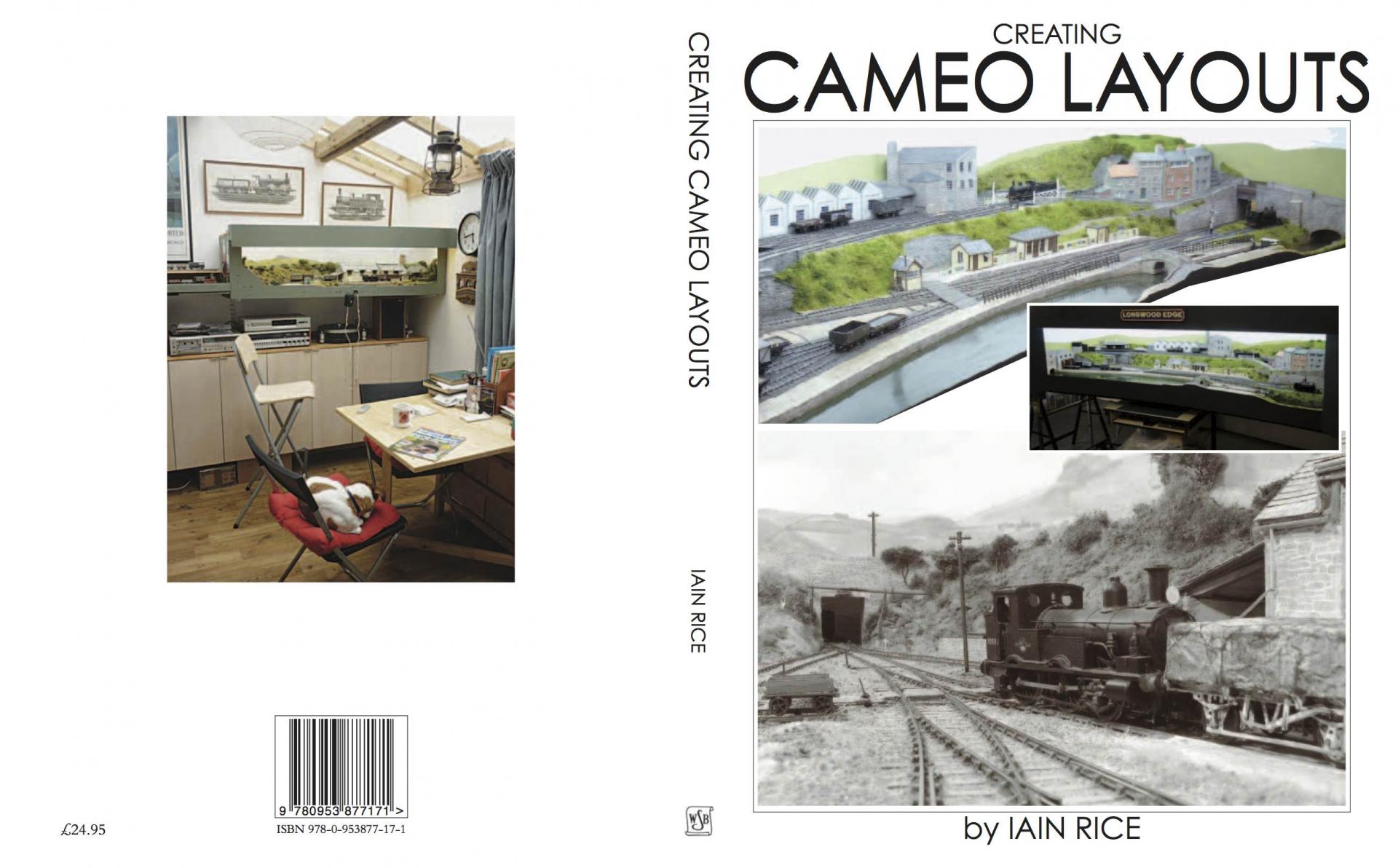
We all get older.  Even Iain Rice gets older.  That young whipper-snapper with radical ideas on P4 modelling and on layout design is now an elder statesman of the hobby.  Fortunately he writes in just the same style as he ever did – and this makes his books a joy to read even about the more boring bits of modelling – but perhaps with a modicum more experience.  His latest book explores the world of cameo layouts.

You may first note the price – a significant £24.95.  It seems expensive, but all books are these days.  And it is still less than a new Farish coach, and probably a lot more useful.

And what is a ‘Cameo Layout’?  The author says that:

It is this sense of something that encapsulates a subject concisely and within a complementary setting that I seek to apply the term ‘cameo’ to a model railway.  That is, a representation which conveys the nature and character of a prototype in a small space while being executed to a high standard, the modelling being set off by a visually pleasing presentation.  To which aesthetic criteria I have added the  practical ones that the whole thing should be structurally and functionally self-contained, easy to move and store, and readily adaptable to different circumstances.

Perhaps we might define it as a small layout, perhaps up to 8′ in length, of a small piece of prototype railway.  This may well be a branch line terminus, or a light railway, but could equally be industrial, urban, or part of a goods yard or loco depot.  It will probably be foldable and easily transported to shows.  And it may well be operated from the front, have an integral backscene and ‘proscenium arch’ to frame the layout, and an integral fiddle yard and electrics.

The covers of the book illustrate the idea from Rice’s own layouts – front and back cover show Trerice, ‘P4′ china clay in 6’ plus a fiddle yard.  And the front cover has the two level LNWR and L&YR urban layout ‘ Longwood Edge’.  Here’s a short video of Trerice.

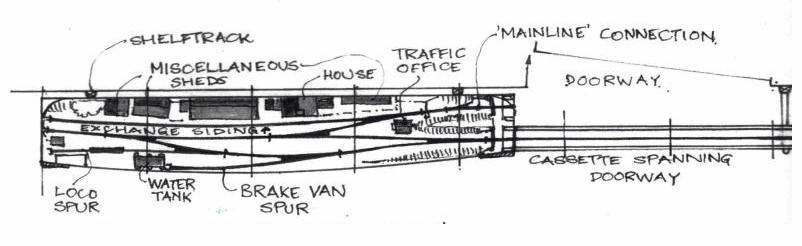
And this is a typical Rice small layout – originally as a three level, ‘stacked’ design where you used the cassette to move from one level, and station, to another.  But it would make an interesting small goods exchange station in its own right.

The book is full of good advice and techniques for design, baseboards, through to couplings and operation.  Indeed, the section on couplings is most worthwhile, although it is aimed at 4mm scale, as it carefully compares a range of different couplers.

At the end of the book, there are a number of worked examples of ‘cameo’ layouts.  All of interest, though my one criticism of the book is that these examples only includes one ‘urban’ one, and none from East London, where I feel some of Rice’s best designs originate.

Again, another recommended purchase to add to your armchair modelling books.


This blog (and the next few) come from Singapore.  I’m lucky enough to be here for 10 days – though I will be working for the weekdays and trying to finish other projects over the weekend.  No chance of trainspotting, though….

Posted in Hints and tips, Inspiration, Layout design, The trade | Tagged , , , | 2 Comments

Crisis – what crisis?

The September 1982 copy of ‘Modern Railways’ has the cover sub-title of “British Rail in crisis.”  This seems to be mainly due to a prolonged strike by the ASLEF drivers.  It seems to have been due to a proposal to take guards off freight trains.  Some things are truly timeless…..

An article, “ASLEF Dispute Diary” says:

In a statement accompanying its strike call ASLEF repeated that the purpose of the strike was to retain the guaranteed 8 hour day and to resist the worsening of conditions of its members.  Referring to calling-off the separate strike by the National Union of Railwaymen the previous day – in terms of a concurrent World Cup football metaphor – a member of the ASLEF Executive said: ‘Now Sir Peter Parker is playing against Brazil instead of Kuwait.’

Or should it be Iceland?  In Germany, there is no union action, but a….

War on draughts  Some travellers in DB’s air-conditioned coaches still complain of draughts and are surprised that there is no simple remedy like shutting a window or ventilator.  The DB research laboratories in Minden are therefore undertaking a detailed study of air movement in compartment and open vehicles, in motion and at rest…..

I had to read it to see why DB were banning board games.  A column by Alan Williams is rather provocative….

Britain’s railways are in a mess, that much few people would deny.  And depending where you sit it is fashionable to blame either the Luddite lefty unions or the wicked, capitalist pro-free-enterprise (ie: pro-road) Government.  Certainly neither side is exactly blameless; Ray Buckton’s antics over flexible rostering have been more than matched by the Transport Secretary’s vacillations, known in Whitehall as flexible posturing.  But what sort of management gets itself into eyeball-to-eyeball confrontation in the first place?  Bad management, that’s what….

It was interesting, but rather depressing, to see BR management in action – or perhaps inaction – during what the media love to call the ‘rail crisis’ – strikes now being rather passe, simplistic confrontations over such minor things as pay.  On such bits of British Rail I confronted during the crisis, the action was decidedly patchy.  At some stations, staff were clearly busy scrubbing, cleaning and planting flowers to such effect that one wondered vaguely if some phantom Royal Train was about to appear.  But at far too many the platforms were deserted and the staff, though presumably still being paid, appeared to have retired permanently to the local hostelry, leaving the station entirely unmanned…..

These days it seems a lost art to write a piece that doesn’t take sides, and has a go at absolutely everyone.  Our journalists should remember that rarely is one side alone to blame.  Elsewhere in this edition, there’s an article that looks rather optimistic in hindsight:

The electrification of Paddington’s suburban services

The British Railways Board’s Corporate Plan of 1980 sanguinely envisaged completion of a Paddington suburban electrification scheme to Didcot and Oxford by 1987, at a cost of £32 million.  But that date had gone by the board long before the Associated Society of Locomotive Engineers & Firemen put all electrification in jeopardy…

As in so many other areas of BR, therefore, the case for the Paddington suburban electrification is one of sheer need to renew worn-out assets in the most far-sighted way if the service is to survive much beyond the life of a Government which, uniquely in Europe, treats public transport as expendable…

Remember that the DTp has recently committed over four times the likely cost of Stage I [electrification] to the M40 [motorway] extension, chiefly to save road transport a quarter-of-an-hour on the West Midlands-Southampton haul.

34 years on, some work is being carried out, but we’re still waiting for the first electrified train.  And we still have strikes.  But there is positive change in other areas.  The privatized railways are a victim of their own success, carrying more passengers than ever before, often with relatively new rolling stock.  Perhaps it’s a case of the yokel’s instruction to the lost tourist: “If you want to get to there, I wouldn’t start from here.”

Still, other snippets put this firmly into the 1980’s….

“Baghdad Metro plans outlined”.  Yes it got built and is operating again.

“London Transport is to accept Visa and Access credit cards in payment for Underground season tickets and longer-period bus passes.  To avoid delays at ticket office counters the facility will apply only to postal and telephone purchases.”  Well, now there are no ticket offices.

“Vauxhall Motors has announced that is has not decided to renew its contracts to distribute cars by rail, and will rely exclusively on road transport instead.  An official statement denied that this reflected on BR’s record of reliability; the decision had more to do with the poor or non-existent rail access to the company’s plants.”

Posted in Out and about, Prototype, Weird and wonderful | Tagged , | 2 Comments

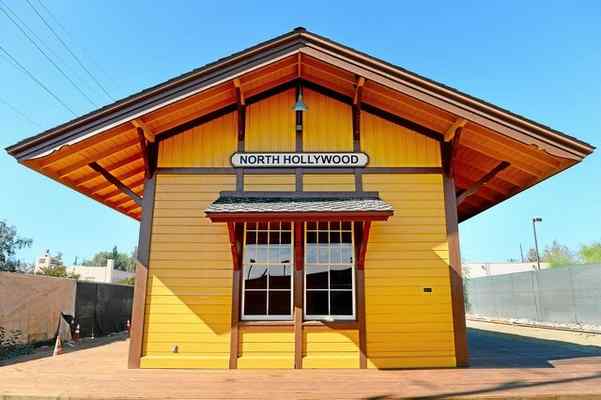
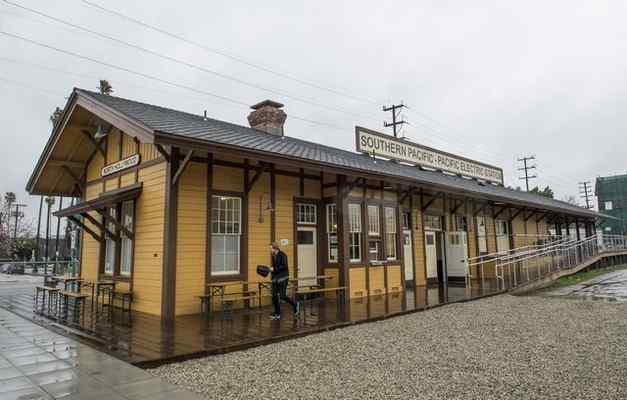
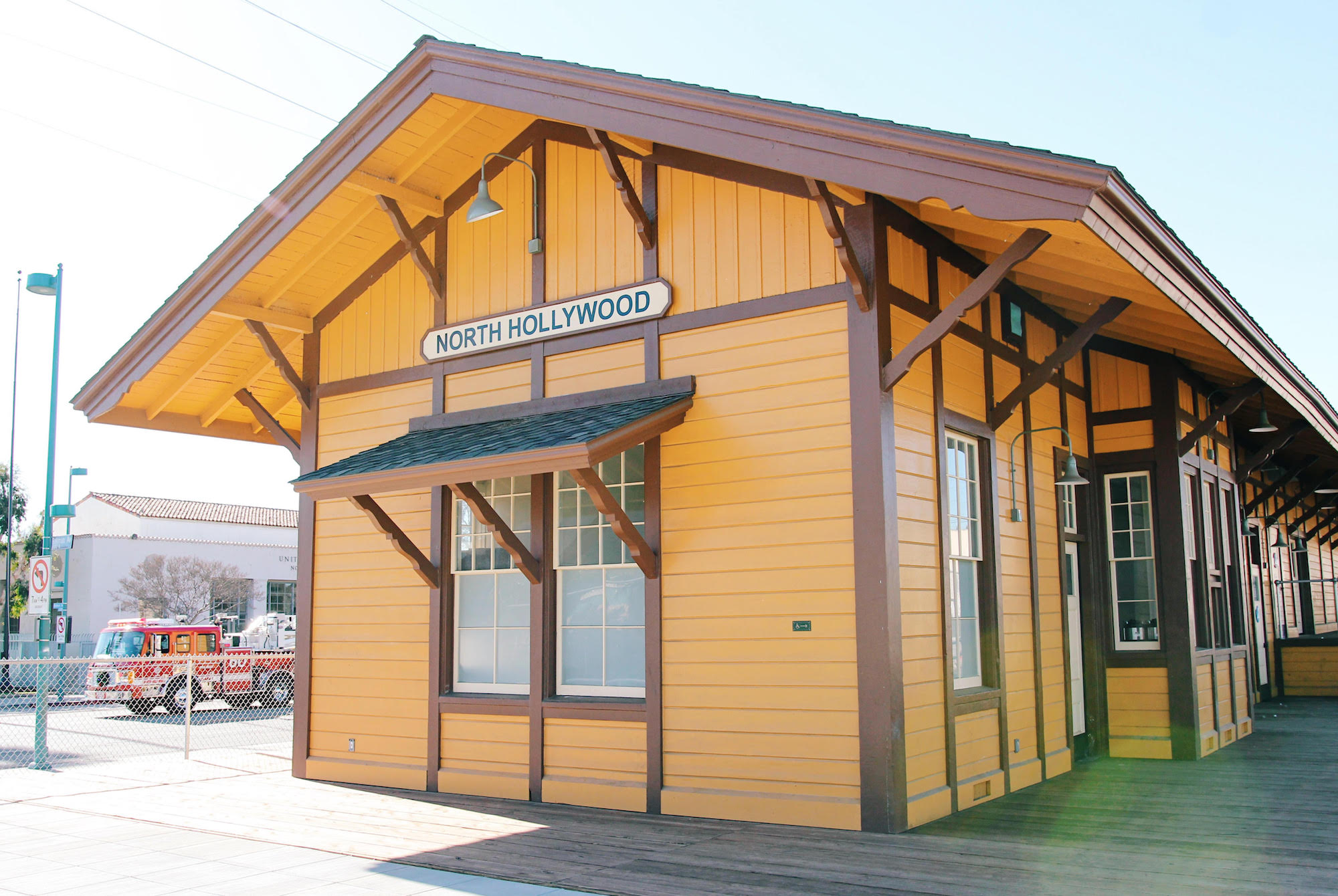
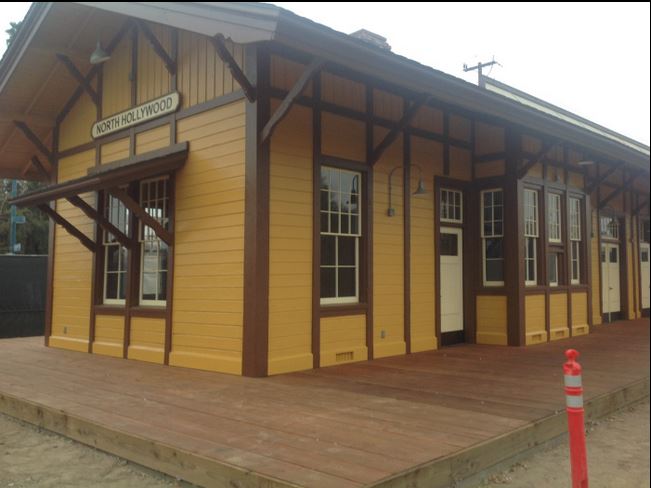
Off my trolley – North Hollywood yet again

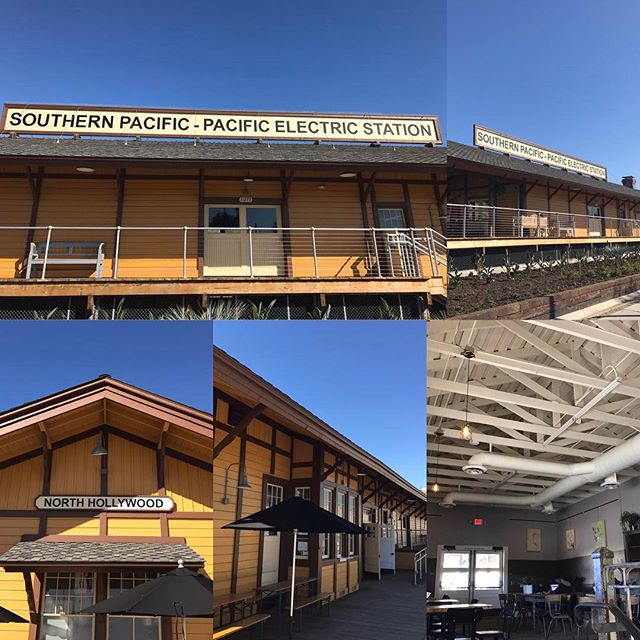
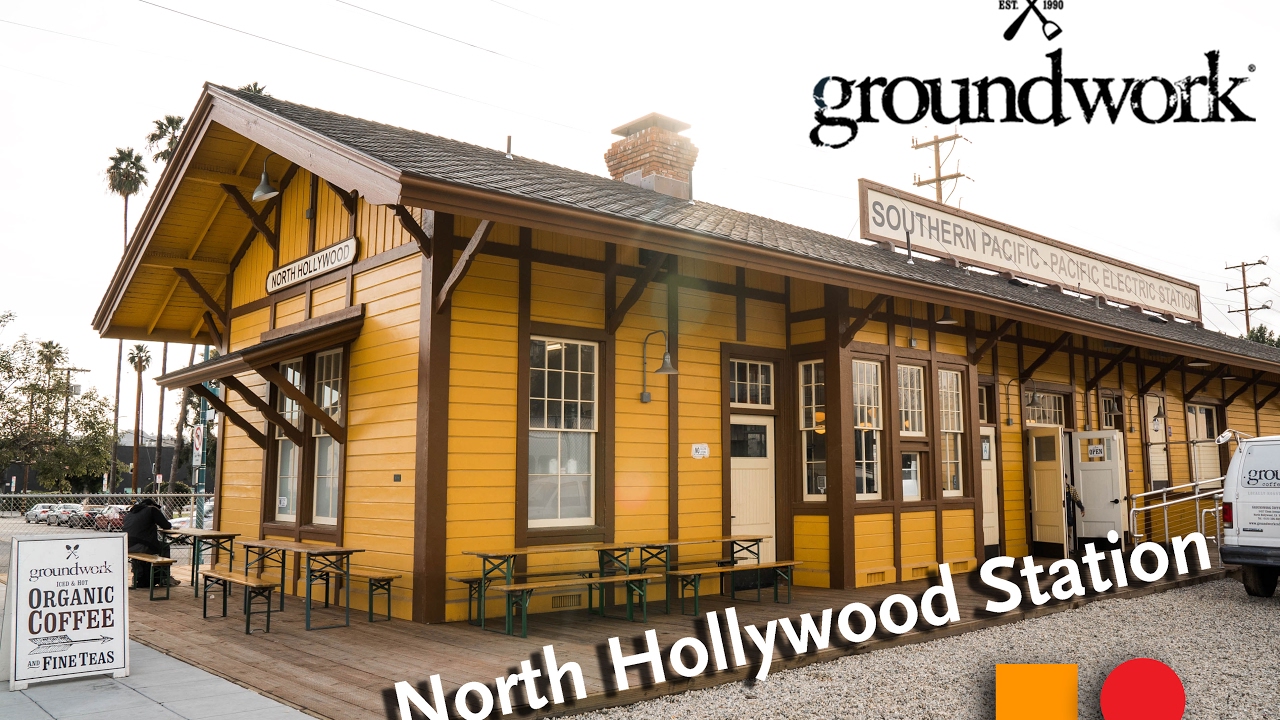
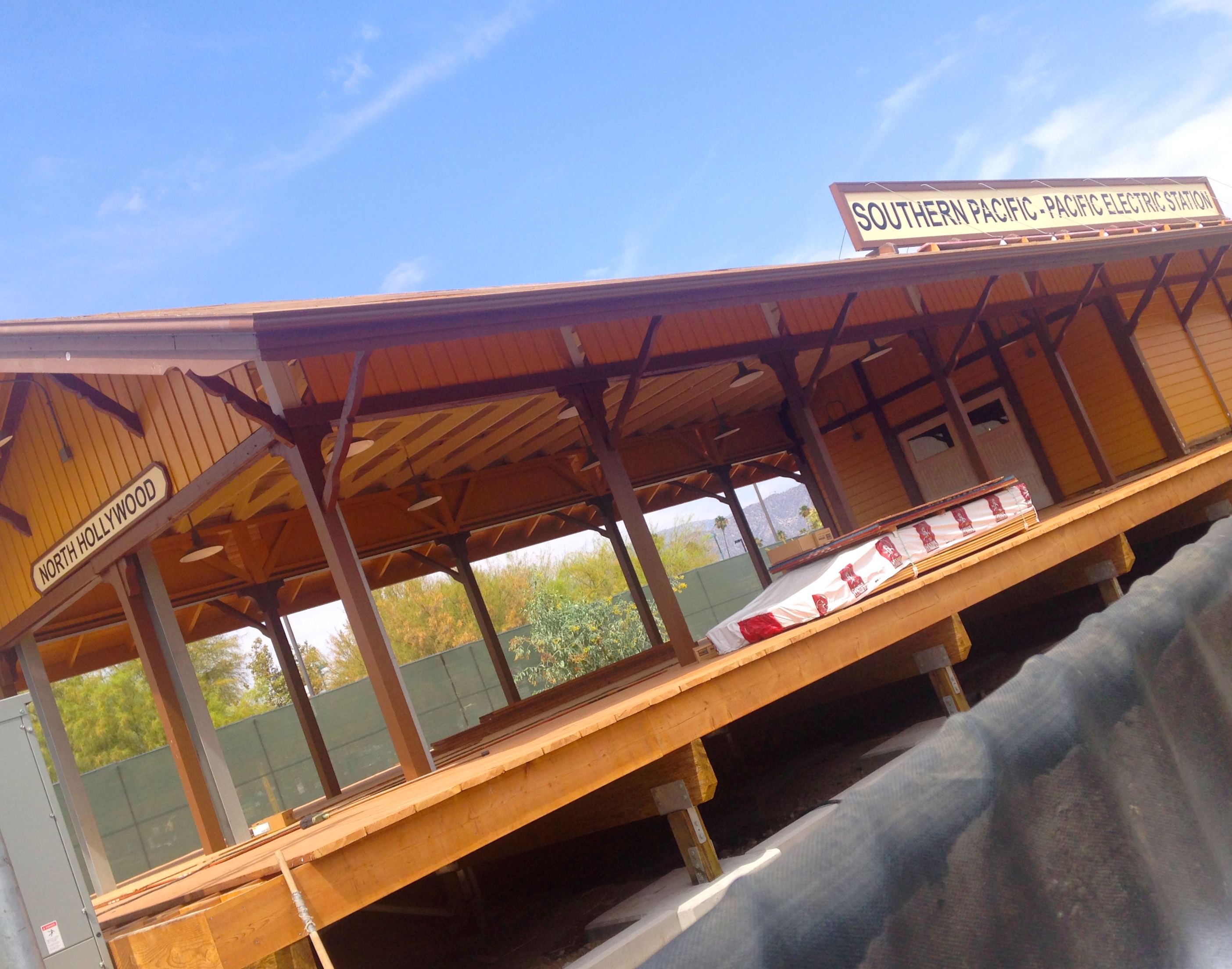
Noticed recently that the restoration of the old Pacific Electric / Southern Pacific depot at North Hollywood has been completed and reopened as a commuter café on the Metro Orange Line.  This article gives the details, including:

The official grand opening of the Groundwork Coffee Co. cafe drew dozens of hipsters and transit officials to the Victorian-era station at South Chandler and Lankershim boulevards, at the terminus of the Metro Orange Line busway.

The hipsters must have mingled well with the transit officials…..

I culled a range of photographs of the restoration from the internet and have included them below – the ones of the café interior are useful as they show the roof structure.

Posted in Inspiration, Layout design, Prototype, Traction | Tagged , , , , | 1 Comment

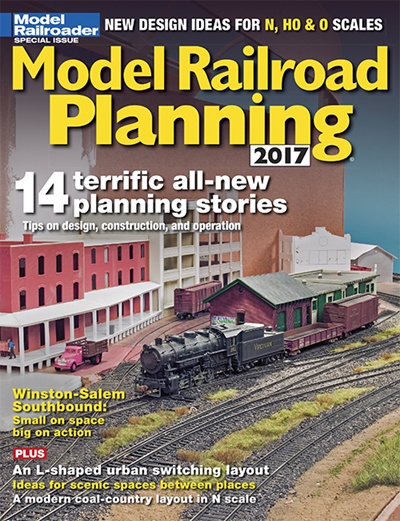
Book review – Model Railroad Planning 2017′

The new year has come around again and it’s time for this year’s ‘Model Railroad Planning’ from Kalmbach.  I get this annual publication every year, and it is almost always worth a read.  There are usually too many (for me) basement sized layouts, but these are usually balanced by a few small ‘British size’ layouts.

This year seems to be a good edition.  The cover layout and featured plan is a shortline switching layout that comes in two sizes, the smallest 8′ (in HO) plus an add on staging siding.  There is also an attractive trolley line.  As the Model Railroader site describes it:

Adding traction to a steam railroad

Thinking of adding a trolley line to your layout? Well, that can be a fascinating addition to an existing model railroad. It can be simple or as complex as you might want. Just be aware of one hidden risk: A trolley operation can become addictive – sometimes to the point that it becomes more intriguing than a traditional steam railroad.

That’s because it can be scaled to your available space more easily than most other types of railways. Most electric lines were short, with ultra-sharp curves, steep grades, simple but frequent operations, and short trains – often just a single car. Scale-length trains are practical. Adding even more realism is that, like their prototypes, the models are powered by electricity!

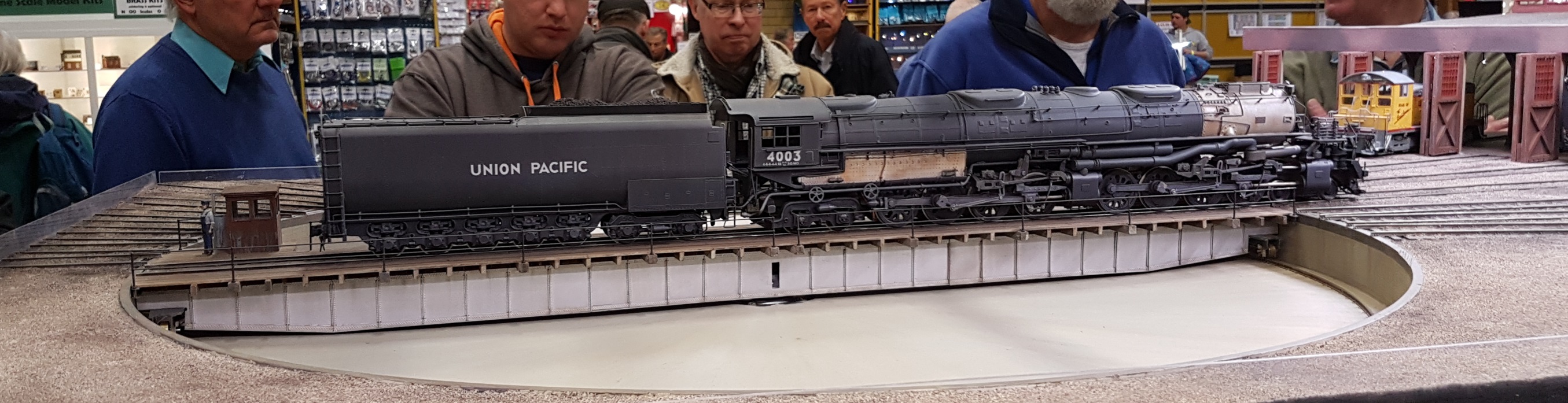
Perhaps the most interesting thing about this edition is the fact that it contains two British based, but American outline, layouts.  The first, the ‘O’ gauge Laramie loco depot is described as:

A slice of Wyoming in the U.K.

Why would someone who lives in rural Gloucestershire, England, model part of a Union Pacific engine terminal in Wyoming? For many, a layout is an unashamed trip back to their childhood. On reflection, I guess there’s an element of this here: I have a clear recollection of the son of two of my parents’ friends having an HO model of a UP 4-8-8-4 Big Boy, and of being insanely jealous of this amazing beast.

This fine layout was at the Stevenage show earlier in the year.

The second UK layout is a gem.  But I would say that, as it is ‘N’ gauge and based on the railways of the North-east.  It even has an abandoned Lehigh Valley line in the background!

An N scale traveling layout

Although I’m a member of the Erie Lackawanna Historical Society and model the EL in HO, I have always wanted to see what I could achieve in a small space in N scale. I started designing a layout capable of being taken to exhibitions and where the main size constraint was the back of my Volkswagen Golf with the seats folded flat. This gave a maximum size of 40″ by 70″ to work in.

I’ve always had an interest in Eastern railroads – especially in Pennsylvania – and have collected reference books for influence. My main interest is the Erie Lackawanna, but I also gathered information on other roads such as the Reading, Lehigh Valley, Lehigh & New England, Pennsylvania, and Central RR of New Jersey.

I scanned this plan from the magazine, to share what a good small design (5′ 10″ x 3′ 4″) this is:

To add interest to a small layout with a small staging yard, Ian Wilson modelled one end of the fiddle yard as visible, so the locomotives and cabooses of trains can be stopped in open view, then moved into the yard as an extra operational movement.  The end of yard tracks are in the foreground below, and a train is leaving past the depot and junction.

Very much recommended!

Posted in Hints and tips, Inspiration, Layout design, The trade | Tagged , , , | 1 Comment

1971 – March – Personalities

Between the February and March editions of Railway Magazine, the price had changed from 4s (20p) to 20p (4s).  Yes, the UK had been decimalised.

From “Some thoughts on the end of steam” by the prosaically named “62741”.

Personalities of the last years

And what of the personalities on the steam scene in the last years – a largely neglected aspect of steam lore?  Mercifully, many bore nicknames so I may chronicle them here without giving offence….

The most noteworthy group was undoubtedly that incredible timing fraternity – more than fifty strong – at Waterloo, who can claim the distinction of introducing BR’s first payment-by-results speed bonus scheme for footplate staff.  (No doubt the Bournemouth electrification resulted in loss of earnings for some of the more enterprising drivers, though not perhaps the famous “Bournemouth Gnomes”!)

What memories the names of this intrepid bank conjure up: “Lurch” (who was nearly out of gauge); “Diddy Man” (round about 4ft, of which the top half was hair); “Squire Huntley” (ever sporting a cravat); “Pest” (since believed to have gone into the Common Market); and last but not least, “Reg Idiot” – the man who always had a faster run.  This led to the coining of the word “Redged” which has passed into the English language wherever Steam is spoken.  For the uninitiated, its meaning is basically “thwarted” (as when discovered by “Gripper” without a ticket, or with one which, by the widest stretch of the imagination and the maximum degree of plausibility, is unusable at the spot where “G” has struck).  There are overtones too of having been “out-done” and being consequently “deflated.”…..

The profound changes in the habits of the steam enthusiasts of this country since 1968 would have made an interesting study.  Some sociologist, preferably female, has missed the thesis subject of a lifetime!

I suppose railway enthusiasts are odd.  But are they odder than any other hobbyist or sportsman?  That I doubt.  Mind you, my younger daughter once asked me, “Are all the German model railway fans in Stuttgart as strange as your friends?”  I defended ESNG, “Oh, far stranger, dear!”

Posted in Out and about, Prototype, Weird and wonderful | Tagged , , | Leave a comment

Minories, Minories everywhere…..

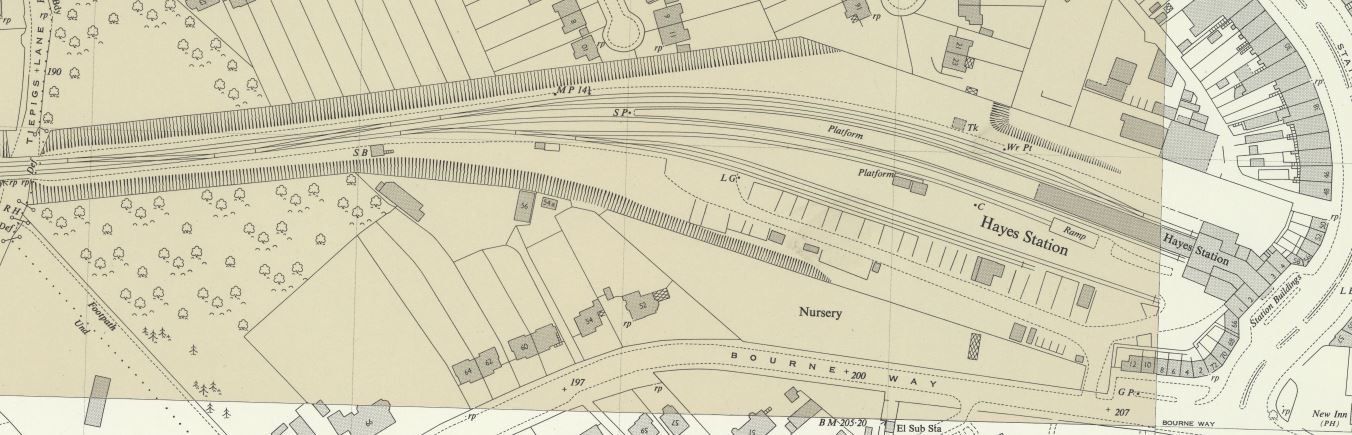
Once you start looking for ‘Minories’ type layouts, they seem to be everywhere.  I suppose this is hardly surprising, as the layout of crossovers and a point to reach three platforms is a simple, intuitive one.  So here’s another attractive suburban terminus, Hayes in Kent.

The West Wickham and Hayes Railway was incorporated by Act of Parliament on 9 July 1880 to build a 3¼-mile line from Elmer’s End on the South Eastern Railway’s Mid Kent line to Hayes.  Traffic was light in the early years.  However, after World War I, traffic grew rapidly with the growth of the outer London suburbia.  The Southern Railway electrified the line in 1925. The branch has thrived with commuter traffic, and despite its short length, there are half-hourly trains between Hayes and both Cannon Street and Charing Cross stations.

In 1950, the terminus had three platforms, and a small goods yard.  It would make an attractive model, being a ‘typical’ terminus, but with a Southern Electric service.  Hayes is not very far from where I grew up, and the way suburbia has formed around the station building is very familiar for the area.

hayes

National Library of Scotland – Creative Commons

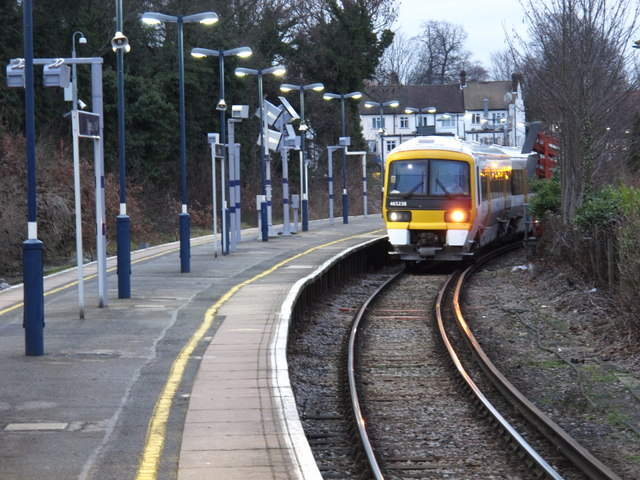
In recent years, the terminus has been reduced to two platforms, but it is still an attractive station, with the double crossovers still in place on the wooded approaches.

2243209_51449fb2

2442668_f52aa33e

At the other end of this short branch is Elmers End.  This too would make an interesting model.  As usual, the small goods yard is mainly a coal depot to cater for local domestic heating needs.  The mainline from London is on the right (and north-east).  The left (and south-west) passes the outskirts of Croydon to join the main London-Brighton line at South Croydon.

elmers_end

National Library of Scotland – Creative Commons

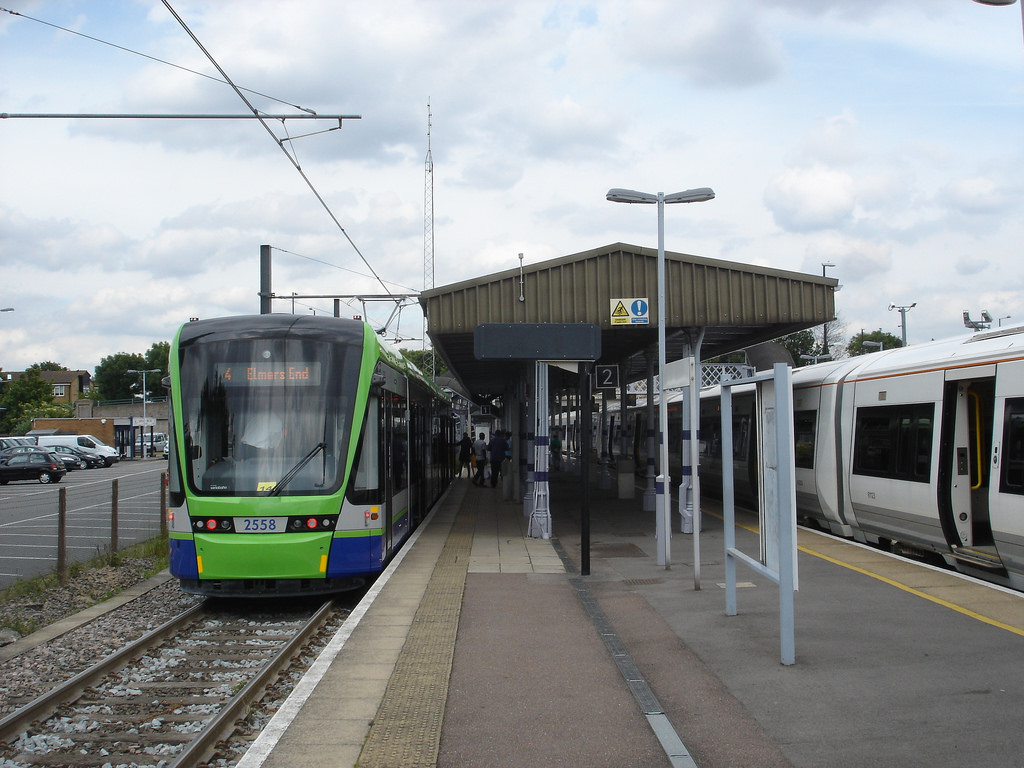
The platform bay to the south is linked to the Hayes branch, that curves away from Elmers End.  Before electrification, it would have been held a steam railmotor shuttle service to Hayes.  The northern bay is still in use today to terminate the Croydon Tramlink service.

7447888908_f5138d6cac_b

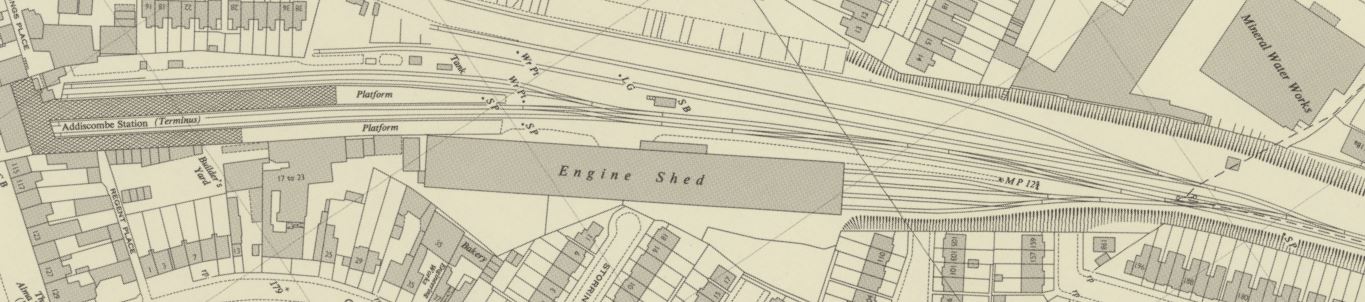
In the past, this bay was home to a shuttle service of a couple of miles to the Addiscombe Road railway station, originally built as the South Eastern Railway’s Croydon terminus.  The station is more imposing than Hayes, with a 4-road EMU storage shed.  I believe that a 4mm scale model of this station is being built for the exhibition circuit.

addiscombe

National Library of Scotland – Creative Commons

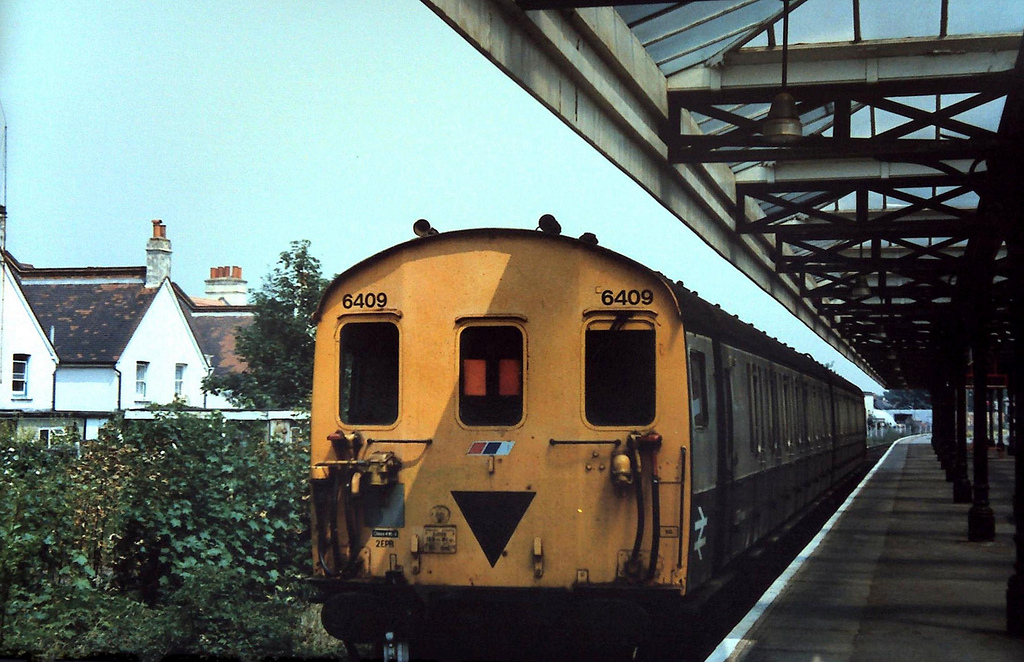
With East Croydon station, on the main London-Brighton line, half a mile away, it was inevitable that Addiscombe Road would be ‘rationalised’  and closed.  In latter years, a 2EPB shuttle service to Elmers End, as below, was its only service.  Now, only Tramlink trams pass through the site of the station, but much of it is a new housing estate.

8354861658_a74f9ff5d2_b

Posted in Hints and tips, Inspiration, Layout design, Out and about | Tagged , , , | 1 Comment