Loss of Scruples

From 2007….

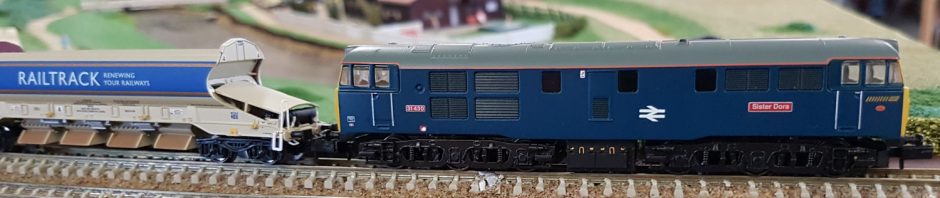
This section was drafted as an appeal from Derek as to who had accidentally taken home a box, after our April show, containing his rake of the new Farish Mk1 Pullman coaches and Class 56 EWS loco. Fortunately, Derek has found them in a box labeled ‘Scruples.’ He had thrown away his scruples (so to speak) and replaced them with some shiny new stock.

Nevertheless, Derek’s original PS has a lot of useful advice in it, so I’ve still included it below!

“PS. A hindsight about taking stock to exhibitions. Make a list of what you take – and USE it. Keep a watchful eye on your stock and be aware if someone offers to help take it to the car – take some yourself at the same time. If possible, mark and identify each item and consider using a secure container – even if you need a trolley to move it as it is not so likely to be carried away. Mistakes DO happen but so, unfortunately, does theft. In this case I don’t know (But he does now – Ed). Derek.”

Posted in ESNG, Hints and tips | Leave a comment

Jon’s modules – first board

Well, the first board is almost complete with track and wiring.  Just a few more ‘jumper’ cables to add, and final testing with a locomotive, rather than my trusty caboose.

first board


The photograph shows a few features that may be of interest


  • Point motors are ‘Cobalt’ slow motion motors.  Expensive, but the system has a lot going for it – especially little things like the jig that allows you to drill all the motor operating and fixing holes before laying the point.
  • Plates at the joints.  I found some thin copper clad material at a show, that looked a little thinner than the usual sleepers.  It was just right to slide under the PECO code-55 rail, that extends down into the sleeper base.  And it gives a solid soldered fixing for the rails at the end of the board.
  • Point motor switches are recessed into the board’s facia.
  • The interchange yard will be laid directly on the N-club board, without the 3mm packing piece in the standard.  This gives a visual difference between the main line and the yard.  The transition was made with the help of a section of Woodland Scenics pre-formed gradient.

Now to lay some track on the second board….

Posted in Jon's layout ramblings | Leave a comment

Easing off a bit….

With a baker’s dozen daily posts to get this blog up and running, I will ease off a bit now, to my planned two or three posts a week. But do keep reading (both of you)!

Posted in General | Leave a comment

Hints & tips – Don’t strive for perfection

Sound thoughts from the Model Railroader (many years ago)

Layouts, like full-size railroads, aren’t cast in concrete. They’re made of relatively easy-to-change wood and plaster or foam. Start small, test as you build, and make changes when needed to improve operation or appearance. Layout design and construction are both continuous learning processes. Most well-known model railroads in the hobby are the result of an ongoing series of changes and additions to the original design – even to the point of being completely rebuilt from the ground up to embrace a new theme.

Once a design is “frozen” and construction commences, be it for a model railroad, a full-size railroad, or even an airliner, rocket, or attack submarine, it embraces old technologies and design concepts. As Steve King, a former Baltimore & Ohio dispatcher and builder of the N scale Virginian Midland, has pointed out, a “perfect” model railroad wouldn’t be much fun to operate anyway, as all of the challenges would have been designed out.

So the goal is to make well-informed decisions, then build a layout that embraces that knowledge yet can still be adapted to changing conditions and additional input. Just as we continue to gain knowledge and skills, our model railroad designs should continue to reflect those ever-improving conditions and be readily able to accommodate them.

Posted in Hints and tips | Leave a comment

ESNG meeting – 16 October 2013

No trains running tonight!

At 7pm there were four members present, and two of them were not capable of lifting modules. So we sat down for a chat with a cup of coffee. By 8:30pm about 10 members had shown up, but it was too late then to get the circuit up an running. Even though Paul had a new Japanese bullet train to test….

So no trains, but a very pleasant evening catching up with each other.

Posted in ESNG meetings | Tagged , | Leave a comment

Inspiration in S-gauge

Rather bigger than our models, but I can recommend this web site for some perfectionist modelling – “Port Rowan in S scale – Modelling a Canadian National branchline from the 1950s in 1:64”. (http://themodelrailwayshow.com/cn1950s/).

None of us are ‘rivet-counters’, but looking at model railways like this encourages me go and build something, perhaps better than last time!

Note too, the branch line flavour of the layout. The USA and Canada are coming to terms with smaller houses, reduced income, and lack of a basement for a massive train room. They have learnt from our UK branch terminus theme, and have improved on it, with simple freight only lines that still offer quite involved operation. Even a single siding can offer complex operation – if you design in three ‘spots’ at three doors to a factory where you have to place a wagon, you effectively have three sidings to shunt.

Posted in Inspiration | Leave a comment

Jon’s modules – layout design

Layout design – rather than building – may be my favourite part of the hobby.  I can read books and magazines of designs for ever and a day, and the first thing I look at in a layout described in the model press is the track layout.  Never mind how good the modelling is – is there inspiration in the design.

When it came to my modules, I came to an unfortunate conclusion – I like single track branch lines.  Although N-club single track modules are possible, I wanted to start off with a double track layout to fit easily into the club setup and maybe even go to Stuttgart.

So what to build?  I toyed with Pacific Electric at North Hollywood or at San Pedro, but this moved me away from the Lehigh Valley.  I designed a few layouts with a separate switching area and the double track main line just passing through.  Nothing quite worked.

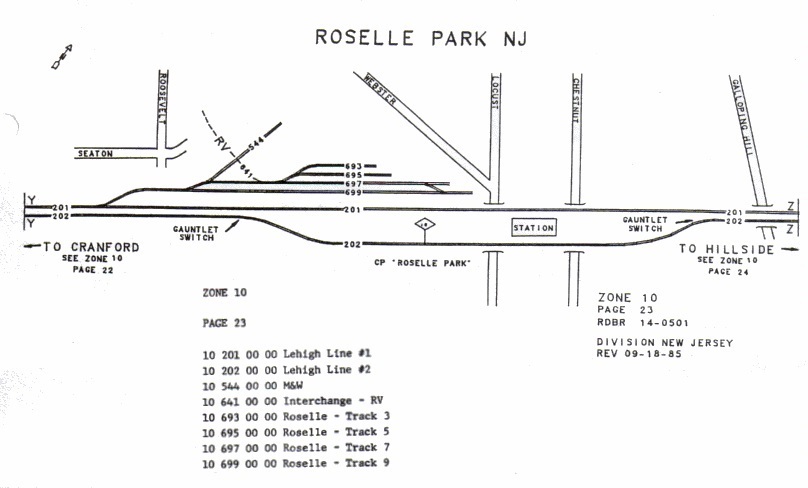
I then returned to an idea that I’d come across some time ago.   In Central New York State, the Rahway Valley Railroad ran for 15 miles and interchanged with the Lehigh Valley, Jersey Central and Delaware, Lackawanna and Western (for more information, see  http://trainweb.org/rahwayvalley/).  The Lehigh Valley interchange at Roselle Park was of particular interest.

route_lehighvalleybranch_interchangemapThe layout shown is the later version of the plan, when the main line was raised to bridge the roads that crossed at three locations, and to join the Lehigh Valley and Jersey Central main lines.  However, the plan as shown is a great basis for a junction, with that interesting crossing of the branch tracks heading north-west, and one of the sidings.
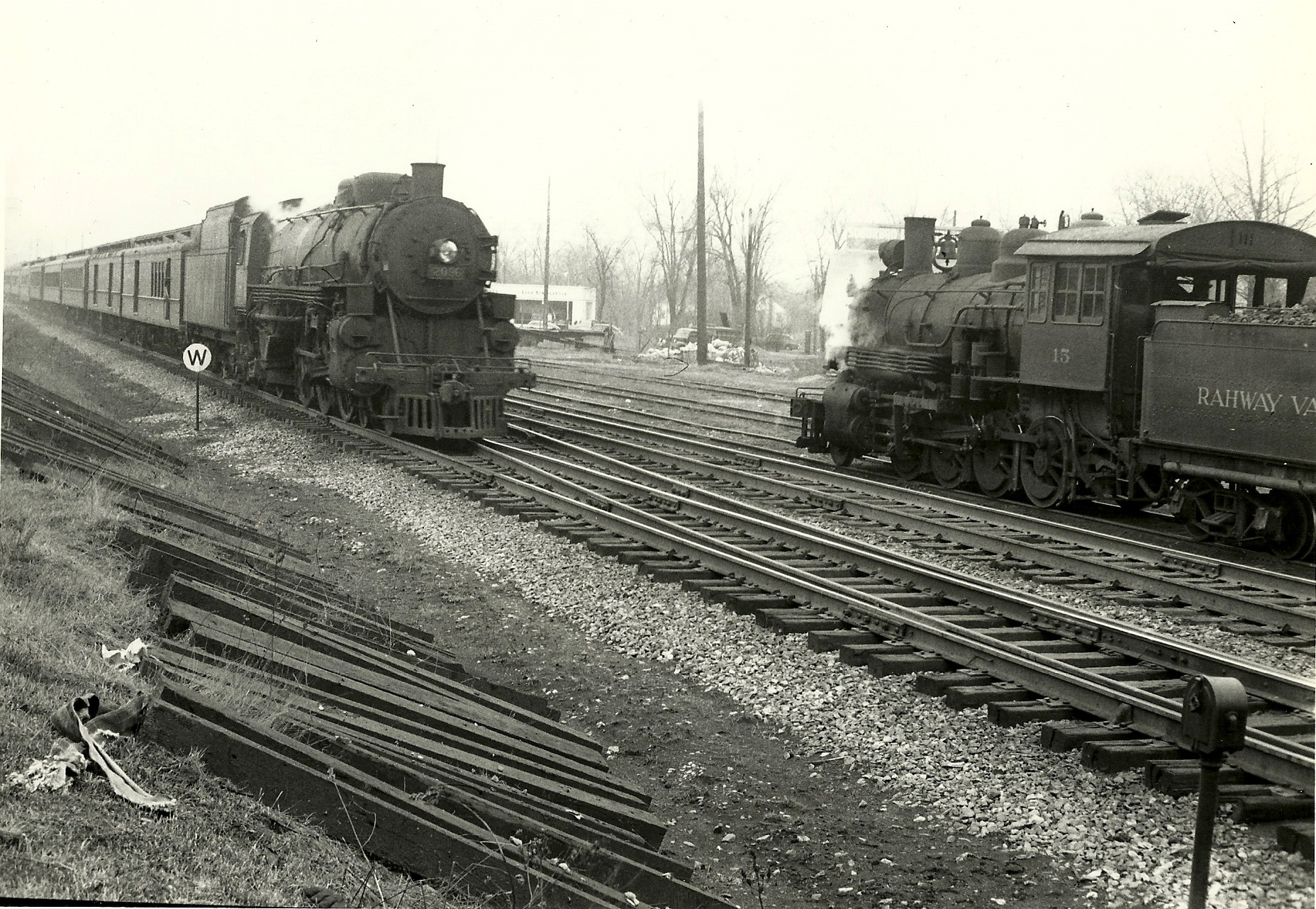
engineRV

The photo below (from the collection of Jeffrey J. Jargosch; photo repair by Michael Kaplonski) shows the interchange in steam days.  You can still see the main line and the route of the abandoned branch on Google Earth.

The layout as shown fits well on 2 x 800mm and 1 x 1200mm modules.  I’ll model the junction as the terminus of a Lehigh Valley freight branch, rather than as the Rahway Valley Railroad.  The main lines will link up to N-club elsewhere, and at home, a fiddle yard on the branch will allow some shunting / switching and a little operation.

lvlogo

So it’s full steam (or rather, full diesel) ahead with the Lehigh Valley!
Posted in Jon's layout ramblings | Tagged , , , | Leave a comment

Model rail rage

Just how dangerous can a hobby be….

A simmering row between two model railway enthusiasts in Berlin came to a head when they agreed to divide the train set they’d built up for three years.  When the one known in court only as ‘Pierre R’ claimed 33-year-old Uwe’s favourite locomotive, Uwe stabbed him 13 times, cut off his testicles and threw him out of a ninth-storey window.

From the ‘Independent’, 14 Oct 2001

Posted in Weird and wonderful | Leave a comment

Hints and tips – tidying wiring

My hints and tips are probably things other club members have been doing for years.  So you can all have a laugh at my expense as to how slow I am!

I have never been good at tidy wiring.  Even a simple board ends up looking like a plate of technicolour spaghetti, due to the range of sources of wire used.  I’m trying to do better this time around.  And I’ve found a hot glue gun a useful tool for wiring.  Hot glue is of course also very useful for scenic work, and if you are Iain Rice, you claim to build baseboards with the stuff.  But a spot of hot glue is ideal for fixing wires in place under the baseboard.  This is best done as the wiring goes into place, so it always looks tidy, and there are no festoons of wire like misplaced Christmas streamers…..

Posted in Hints and tips | Leave a comment

DJM models

Dave Jones’ departure from Dapol caused a certain amount of discussion in the club.  He announced his new direction at the N Gauge Show in September, and RM Web carried the following statement.

Hello and welcome to the launch of an exciting NEW model railway company.
Starting from a blank canvas and using the best design, and modelling techniques currently in use for ready to run model locomotives, I intend to produce a raft of models over the next few years with my desire for innovation, and forward thinking put into each and every model I make.

For example, all models will have 100% spares available at launch for each model, and these will be readily viewable through a break down schematic for each part (which will be numbered) on a comprehensive instruction sheet included with each model and online.

Each model will feature on the ‘timeline’ page which will show you when every process from start to shipping has taken place, and even give you the ship name so those that are able can track its progress from China to the UK on their computer. This way we will be very open about delivery dates and not give ‘hopeful’ ideas to dates to keep you dangling. Where possible, all locomotives will now have a close coupling mechanism as standard in both N and OO gauges.

In co-operation with my distributor, each model locomotive will be personally hand checked by me for running ability, wobble, back to backs, lighting etc., before being sent out  to the customer, so that when you receive your DJM locomotive you can be as sure as can be that it is in good health straight out of the box.

Electrical PCB boards will be designed by ourselves knowing the electronic signatures of the coreless motors we will use with every model so that components for the PCB boards can be purchased and fitted to match perfectly.

We have also agreed with that fantastic weathering company, Mercig Studios, that from now on they will only produce weathered masters exclusively for DJM, while also producing his masterpieces for his existing and new individual customers.
Special commissions can also be considered as we have plentiful factory capacity, and hold ups/delays should be a thing of the past.Production for all the models you see here will not take place overnight, but rest assured , as you can see by the finished and almost finished cad/cam designs within, I am deadly serious about my work.

I liked the bit about 100% spares availability – a Dapol failing I understand.

The N gauge models announced were a Class 17 ‘Clayton’, a Class 23 ‘Baby Deltic’, and a J94 Austerity 0-6-0 tank.

Posted in The trade | Leave a comment