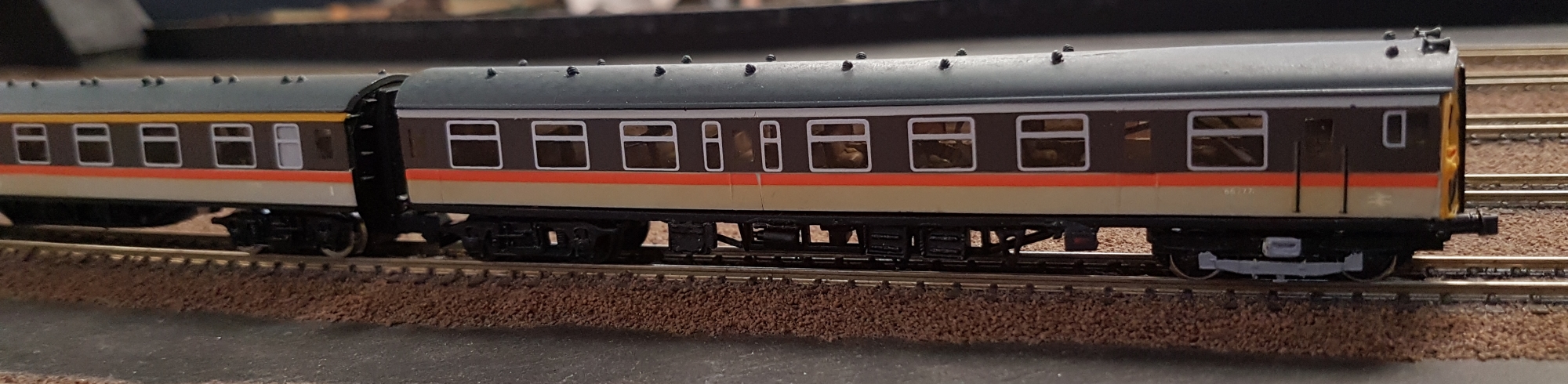
Modular model railways – the pros and cons?

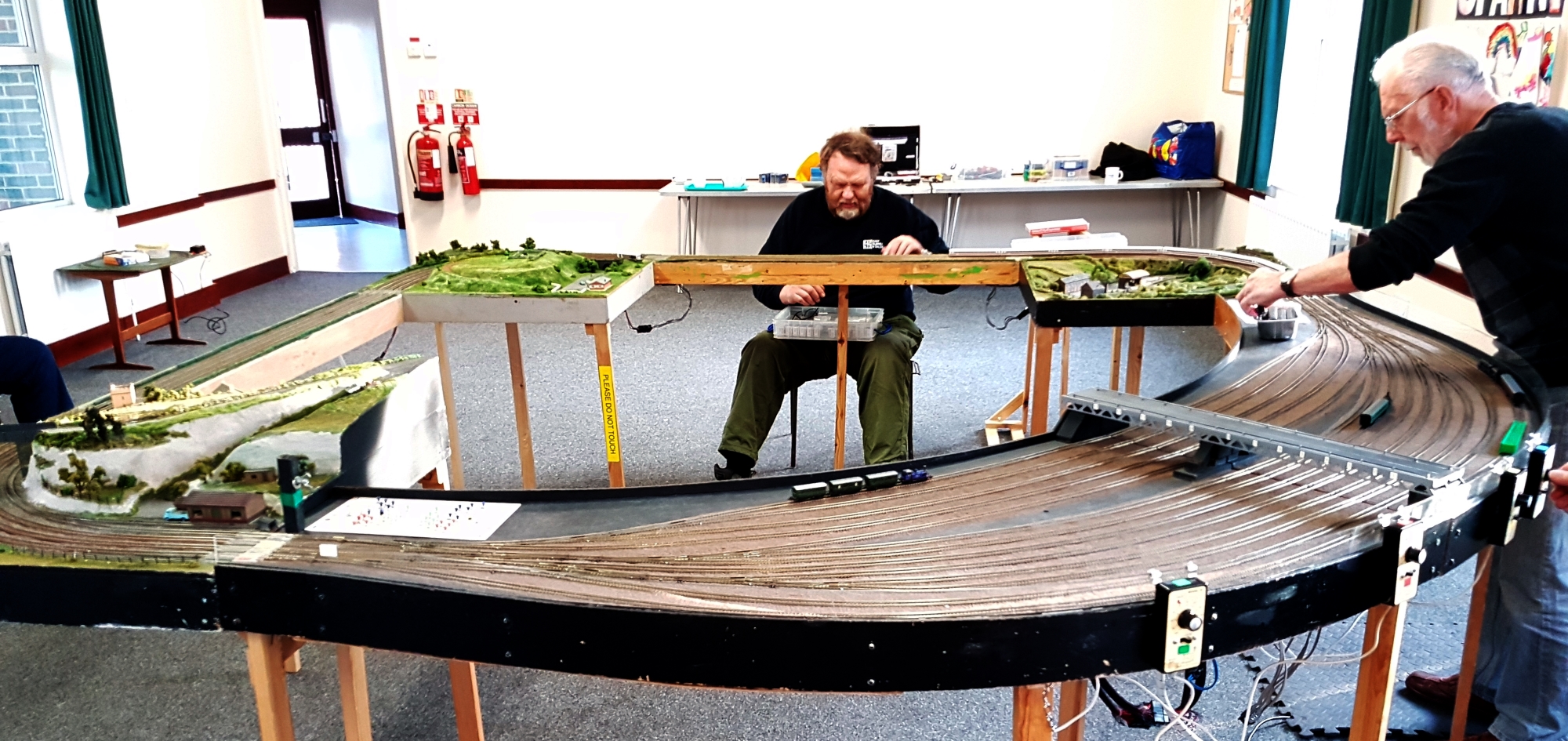
Dave emailed me recently about exhibiting our ‘N’ gauge modular layout at local exhibitions.  His comment was (in part)….

Hi – not having much success with exhibitions at the minute. The larger ones don’t seem interested in modular layouts….  We seem to have more success at places that put on exhibitions which are second to the main attraction – like Rural Life, Bluebell and Gaugemaster – or smaller shows.

My response was (in part)…..

A lot of shows will tend towards ‘scale’ layouts, so are not interested in our ‘anything goes’ approach to exhibiting. Which is a shame, as there are usually a number of rubbish generic ‘OO’ tail-chasers at most big shows. And we all know that a modular circuit does get plenty of viewing from those who just like watching the trains go by.

The modular approach might be classified as being not scale enough, or too much fun and not enough rivet counting?  However, I remember doing the Gaugemaster show in 2016, and on the Sunday Paul took over the outer two tracks with Japanese Bullet trains, whilst the inner two ran mainly UK stock.  And we had lots of spectators, who appreciated the unusual and interesting trains, and perhaps the way the Kato stock stayed on our trackwork at high speed.

It is interesting that the latest focus in the free USA web-zine, ‘Model Railroad Hobbyist’, is the ‘TOMA’ concept – The “One Module” Approach.

With TOMA, the idea is to build your home layout using portable
sections, and to complete each section all the way from bare
benchwork to a finished module section with all the scenery,
details, structures, and bridges totally done. If you have signals
or lighted grade crossings, they all work. In other words, each
TOMA section is completely finished before going on to the next
TOMA module section.

Rather than just have a “still life” layout section, TOMA thinking
encourages you to add flattop staging to both ends of the
module, then go ahead and run trains. No need to wait for the
entire layout to get into operation. With TOMA, the idea is to
experience the entire breadth of the hobby from beginning to end including ops – but because you’re doing your layout just a small piece at a time, you can get to completion a lot more quickly.

Now I’m impressed that the hobby in the USA is moving in that sort of direction – possibly due to the space for basement size empires becoming less common?  And of course they have had ‘N-track’ and ‘One-track’ around very successfully for years.  But we’ve also been doing it for years in the UK.  Firstly in layouts that do expand, and secondly in modular layouts.

I also replied….

For modular layouts there is potential in the Alpenbahn approach (and also to some degree in N-club), where the appearance of the modules is uniform, and they are based on a consistent location, so that put together they are ‘scale’ enough for most exhibitions. Our trouble is that our interests are too far reaching!

I am not sure that our membership would be interested in building a consistently themed set of modules, that would pass both as a ‘fun’ layout, and on occasion a ‘scale’ layout.  But maybe it’s worth thinking about?

Posted in ESNG, Exhibitions, Layout design | Tagged , , , | Leave a comment

Virgin on the unreadable?

An article in the papers today caught my eye:

Virgin West Coast train firm stops selling Daily Mail

Virgin Trains has announced that it has stopped selling the Daily Mail newspaper on its West Coast trains.

A spokesperson for Virgin said it regularly reviewed products sold on its trains, adding that “after listening to feedback from our people” it decided to stop stocking copies of the paper.

A Daily Mail spokesman called the decision “disgraceful”.

Last year, stationery chain Paperchase apologised for a promotional giveaway in the Mail following criticism.  The Virgin spokesperson added that when it stocked the paper, which it stopped carrying in November, it only sold one copy for every four trains.

The spokesperson told the BBC that the paper had never been stocked on its East Coast trains under the management of Virgin/Stagecoach.

And Drew McMillan, head of colleague communication and engagement at Virgin, told staff in an internal memo: “Thousands of people choose to read the Daily Mail every day. But they will no longer be reading it courtesy of VT. There’s been considerable concern raised by colleagues about the Mail’s editorial position on issues such as immigration, LGBT rights and unemployment.”

“We’ve decided that this paper is not compatible with the VT brand and our beliefs.  We will continue to offer The Times to customers, but we won’t be stocking the Daily Mail for sale or as a giveaway.  This won’t suit all of our customers or all of our people – it’s certain to draw some criticism. But we’ve listened to many colleagues over the last few months, and we feel that this is the right move to take.”
There’s more where that came from!

Now (sorry Mail readers), I have a lot of sympathy for Virgin.  A glance at the front page of the Daily Mail (otherwise known as “The Hate Mail” or “The Daily Fail”)  can depress one on the brightest of mornings.  However, I did wonder about equivalents in the model railway world.  Who might not sell what?  How about….

Rail Unions ban Graham Farish from staff shops

A union spokesman said that the lack of a guard in all models showed support for management and a total disregard to the safety of the operators….

Samsonite withdraws sponsorship of TINGS 

It is rumoured that the well-known luggage manufacturer Samsonite will withdraw sponsorship from the N-Gauge Show.  A spokesman for the company stated that the inappropriate use of their products, especially rucksacks, to assault other model railway enthusiasts had caused them to rethink their policy.  However, a TINGS organiser was hoping for new sponsorship from Lynx or Brut, and free samples would be offered to any member of the public carrying a rucksack…..
(For those not in the know, unwashed rucksack carriers are rumoured to frequent TINGS and Warley, using BO and bags to fight off other enthusiasts and get the best bargains.)

Any (slightly libellous) examples welcome as a comment!

Posted in Inspiration, Out and about, Prototype, Weird and wonderful | Tagged , , , | 1 Comment

Holborn Viaduct

This is a layout idea that has been bumbling around for a few months.  It all started with a thread on RMweb, describing some possible ideas for the 2mm Association Diamond Jubilee layout challenge.  This involves developing a cameo layout with visible dimensions of 600 x 240mm.  That’s a tiny space, but it’s surprising what one can come up with in the space.  Perhaps not surprisingly, many ideas were urban, where the railways didn’t have much space anyway.

So this is the design that caught my eye, based on the old LCDR Ludgate Hill station, just to the north of the River Thames, and a stones throw from at least three other stations.  It didn’t stay open for long, but the remains of the station lasted until the Thameslink remodelling, completed around 2012.

The layout sketch below shows the station in its early 20th century form, with some wonderful pointwork.  The bottom two lines go to Holborn Viaduct station, just off the plan.  The top two drop down to Snow Hill and then through to Farringdon and to the north London stations.  Early last century, there were services across London, and visiting trains from the Midland and LSWR.  Plus masses of cross-London goods, that continued into the 1970’s.  These lines, greatly modified, now form the route for Thameslink services.

And this is how the layout might look, though this is the post-war look after that nice Mr Hilter from the Ball and Compass (Monty Python reference) thinned out the buildings during the 1941 Blitz.

And here’s a view early in the century, with all buildings intact and a train of private owners wagons – empty coal traffic – heading north.  In our era of gas central heating, it is easy to forget just how much coal traffic there was from the northern and midlands collieries down to London.  Every suburban station would have had a coal yard, now converted to a car park or blocks of flats.

This drawing from ‘The Engineer’ shows the remodelling of the original station, abandoning one platform, still early last century.  The pointwork is marginally simpler!

To model this sort of pointwork, one would have to work in 2mm or one of the larger fine scales.  Otherwise, the clearances in ‘N’ for frogs and wing rails would just not work.  Here we see an attempt to draw that complex pointwork in ‘Templot’.  It does show how accurate many of the large scale Ordnance Survey maps are – the map can be tied in very well to the Templot trackwork.

But it’s when you look at the site in the context of its surroundings that one sees the potential of the area for a model.  Here’s the circa-1900 plan.

And here’s the circa-1950 equivalent.  The trackwork is noticeably less complex, and with a little further simplification would be buildable in ‘N’.  The track centres might need to be slightly increased, from the absolute minimum 6′ way of the prototype (22.5mm or so) to the PECO standard of 27mm, to fit everything in.  Holborn Viaduct station has lost all its loco spurs, and gained longer platforms for 8-car suburban EMU’s.

It’s when one draws some distances on the maps that one realises how small the station is, and how good a model it could make.  The three lines below are 1m, 4′ and 6’6″ long.  All could make a good layout.  The walls of Ludgate Hill station make a natural scenic break to the left.  For the longer layout, the overall roof does the same job to the right.

I like the idea of a hollow ply half-door forming the basis of the layout, strength being added by the raised railway on the viaduct.  Trackwork would have to be hand-laid – code 40 would be ideal.  A lighting ‘proscenium arch’ a la Iain Rice would limit the views left and right.  Perhaps the foreground could be made more interesting by assuming a few buildings survived the bombing, and the whole area hadn’t become waste ground and car parks.

Operation would be interesting.  There was a busy commuter service into Holborn, and I believe that the platforms at the bottom of the plan were used for non-passenger stock and van traffic.  And the two lines to Snow Hill dropping below the station carried a range of cross-London goods traffic, with a range of locomotives from the Southern and other regions.

Perhaps the most difficult part of the design is the fiddle yard.  For home use, I might leave the Snow Hill lines unconnected, and then add a fiddle yard or loops onto the end of Ludgate Hill station.  For exhibition use, a second set of loops could be added to the Snow Hill lines, but this is becoming a large layout.  Perhaps a continuous circuit, with a double ended fiddle yard would be best, allowing you sit and watch trains running through Snow Hill.  The end curves would have to be a reasonable size, not less than 15″ day, to allow for steam engines to run freely.  I’m still thinking about this question.

The other issue is the size of the boards.  With all those points, it’s difficult to find a natural place for the baseboards to join.  A 6’6″ half door is transportable, but may be a stretch for most cars.  And it might be difficult to get it out of the house – I had enough trouble getting the 6′ x 2′ Kuritu into my loft!

Finally, here are a couple of photographs of the area.  The first, taken in 1953 I think, looks towards Holborn Viaduct with the Snow Hill lines dropping under the signal box to the left.  The second shows Holborn’s overall roof earlier in the century, when there was still a small engine shed to the right.

EPSON scanner image

So there it is – (one of) my (many) dream layout(s).  I doubt whether it will ever get built, but there is a delightful model there for someone.

Posted in Hints and tips, Inspiration, Layout design, Out and about | Tagged , , , | 1 Comment

ESNG meeting – 3 January 2018

First club night of the new year, and despite the Chairman not being there due to anti-social working hours, 13 members enjoyed a varied procession of trains on the layout.  Mind you, Ian doesn’t look too excited by proceedings in the picture below, or perhaps it was the Treasurer’s conversation skills?

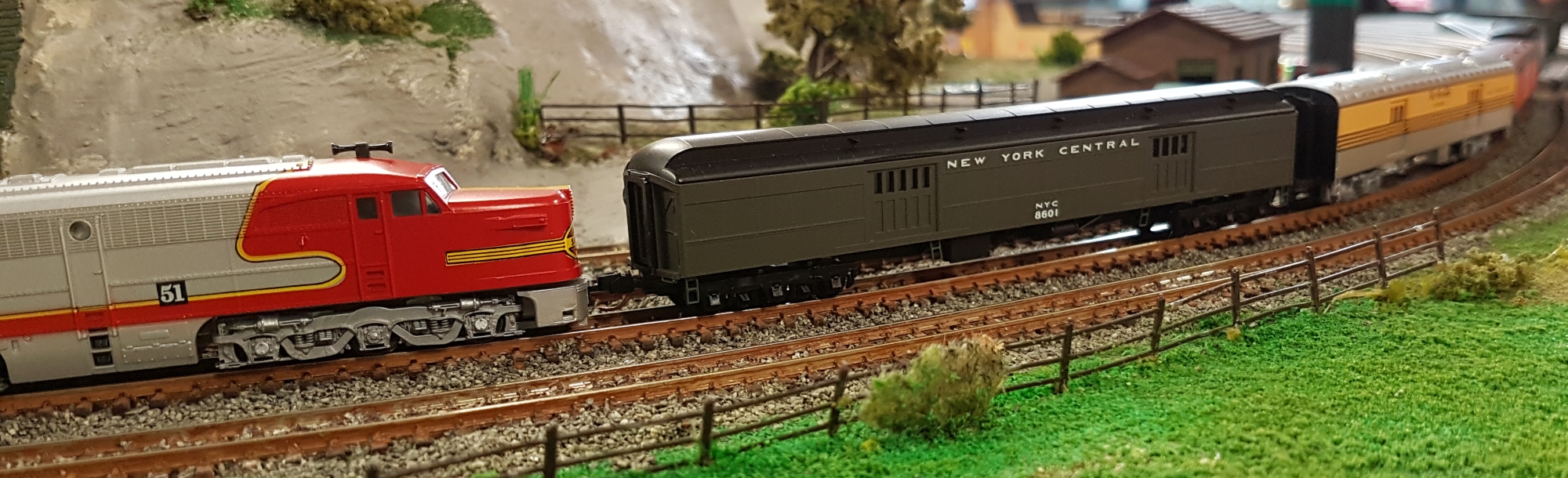
There was a strong American flavour contributed by Simon, Ian and Graham.  Here, Simon’s Con-Cor PA-PB-PA set head an express parcels train.

And Ian’s Metra double-deck push-pull rake ran as well as it looked.

Meanwhile, Paul was filling the fiddle yard with Japanese tankers, preparing for the usual long goods train.

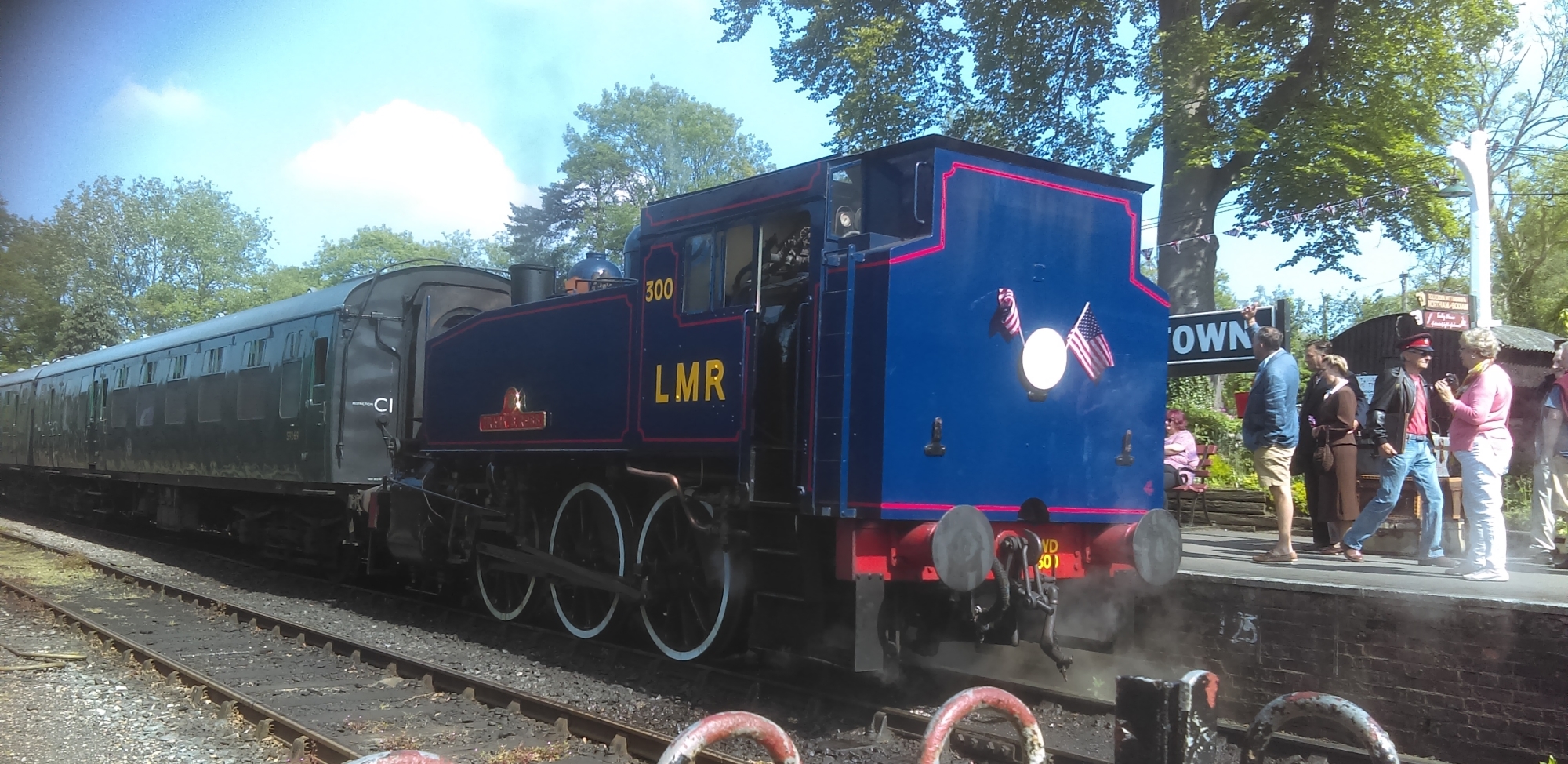
Derek was running an Longmoor Military Railway ex-WD 2-8-0 and passenger stock.  The WD looks rather more impressive in blue and red than the more usual BR grimy black.

And Peter contributed, amongst other things, two more early German multiple units.

All in all a good social evening!

Posted in ESNG, ESNG meetings, Out and about | Tagged , , , , | Leave a comment

More on the detail trap

More on the detail trap from The Erratic and Wandering Journey….

Out of Context?

I recently re-blogged René Gourley’s post, in which he quoted Marty McGuirk’s comment on Georgia O’Keefe:

“Nothing is less real than realism. Details are confusing. It is only by selection, by elimination, by emphasis, that we get at the real meaning of things.”

This is a lot deeper than an initial reading might suggest: O’Keefe was talking about identifying the essence of something, so that it can be drawn out. She was not, necessarily, talking about eliminating every detail, but making the point that you can remove some of the distractions from what you are trying to portray, to make your creation clearer.

That said, I think a degree of caution is necessary when translating Georgia O’Keefe’s words to our hobby.

Our models are not static 2-d representations attempting to emulate the impact of distance on stereoscopic vision which makes judgements of size and distance based on relative angular displacement (“perspective”). We have depth as well as height and width. We actually have twice as many dimensions to play with, for we also have time, allowing movement, which in a painting may be portrayed by blurring some of the detail, and things which are far away and indistinct may come closer and resolve into exquisitely made tiny parts on a model.
Say, for example, that you are building a model of an industrial steam tank engine. There would be levers for opening the sand pipes, with flat rodding and various cranks running from the cab down one side to a sandbox, with a crank and rod running across the back of the smoke box to a sandbox on the other side. For the sake of illustrating the point, this is a scratch build.
How do you best represent this? In theory, you should have some rectangular strips of brass, pinned and soldered at each joint, using the head of the pin to represent a rivet or bolt. That would provide the ultimate in detail. Of course, if you were working on a 5” gauge live steam engine, it might well be assembled to work, but as you come down the scales, you get a point where the extra detail of doing it the “hard way” gets lost in shadows, so unless you are building for a competition, is it worth bothering at all? Possibly not, once you get down to Z gauge, maybe, but even in N Scale, a complete absence of the rodding may not look right. So, what you can do, is use a piece of wire to represent the rodding, cranks and joints: if you feel really adventurous, you might even squeeze parts of it flat, to improve the looks. This would work well on a “layout quality”/“3 foot rule” model in most scales, including 7mm scale, but especially so for scales smaller than this (I know, ‘cos this is what a friend has done). [b]But[/b] – and this is the crucial point – it still needs to be bent in the right places, and in the correct direction. You don’t simply take any old piece of wire and 30 seconds later say, et voila! No, you take care to select a piece of wire that is noticeable but not obvious, and measure and bend carefully. Say 5 minutes. Still easier and less time consuming than doing it all with separate pieces, and far better than leaving it out.

Another example. Geoff Forster, of Penhydd and Llangunllo fame, emailed me today about this and that, as you do, and went on to say:

“I was comparing two recent 16T mineral builds with an earlier example that I put together. The latter has etched ‘V’ hangers, brake lever, ratchet and safety links, whereas the new builds have just had the kit parts refined, and a wire brake cross shaft fitted. Can I tell the difference on the layout, can I heck, which begs the question is it worth going the extra mile in 4mm scale?”

Geoff went on to add that shape, colour and texture are more important than detail -which can be simply suggested by these three – in contributing to the wider scene, a sentiment with which I agree and which Geoff demonstrates oh so eloquently…

My take on the O’Keefe reference is not that you simply omit features, but you decide on how you are going to represent the features – in this respect, I am put in mind of what Allen McClelland unfortunately called “good enough”. I say “unfortunately” as the phrase is ambiguous and could be interpreted as settling for second best, when really it’s about asking what level of detail is required to suit your purposes. If you are operations-focused, then moulded on details will be more robust, yet will still catch the light. You also need more stock, and the fist- and time- saving features of freight cars with mould details are not only substantial but essential. If you are details-focused, where close-up viewing of your models is the order of the day, then moulded on details are definitely not if interest.

As René pointed out, “Marty is right: don’t sweat the details, unless that’s your thing, in which case, don’t expect anyone else to notice.”

But whatever your choice, you still make a neat and clean job of it: craftsmanship and workmanship are always necessary.

Posted in Inspiration, Jon's layout ramblings, Layout design | Tagged , , , | 1 Comment

Canals, spies & politics – the Crossrails that weren’t built

A very interesting article from the Ianvisits blog.  Crossrail under London is nothing new…..

018 will be the year that Crossrail is completed, and the Elizabeth line is born, yet it could have looked ever so different had previous plans been built.

It’s been a long time arriving, much longer than most realise…

When it launches on 9th December 2018, the Elizabeth line (nee Crossrail) will increase central London’s underground rail capacity by around 10 percent. To put that into context, it’s equivalent to lengthening every tube train passing through central London by an additional carriage.

But the process of getting to 2018 has not been an easy one. The path was long, strewn with politics, spies, and debates about whether railways were even needed at all.

But first we start with a predecessor of Crossrail.
Liverpool Street railway station

For a very short period of time it was possible to catch a Metropolitan line train from the mainline platforms at Liverpool Street station and travel to Paddington via the Underground.

Built in 1874/5, a tunnel creates a link from the underground railway to platforms 1 and 2 on the mainline — to create a temporary terminus for the Metropolitan line while their underground platforms were still being constructed. Intended to allow the Met line to run out to Walthamstow, it ceased use just six months later, and fully closed in 1904.

The tunnel’s name is interesting. It used to be simply the Great Eastern Railway (GER) Connection Tunnel, until a Queen used it, as it is said that the Queen Victoria Tunnel was used for special after-hours services carrying the Royal Train from near Buckingham Palace to interchange with services to Sandringham.

The tunnel still exists, and was used for a staff canteen and storage, and for a while by the City of London police. The remainder of the tunnel will eventually accommodate a passageway from the existing London Underground station to the Elizabeth line station.

But to build a proper mainline railway crossing central London, we first turn to the canals.

Read more here.

And here’s a report about the GER Connection Tunnel, prepared during the Crossrail work.


I’ll be looking out for articles on two of the other projects completed over Christmas – London Bridge and Redhill Platform 0.  It will be interesting to see how they perform on 2 January…..

Posted in Inspiration, Out and about, Prototype | Tagged , , | Leave a comment

Happy New Year! – And on my workbench #3

A Happy New Year to all our readers!  It’s unlikely to be a prosperous one, but wishing you many hours of happy modelling.

I was able to spend a number of hours in the railway room over Christmas, slaving over a hot soldering iron. I also had a sad job to do – I stripped all the reusable bits off my Earl’s Wood layout, and took the carcass to the tip. The man on the gate must have been an expert – “Dead model railway, sir – that goes in the electrics skip, as there are lots of wires”. Well, not that many, as I’d already recycled a lot.

It was a shame to dispose of this layout, that is about 10 years old, and has been exhibited a few times, but I wasn’t running it, it was unreliable, and it was time for something new.  Here are a few shots of it in its final form (it was both continuous run and end-to-end in its 10 year history, with 4 attempts at fiddle yards, none really satisfactory.  The photos were taken at the 2015 Dorking MRC exhibition, where I spend two days shunting a 4′ layout….

The next, happier, job was to start the new wiring and additional point motors for my American N-club modules.  I’ve just about finished the first, smaller, module, that is now ready for ballast and scenery.

Posted in ESNG, Jon's layout ramblings, On my workbench | Tagged , , | 1 Comment

2017 in hindsight

At the end 0f 2017, it’s worth a look back and see where my hobby has taken me.

It’s been a year of exhibitions.  I’ve visited more model railway shows than in recent years.  Most have been very good, and I have usually come away inspired to start modelling again.  I’ve also been on the road with ESNG more than previous years.  We can never be exhibiting every couple of weeks, like some individuals and clubs, but it’s been good to do a couple more exhibitions.  Our own ESNG show went off well, and it was good fun exhibiting at the Bluebell Railway, the West Sussex show, and at Stuttgart.

I think I finally decided this year that, having been a collector for a number of years, it was time to get back to making models.  I realised that this is my real interest in the hobby.  As I have worked (and earned) more than expected this year, I have taken the opportunity to stock up with some etched kits and ready-to-run bargains as the basis of future projects.  I’ll report on progress with them on the blog in due course.

As for modelling, not much got done early in the year, as I was travelling too much.  But in the last few months, I have completed some repairs to Aldersford, built a new N-club module, and progressed my American switching modules.  And projects on the workbench are under way.  It’s surprising how much progress one can make if one takes an hour or two here or there for modelling, rather than write reams of rubbish for my readers.


Outside of the railway world, there’s been two big events.  I’ve almost retired, and have (deliberately) lost 3 stone and 4 inches (circumferentially not vertically).  The challenge will be to keep both work and weight away in 2018.

And finally, here are the most useful purchases of the year, as I start to try to solder small bits of metal together – an etch folder, and a set of watchmakers magnifiers.  I’ve had them for some time, but they are now getting some use.  (Not as bad as my multimeter – made in 1973 as my first university engineering project – used in 2013 or so for the first time to test the layout!)  They are pictured here on my tidy workbench….

Posted in ESNG, Exhibitions, Jon's layout ramblings, Weird and wonderful | Tagged , , | Leave a comment

A few post Christmas links

A little light reading after that heavy Christmas luncheon.  (I think mine is just wearing off….)

The BBC recently had two interesting articles on railway stations ‘worth lingering at’ – stations often with few trains, but lots of other interest.

Play stations: Railway stops worth lingering at

The golden age of rail travel appears to be well and truly over, and stations lack the glamour formerly associated with letting the train take the strain. Often unmanned and usually unloved, they are places to hurry through.

Commuters on the daily grind tend to be grimly determined when leaving a train. Heads down, elbows out, it’s a fight to get to the exit. The only reason to pause is to grab a cardboard cup of something caffeinated before stalking out into the ice-spiked drizzle of a dark winter’s morning.

But what if your station wasn’t full of faceless coffee chains and people pushing? What if there was a station garden filled with fragrant shrubs, or an art gallery, or a top-notch local restaurant?

Here are some everyday railway stations with added extras you may wish to linger at – or even arrive early for.

For example:

Melton, on the line between Ipswich and Lowestoft, is one of the few railway stations with a butcher on site. The station itself opened in 1859, was closed in 1955, and reopened in 1984 following a local campaign.

Although there is a rail service, the station is unmanned – so there was a nice butcher-shaped space available for the purveyors of pork.  During the winter the Five Winds Farm shop specialises in local game, and the team have been national finalists in the awards known as “the Oscars of bacon.”

Track suits: More railway stations worth lingering at

While most railway stations in England are places to scurry through on the way to get somewhere else, there are some which are worth lingering a little longer at. BBC News recently suggested some everyday stops that offer commuters a little more than hurrying hordes and characterless coffee shops. Here are some more, this time recommended by readers.

For example:

People wishing to linger at Cromford railway station in Derbyshire can do so overnight, as the waiting room is now a holiday cottage.  The stone building, with the original pitched roof, is situated on the now disused southbound platform.

It was used by Oasis on the cover for their 1995 single Some Might Say.  Lyrics include, “Cos I’ve been standing at the station/In need of education in the rain”, so take on board the advice from the Gallagher brothers and remember your deckchair, book and umbrella.

And now for something completely different:

Scottish railway station is least used in Britain.

A railway station in Angus is the least used in Great Britain, new figures have revealed.

Just 24 passengers travelled to or from Barry Links station in 2016/17, according to data published by the Office of Rail and Road (ORR.)  Only two ScotRail trains stop at the station, which is unstaffed and has no facilities, each day between Monday and Saturday.
The station, which opened in 1851, is located between Dundee and Carnoustie.

Here’s the official statistics…..

I’m just surprised there are no Southern stations included….

Posted in Hints and tips, Inspiration, Out and about, Prototype, Weird and wonderful | Tagged , , , | Leave a comment

On my workbench #2

As Christmas approached, I found the time to tidy up the railway room, and have made a list of projects and tasks for the weeks and months ahead.  Some might be considered as overambitious…..

But as a simple warmup exercise, I decided to upgrade the two Lima Siphon’s that I had picked up second hand.  This was a quick and nasty job, using the Dapol Siphon G chassis – sometimes available separately – to improve the bogie and underframe detail.

All is needed is to flatten the raised detail on the chassis, except the four pegs on the four corners that locate the body.  The Lima weight is added to the chassis. It could be glued in place, but I opted for a plastic card retainer to prevent it coming loose in the future.  A coat of grimy black, and underframe complete.

The bodies needed a mere sliver of plastic scraped from the inside of the ends, and the Lima body then fits perfectly onto the Dapol chassis.  A coat of grimy black for the roof, and a little ‘gunge’ on the sides completed the job.  The resulting Siphons are seen here posed on ‘Earl’s Wood’.

I really ought to do something about those ridiculous NEM pockets, that space the vehicles so far apart – why did Dapol do this?  And a better coat of paint would be nice.  But this was an ideal project to get me back into model making, rather than buying things!

I’ll report on any progress on other projects in future posts.  In the meantime, I have a new computer to set up.  The old ones screen expired yesterday, probably a short in the laptop hinge, as there was an electrical smell, and the screen went white.  Fortunately, most of my files are in the cloud, and having connected a screen to the laptop, it worked fine, and enabled me to save the rest of my files (not that many).

Posted in Jon's layout ramblings, Layout design, N Club International, On my workbench | Tagged , , , | 1 Comment