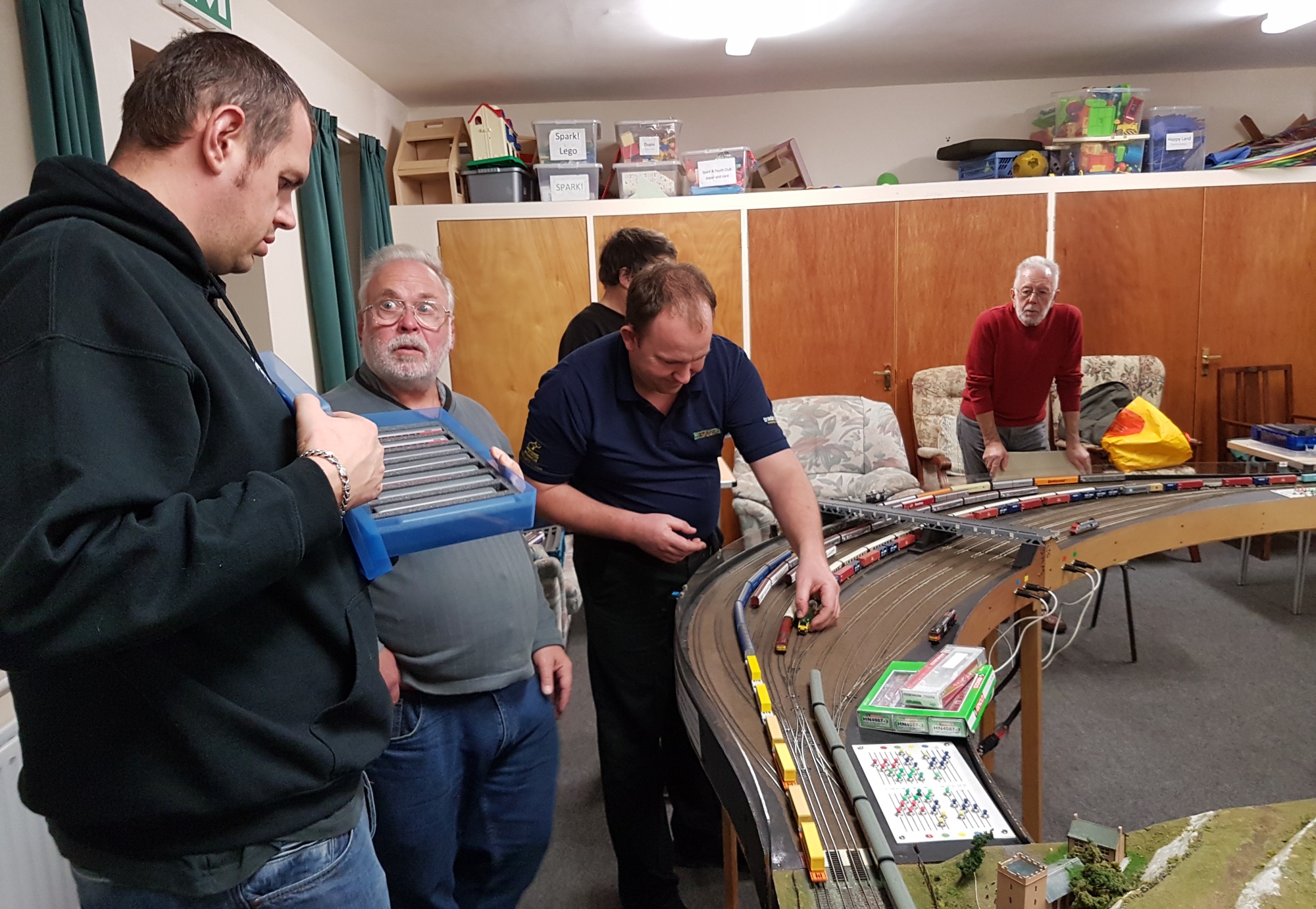
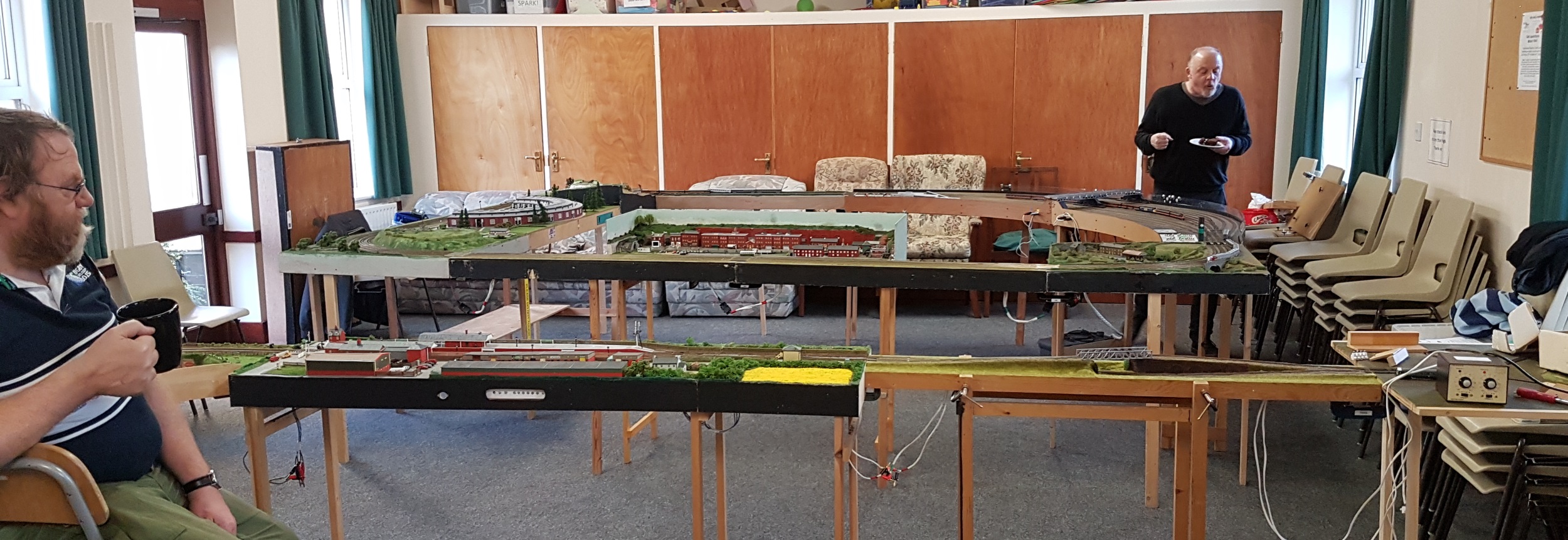
ESNG at the Bluebell – 1

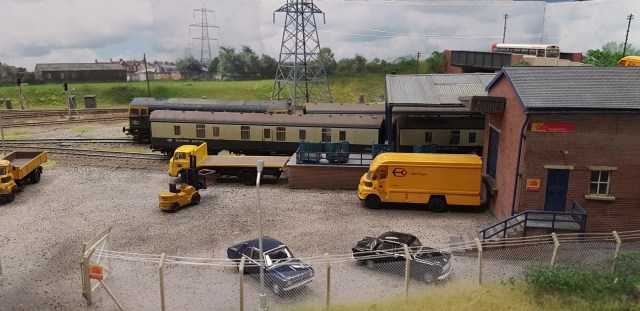
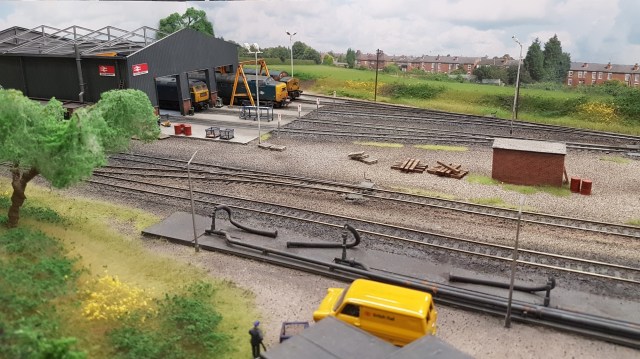
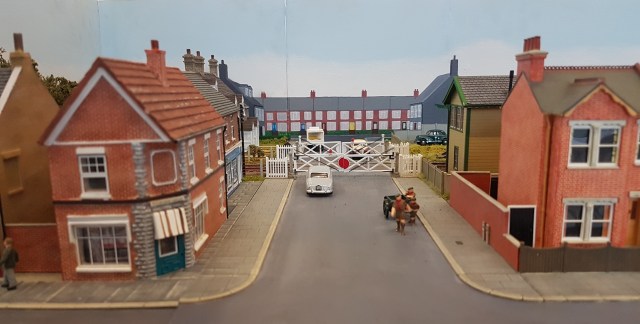
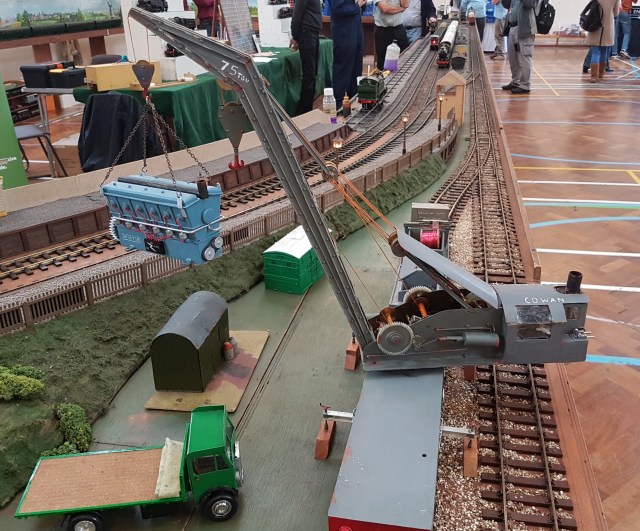
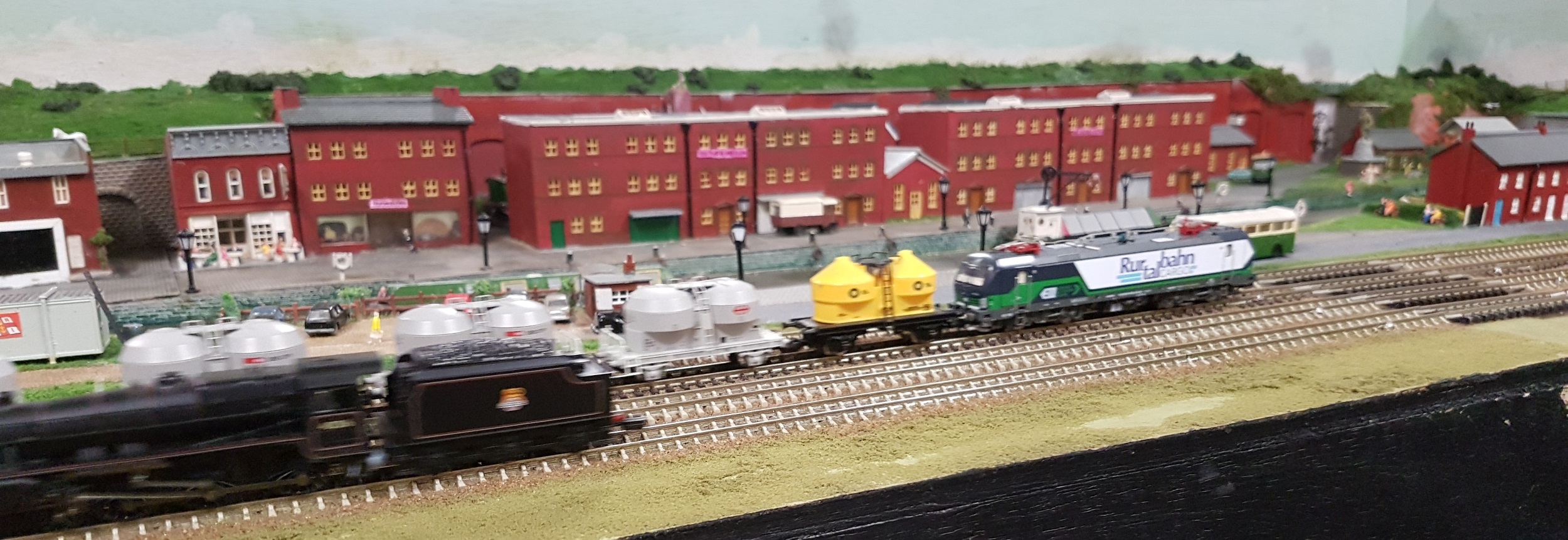
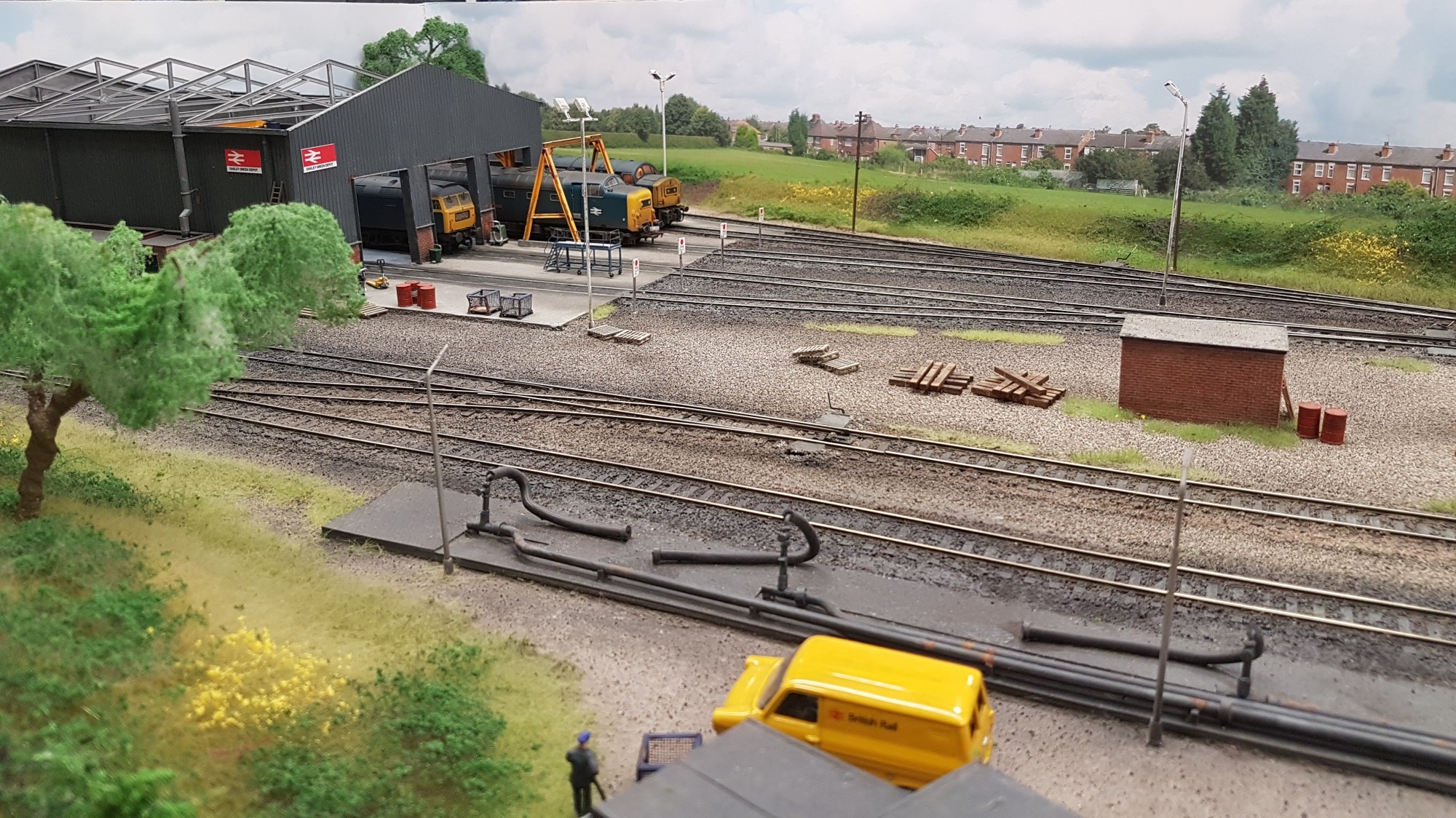
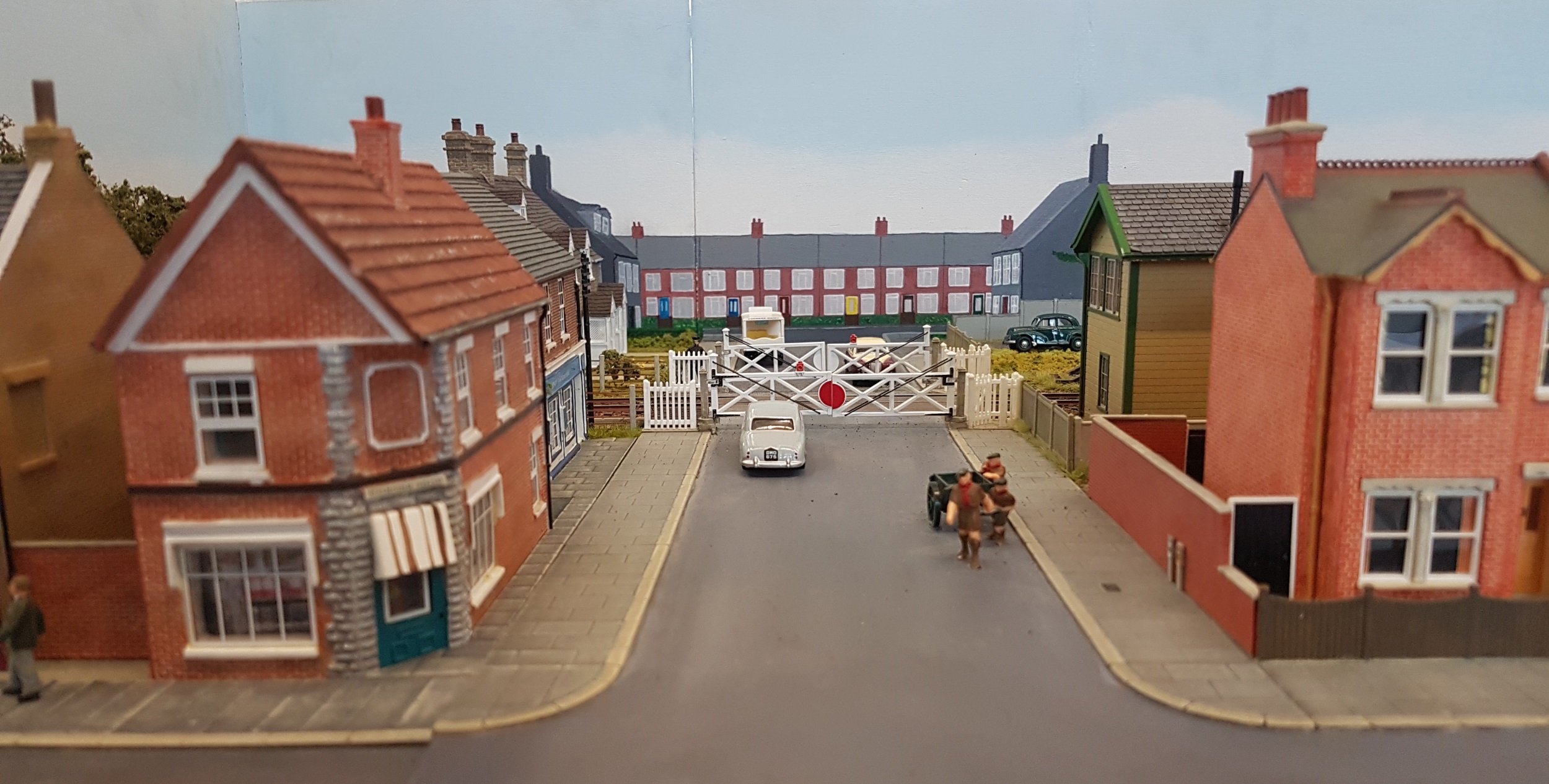
We spent a very pleasant weekend at the end of June exhibiting at the Bluebell Railway Model Railway show.  Two days playing trains, with the real thing just outside the “exhibition hall”.

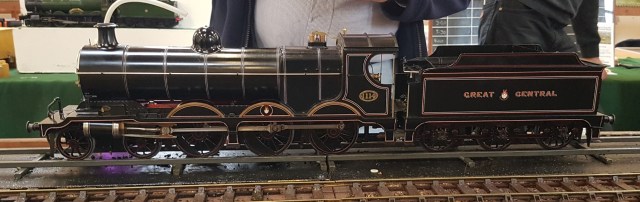
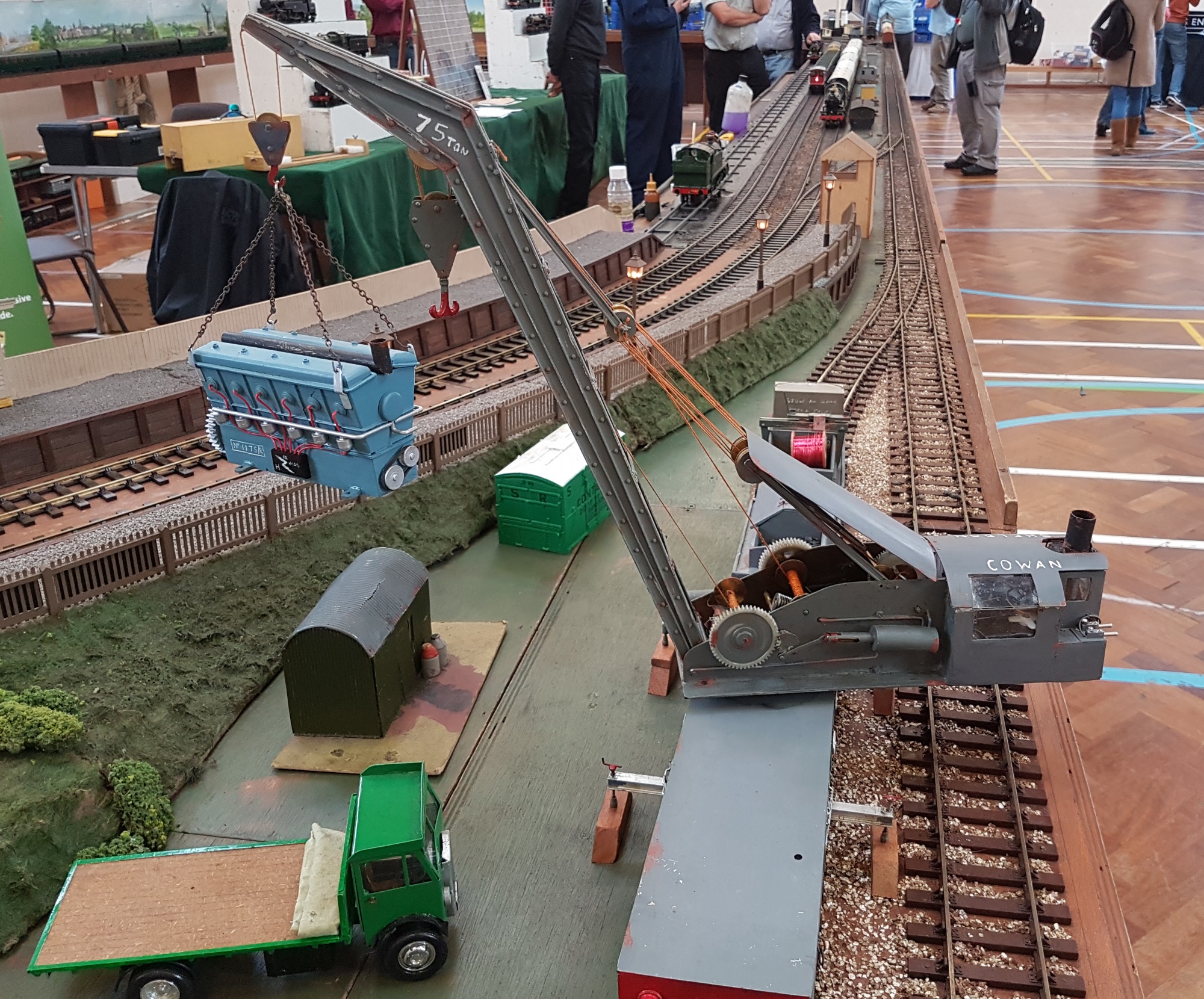
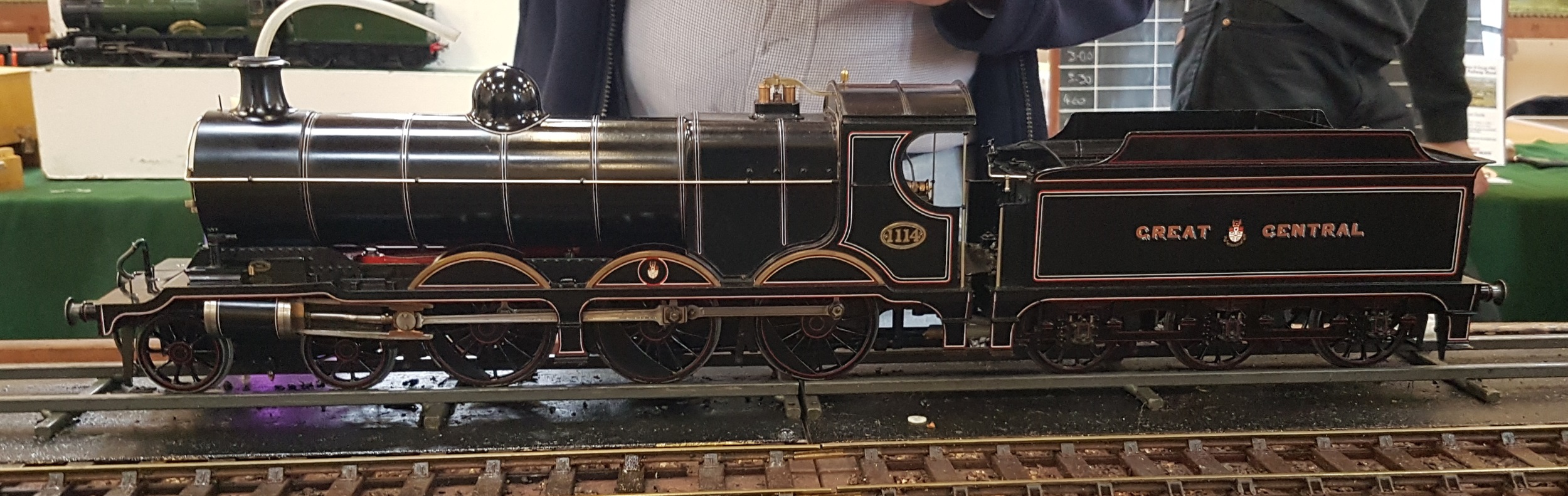
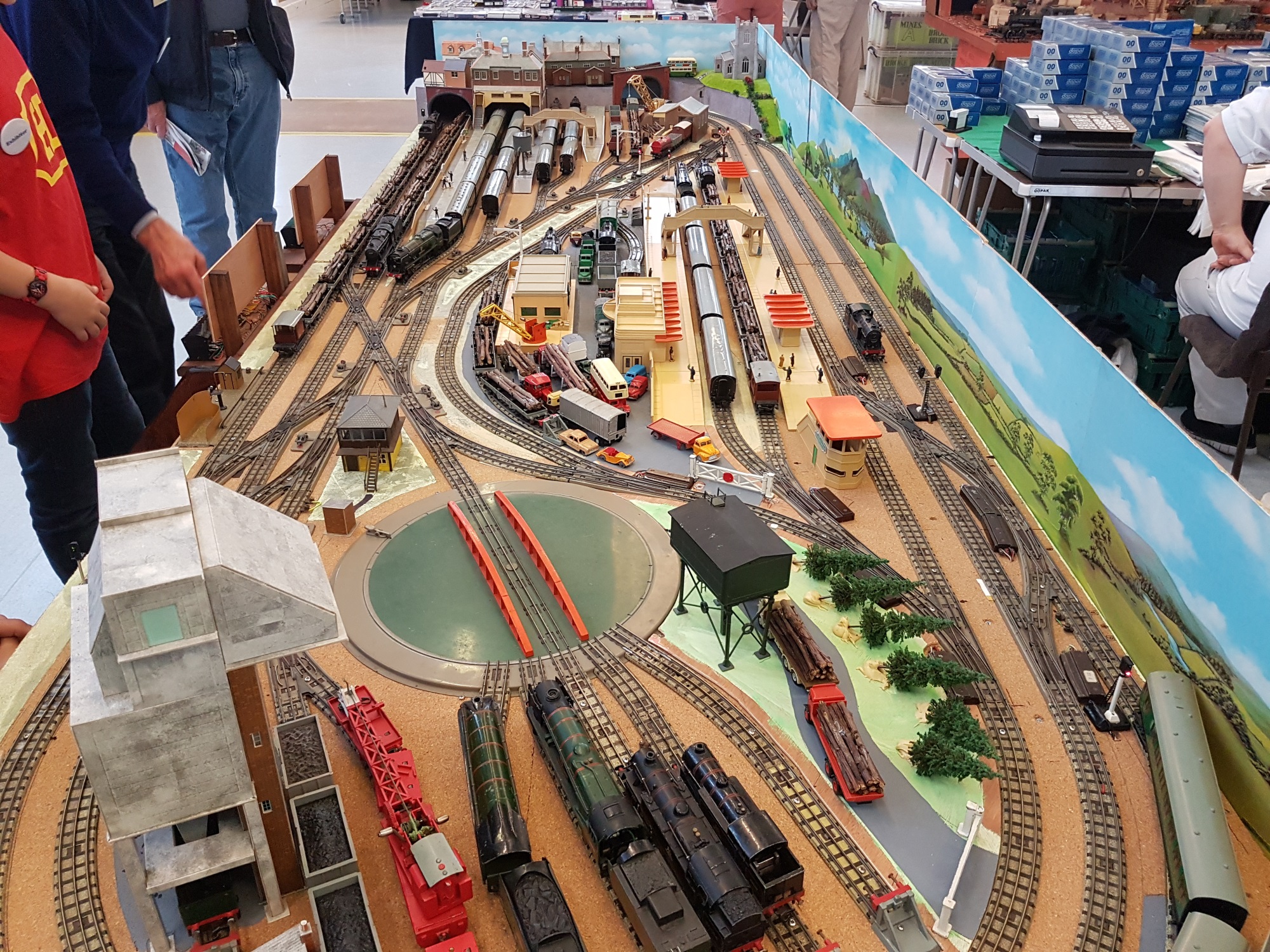
The models at the Bluebell show are scattered between Horsted Keynes and Sheffield Park stations, in the works buildings and on the platforms.  We ended up in the locomotive works, that was certainly different, and a good place to be.  On our right was a locomotive wheel lathe, and through the open door at the end, full sized engines were being steamed up for the day’s work.  In fact, it got a bit smoky in the works, what with the smell of coal from the large locos, and the smell of methylated spirits from the Gauge 1 live steam next to us.  The only complaint was the slightly grimy and oily surroundings – a number of module boxes came home with finger-prints on.
There was another interesting bit of kit next to the fiddle yard, and the workbench behind contained all sorts of bits of steel, tools and junk – much as my railway room at home, but on a slightly larger scale.

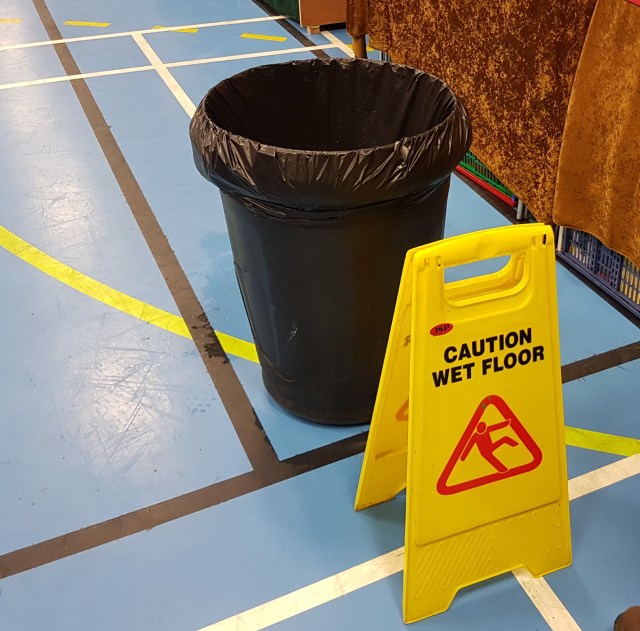
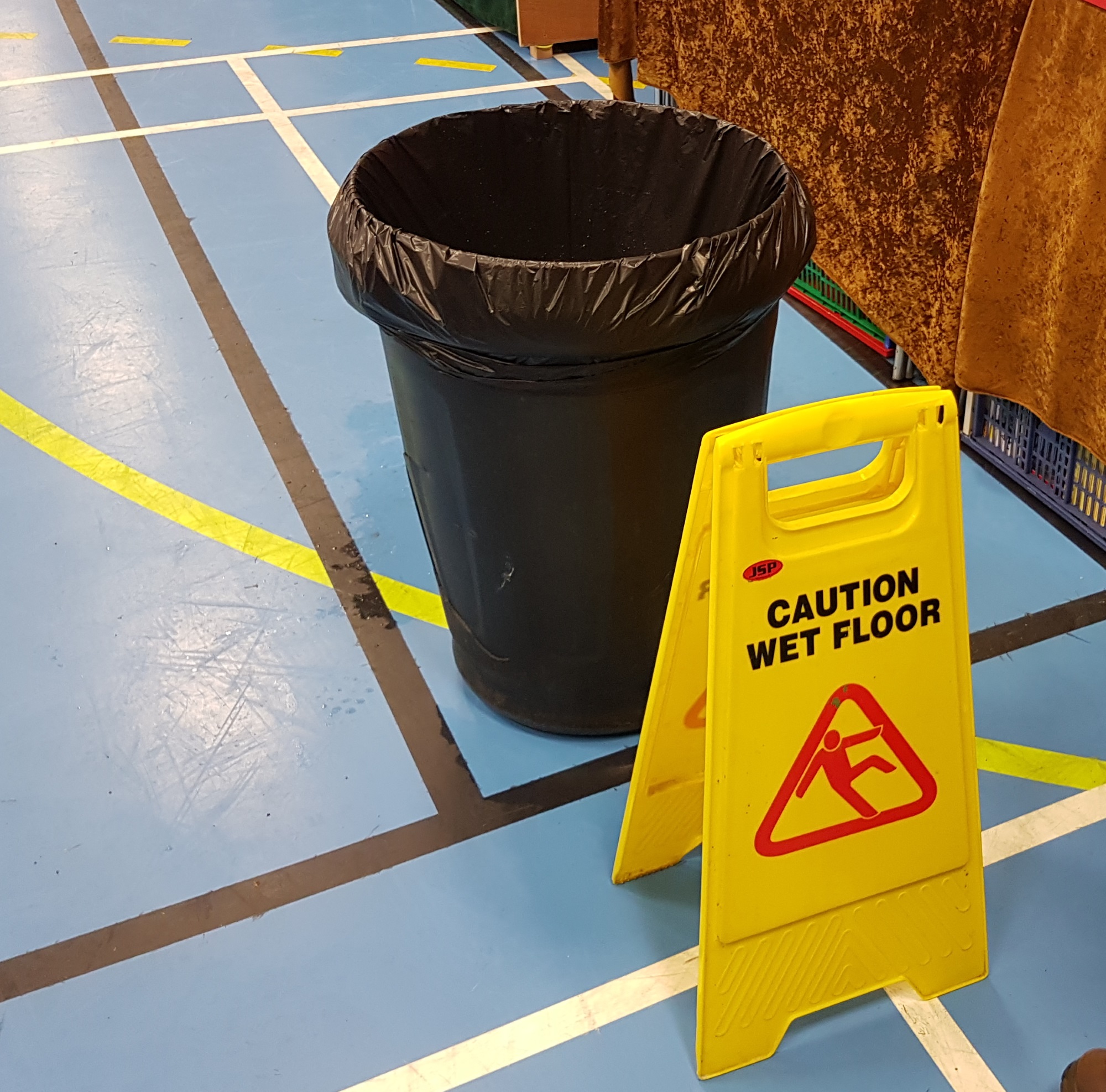
And as for these spanners – you could fix anything (large) with this lot.  But why is the bucket numbered “65”?  Could this be a new hobby – bucket numbers?

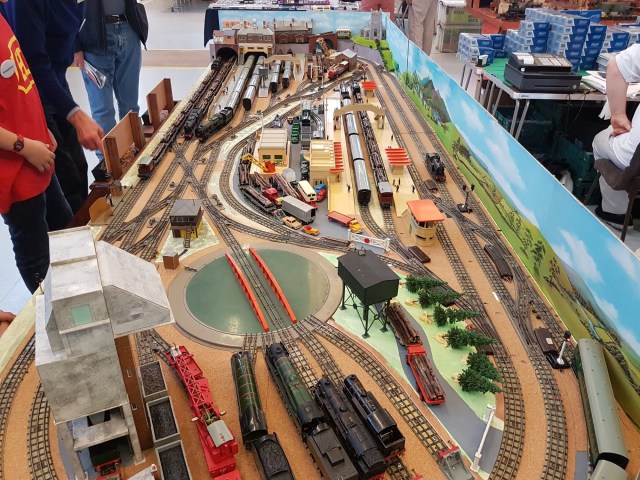
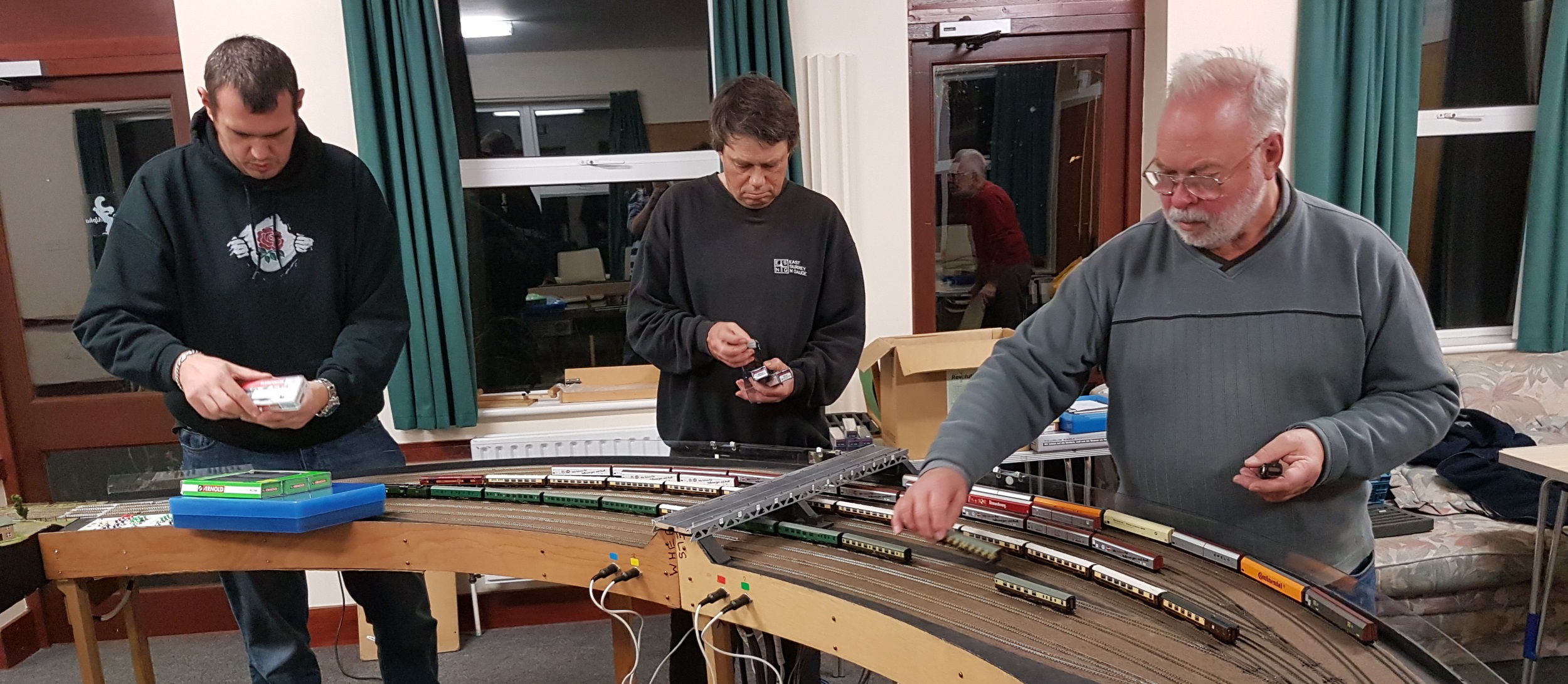
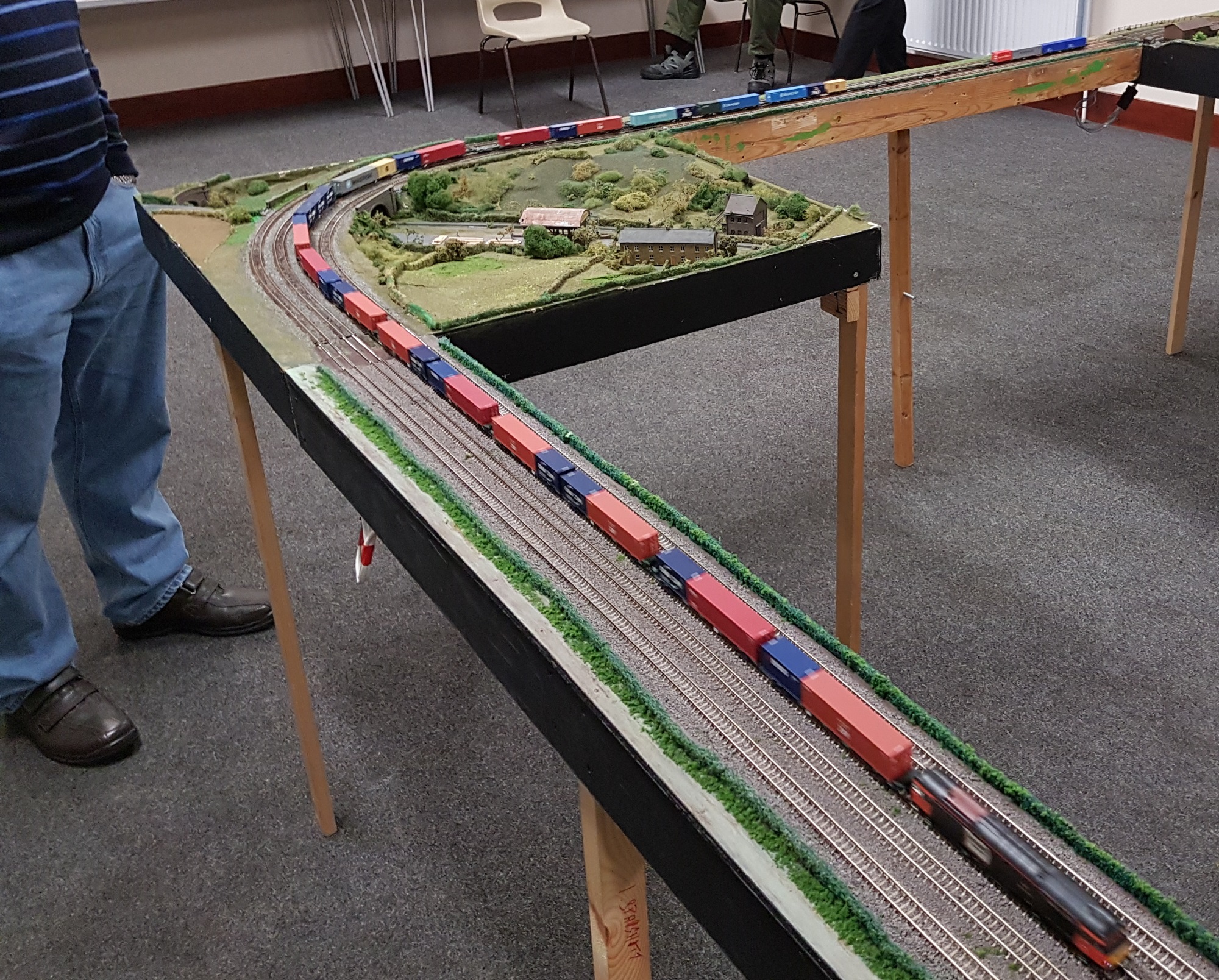
We set up an end to end circuit, having modified the design slightly to fit the available space.  One advantage of modular layouts – you can change them on the fly.  It was an early start on Saturday morning to get up and running, but everything was complete and running well by opening time at 10.  ERIC reappeared as an international tramway museum, partly because all my trams were still sitting in a box in the loft, as I hadn’t got around to putting them away after the ESNG show in April.  The combination of ERIC and trams got a lot of favourable comments.

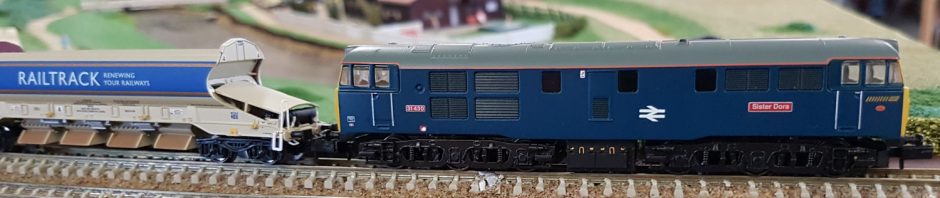
We ran the usual selection of member’s trains, and we actually had trains from all continents (not including Antarctica), as Peter brought along an Australian diesel to run.

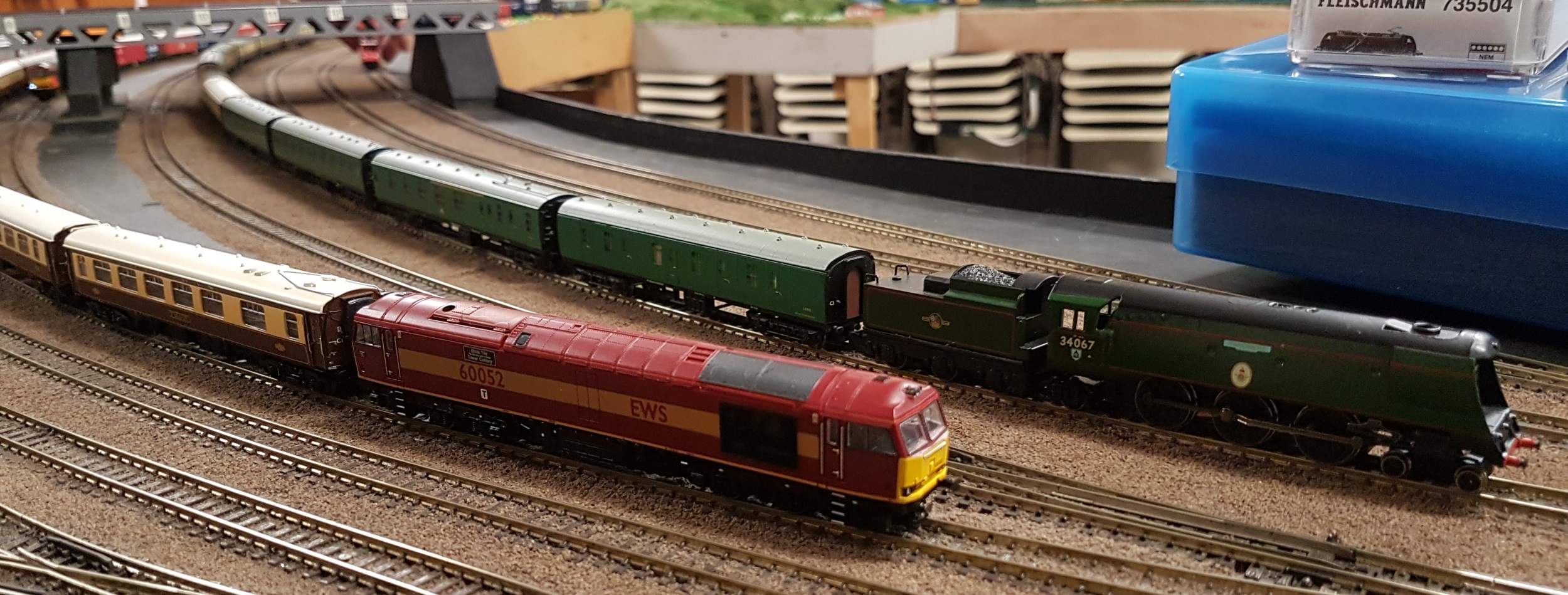
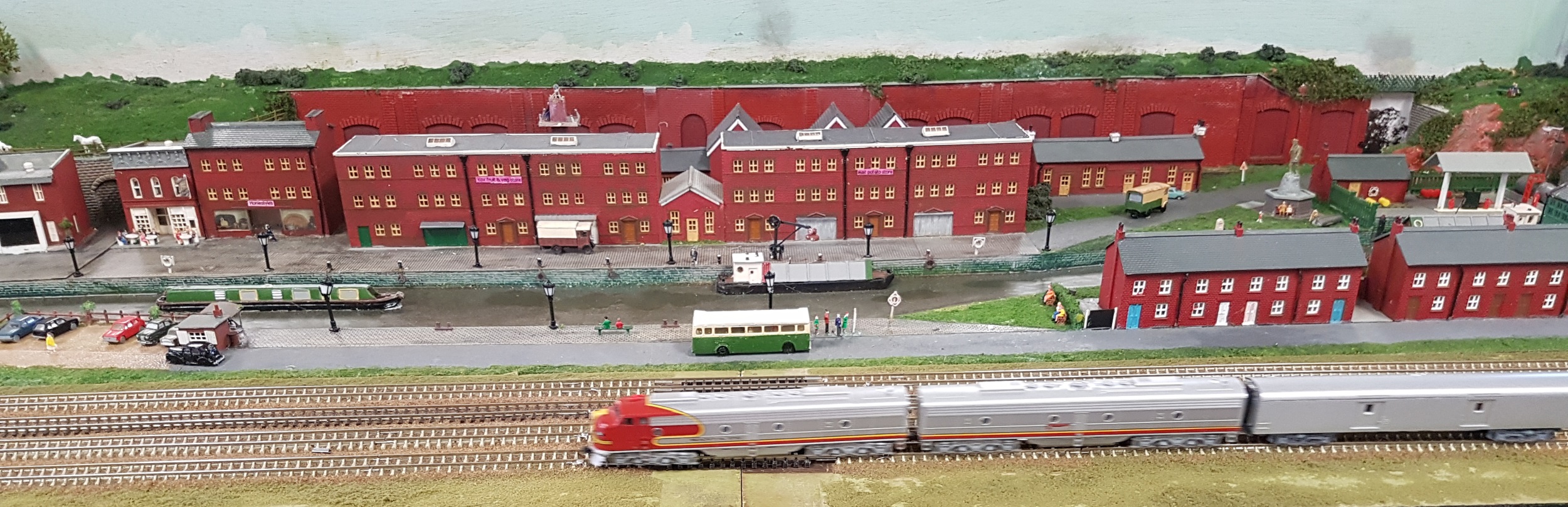
On Sunday, Simon ran some impressive Santa Fe trains.  Firstly a 14-coach passenger service – also seen below passing a Deltic with a Pullman express in tow.

Sunday afternoon is definitely time to run some very long and very short trains.  Here, Simon has a Santa Fe oil tanker train with 45 tankers and a caboose behind an A-B-B-A diesel consist.  The train stayed together pretty well, and it’s also interesting that the 4 Kato locomotives didn’t overload our controllers, drawing so little power.

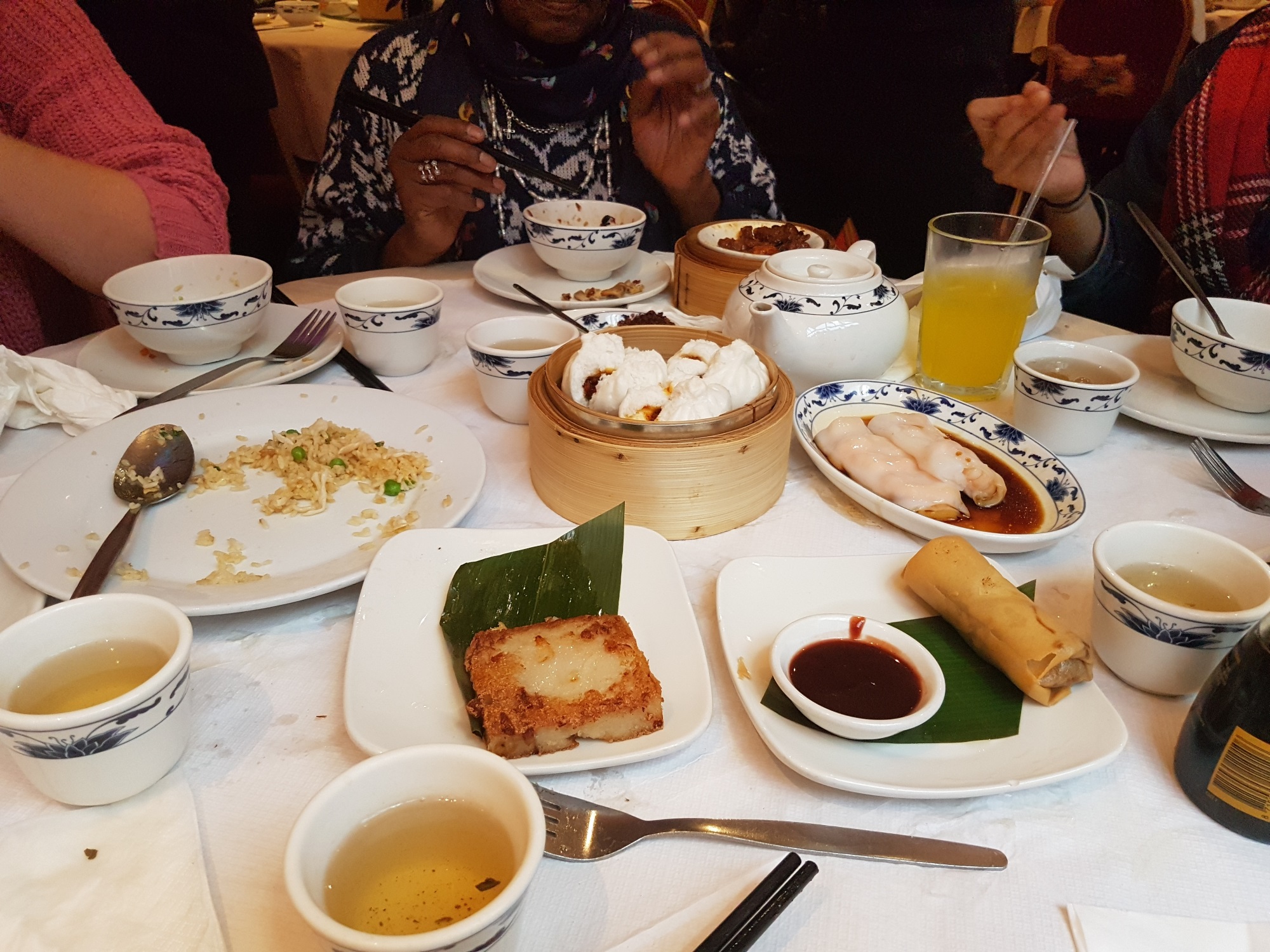
And finally, a shot not for the weak-hearted or vegetarian.  The Cha(I)rman’s breakfast.  The restaurant on the platform at Sheffield Park did a magnificent full English breakfast – the large one having two of everything.  (I only managed the small version!)  As my grandfather once said, “What you eat would kill a weak man!”

Next post, I’ll report on the real trains….

Posted in ESNG, Exhibitions, Out and about | Tagged , , , | 1 Comment

The empty railways of America

Before reporting on ESNG exhibiting at the Bluebell Railway, here’s a couple of links to an article I came across on the BBC website, “In pictures: The empty railways of America.”

One of photographer John Sanderson’s earliest memories was family road trips to Pennsylvania from his home in Manhattan, New York.
While on one of these trips, 13-year-old Sanderson discovered the delight of taking pictures when shooting the Strasburg Rail Road and its historic steam engine.
Returning to the subject of railways in adulthood, he rebelled against his younger self and this time chose to photograph American railroads devoid of trains.

He appreciated the quietness of the tracks, as opposed to the more frequently documented roads of America.
That is, he said, “until a 100 car-long freight train rumbles into the scene”.

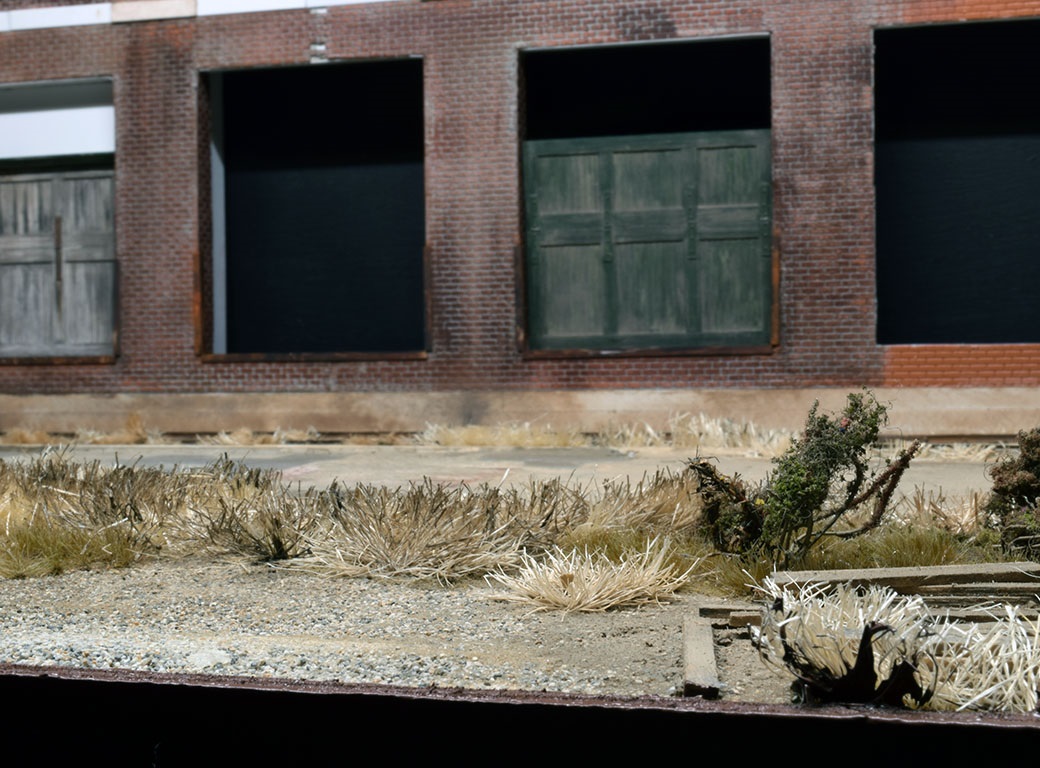
The end results are most attractive, and could give a few ideas for scenery on our layouts – American or otherwise.  Here’s one of them (copyright John Sanderson.)

There are more photos on John Sanderson’s site, under Railroad Landscapes.

Looking on the menu, there is also an item, “Fallen Flags.”  This is a series of head-on photos of preserved F-units, all in the colours of railroads no longer with us.  Worth a look, and I liked the Lehigh Valley example (copyright John Sanderson.)

Posted in Inspiration, Out and about, Prototype | Tagged , , | Leave a comment

ESNG meeting – 22 June 2017

I’d missed too many club meetings with travels and holidays, and was missing the chance to meet with friends and watch the trains go by.

Early June we had a working party, where two workers were supervised by two others.  But we did get some wiring faults repaired on the fiddle yard, and some track laid on the new corners.  And as ever the afternoon finished with a curry to celebrate commiserate on the Cha(I)rman’s birthday.

The next Wednesday meeting was well attended, although it was one of those record hot June days.  It was good to welcome Ian Buck along, and he brought some interesting stock to run.  I’m been tempted by the Napa Valley Wine Train, but it’s not really the same without the wine.  The technicolour Japanese bullet train celebrates one of those strange Japanese cartoon series.  Ian said the train is decorated with vinyls – but surely they would peel off at the extreme speeds these trains reach?

And Neil was testing a couple of modern German rakes.

A reminder to ESNG members – this Thursday is the AGM.  Come along for another riveting evening’s entertainment….

Posted in ESNG, ESNG meetings | Tagged , , , | Leave a comment

Here we go again…..

I’m back!  I’ve appreciated a month break from the blog, but have missed putting my railway thoughts and findings down on ‘paper’.  And a chance to offer modelling challenges like this one (picture picked up from a forum – trust the copyright is OK.)  The challenge is not to lay track like this – we can all do that on an off day – but to do it so it (a) works, and (b) looks like it’s realistic, not incompetent.

It’s been a busy month, with too much office work.  Ten days in Singapore gave me a chance to catch up with the friendliest otters in the world, just outside the hotel.

And buy some more relatively cheap trams off the internet….

Over the next few days, I’ll be writing about….

  • ESNG exhibiting at the Bluebell Railway.
  • Our annual visit to Berlin.
  • Recent ESNG meetings.
  • The 2018 ESNG show.
  • An (almost) new layout.
  • Other modelling musings.

I’m looking forward to pontificating again.

But finally, thanks to NGForum, a questionable item from Hatton’s website….

Noch 36959Noch-SD
N Gauge
Ladies of the Night – Pre-owned – 1 has broken arm

I’m not sure about the pre-owned bit, and as for the broken arm?

Posted in ESNG, ESNG meetings | Tagged , , , | 3 Comments

Lost – another committee member

Looks like a nasty attack of pots and kettles!

After all my missing Chairman gags, where’s Wally the Secretary?

Positive sighting in the rice fields of Java….

And on the South Devon Railway….

This week look out for him in Singapore….

I really do intend to be at the June Wednesday ESNG meeting.


As you realise, life is a bit hectic at the moment.  So, after nearly four years and an apocalyptic 666 posts, I’m going to take a month or so off from blogging.  I’ve thoroughly enjoyed writing, getting read, and making friends through this blog, but I’m running out of ideas and need a break.

I will keep reporting on ESNG meetings, though, and perhaps on any other highlights from the month.  (And if my mojo starts working again, who knows what will happen!)

I indeed hope to be back sometime in July, with some new ideas and fresh enthusiasm.

Keep modelling, folks!

Posted in ESNG, ESNG meetings | Tagged , , , | Leave a comment

An alternative grouping

‘Proto-freelancing’ is far more popular in the USA than in the UK.  Perhaps this is due to the use of the same locomotive designs, with detail differences, across many railroads – for example the iconic F3 and F7 diesels.  Bu

This web page discusses how the 1923 grouping of railway companies should have been carried out:

So here is my idea of how the 1923 Grouping should have been done. I have actually grouped the pre-1923 companies into five different groups. My Grouping has the advantage that the five companies are more equal in size. It also maximizes competition. I guess if I had my way Nationalization and Denationalization would also have looked pretty much like this. So in my ideal world, these would be the regional railways operating in Britain today. And there would be no Railtrack. There might be some franchising, but that would be up to the five regional companies to decide for themselves.

Most noticeable are the grouping of the GWR and the Great Central (who worked closely together, anyway) and the separation of the arch-enemies of the Midland Railway and the London & North Western Railway into new groups.  These would make interesting models, retaining (but evolving) their distinctive liveries, and developing locomotive designs for them.  The LNER and the Southern Railway remain much as they really were.

An interesting challenge for someone?

Posted in Hints and tips, Inspiration, Out and about, Weird and wonderful | Tagged , , , | Leave a comment

Book review – ‘Locomotives worth modelling’

Our visit to the South Devon Railway did, of course, include a visit to the second-hand book shop.  (It has to be said, too, that we visited the bookshop at Buckfast Abbey and came out with a purchase.)  I couldn’t resist this gem.  I think I have a copy in rather better condition somewhere in the house, but for £3, it was a bargain and it would have been rude not to purchase it.

This book was an inspiration in my teens.  I think the Beckenham and West Wickham MRC library copy was almost permanently lent out to me.  I even spent some time building one of the locomotives described, a Holden 2-2-2 single.  I recall that it had a tender drive (probably K’s, and Hambling’s drivers, as they were the only people doing a 7′ driver in those days.  Even so, I had to remove the crank pin and tidy up the spokes, as this GER single had inside cylinders.)  The model went to the tip some time back.

A review on Amazon sums the whole thing up rather well:

For those of us who love older steam locomotives, this book is a delight. Mr Hambleton’s wonderful drawings, his descriptions of small details and his personal reminiscences of an era long gone, all combine to make this an enchanting read!

What I love about the book is Hambleton’s enthusiasm for the subject, and the variety of late-19th and early-20th century locomotives illustrated.  He does have a soft spots for singles.  As an example, here are three examples from the LSWR chapter.  Three of William Adam’s 4-4-0’s, all predating Drummond’s better known T9, and their tender.  All are beautiful, well-proportioned locomotives.  All just about made it into Southern Railway days in 1923, and a T3 (the third and most modern of the classes illustrated here) has been preserved as part of the national collection.

They would all make wonderful models – though it would be a challenge in ‘N’ to fit a motor in the tender and the drivers in the splashers.  The splashers would perhaps be easier in 2mm fine scale.

Another one to add to my list of potential retirement fails???  But the book is unreservedly recommended – there are copies to be found on Amazon, and probably in many other railway bookshops.

Posted in Hints and tips, Inspiration, Prototype | Tagged , , , | 1 Comment

South Devon Railway – 2

Buckfastleigh station is very well kept, and has some good branchline touches, like the trolley for the luggage and the milk churns awaiting collection.

1930’s carriages sit next to the preserved line’s staple piece of rolling stock – the BR Mk1 carriage.  The different shades of early BR livery are interesting.

And every preserved line needs an O3 shunter.  The SDR does run heritage diesel services as well as its historic steam trains.

At the back of the yard was this Hall class 4-6-0, in need of some TLC.  I have always liked these medium sized GWR 4-6-0’s better than the large Castles and Kings.  The cylinders situated at the mid-point of the bogie, with a straight steam pipe feeding them looks much neater than having the cylinders behind the bogie.

Also at the back of the yard were a coupe of diesels, a single railcar, and some wagons.  The original line to Ashburton would have been through the crossing gate in the background.

Back at Totnes, this Hawksworth brake composite was on the end of our train.  Handsome carriages, with their curved roof profile, and minimal tumblehome on the bodies.

Also in Totnes was this BR Southern Region ferry van, for services into Europe on the cross-Channel train ferry.

And a GWR ‘Monster’ – like a very large, flush-sided, Siphon.  I’ve always wanted a model of one of these.

Another regular on preserved railways – the standard BR brake van.

And a line of wagons, including a pipe wagon.

Back at Buckfastleigh, we waited for the next train to leave.

And we then drove a mile or so to visit Buckfast Abbey.  Founded in 1018, but ruined during the dissolution of the monasteries, it was rebuilt between 1907 and 1938.  The abbey is an attractive building, with its light stone interior making it an ‘airy’ place.

And it’s a bit of a contrast to the little Methodist chapel, that overlooks the abbey.  It predates the rebuilding, so there’s no sense of competition here – just two very different but equally attractive places of worship.

Posted in Inspiration, Out and about, Prototype | Tagged , , , | 1 Comment

South Devon Railway – 1

A week’s holiday in the south-west started with a company reunion meal in the RNLI at Poole, Dorset.  Wonderful views of the harbour and the lifeboats parked moored outside the headquarters building.  We also had a tour of the training college, and a chance to have a go on the lifeboat simulator – a full bridge simulator with 3D projection through all the cabin windows – allowing you to navigate a lifeboat out of Dover Harbour and rescue people from a sinking ship.  It became more interesting when they wound the waves up – it was so realistic that you swayed from side to side to keep your sea legs even though the simulator itself wasn’t moving.

Weekend in Poole, then on to Brunel Manor in Torquay – for more reunions, this time from the church I attended for 20 years (on-and-off) in Hong Kong.  Brunel Manor was never occupied by Brunel, but he bought the land for his retirement home, then died before enjoying it.  The grand house was built after his death.

He would have had a good sea view, especially as most of these trees wouldn’t have been there 100 years ago.

We had a difficult choice.  Should we visit the Paignton to Kingswear railway and have a ride across to Dartmouth on the ferry?  Or visit the smaller South Devon Railway (formerly the Dart Valley line)?  The South Devon Railway won, partly from nostalgia – I had visited it in its early days about 45 years ago with my parents – and partly from convenience, as there is a large free car park at Buckfastleigh, and we didn’t have to park in Paignton.

We thought we had missed the train we were aiming for, but this GWR small Prairie tank was still in the station due to a signalling problem, so we had plenty of time to get aboard.

The station yard had more diesels than steam on show.  No doubt the steam locos were tucked safely away in the engine shed.

The half-hour trip to Totnes was in a 1930’s Collett carriage, and we enjoyed the views of the River Dart – the railway and river run very closely parallel for much of the way.

Pausing at Staverton, the one intermediate station, we were soon under way again.

And arrived at Totnes.  The branch station is just outside the main line station, as it dates from the period when British Rail wouldn’t allow preserved lines to share a station.  So short sighted.

High speed trains were passing on the main line behind, but not when I was looking at it!

The locomotive then ran around its train and took on water.  It’s operations like this that make steam branchlines interesting!

And we then returned to Buckfastleigh.  I’ll post some more photographs next time.

Posted in Inspiration, Out and about, Prototype | Tagged , , , | Leave a comment

1971 – December – you can’t please everyone

Our last look at the 1971 Railway Magazine.  From the always reliable letters page, an outbreak of outrage, but from Dawlish, not Tunbridge Wells….

Ridiculous

SIR – The photograph facing page 577 of the November issue of The Railway Magazine must be the ultimate in absurdity, caused by the fooling about by photographers with their telescopic lenses.  The locomotive looks twice as high as it is long, the signals on the gantry seem to be wider than the track, and the curves of the lines are ridiculous.  Television, of course, is also ruined by this sort of thing.

Well, here’s the photograph.  Looks like a standard, and rather attractive, telephoto lens shot to me.  Obviously, such things as perspective hadn’t reached the rural seaside of Dawlish yet..

33

And finally, a more whimsical exchange, that typified some exchanges through the year – such as the design of Scottish mileposts, and whether the Adams LSWR 4-4-2 radial tanks had been loaned to work to Kyle of Lochalsh in the west of Scotland (consensus was they did.)  This is on station names.  It was started in November by….

Piccadilly “H” line

SIR – When the Piccadilly Line extension to Heathrow Airport is complete, there will be five consecutive stations all beginning with the same letter – Hounslow East, Hounslow Central, Hounslow West, Hatton Cross and Heathrow Central.  Is this unique?

Then in December came the replies…

Southern alliteration

SIR – With reference to the letter (November) concerning consecutive stations with the same initial letter, I would point out that until 1961 there were six stations on the Waterloo-Portsmouth line, all with the initial letter “W”.  These were Walton-on-Thames, Weybridge, West Weybridge, West Byfleet, Woking and Worplsedon.  The sequence was broken when West Weybridge was renamed Byfleet and New Haw.

SIR – Four stations on the “Cuckoo Line” consecutively began with “H”.  They were Heathfield, Horam, Hellingly and Hailsham.  Although Mr Beauvais mentions five stations on the Piccadilly Line, three of them begin with “Hounslow”, whereas the “Cuckoo” stations are all different.  Hampden Park would have made a fifth on the way to Eastbourne, but Polegate intervenes.  Horam was called “Waldron and Horam” before the 1939 war, but in later years it was simply “Horam”.

SIR – Although the Rother Valley Line has only four consecutive stations beginning with “H”, it also has three consecutive stations ending in “field” – Rotherfield, Mayfield, Heathfield!

SIR – The letter headed “Piccadilly ‘H’ Line” reminds me of the staff man, deputising some fifteen years ago for the customary female announcer at Leeds City one afternoon, who spoke of “… the 5:42 to ‘Arrogate, calling at ‘Olbeck, ‘Eadingly, ‘Orsforth, ‘Arthington….”  ‘Onest.

Posted in Out and about, Prototype, Weird and wonderful | Tagged , , , | 1 Comment