Obituary – Ian Allan

I spotted this obituary in the Daily Telegraph.  In the UK and for those of my generation, Ian Allan was synonymous with train spotting books and quality transport books.  Certainly in my teens and early twenties, Ian Allen was THE transport publisher – we don’t often think how lucky we are today with so many excellent and often very specialised books.  I had plenty of both.  I got rid of my spotters guides – perhaps I shouldn’t, but all they showed was that I was too young to see much steam in day-to-day service.  I have still got some of my early Ian Allan photo albums, including my first, ‘Southern Steam’.

Reading this obituary, I learnt a lot about the man, including….

Ian Allan, who has died the day before his 93rd birthday, triggered the post-war explosion of trainspotting as a British pastime by publishing the first booklet of engine numbers in 1942 and starting a club which had 230,000 members by the time steam gave way to diesel. He diversified the business to embrace magazines, bookshops, a travel agency, a Masonic publisher, a printing business, organic garden supplies, commercial property and car dealerships…..

At 15 Ian lost a leg following a camping accident during exercises with the OTC, and this seemed to limit his career opportunities. Already a railway enthusiast (and regular visitor to the signal box at Christ’s Hospital station), he left school when war broke out to join the Southern’s staff at Waterloo. He helped to produce the company’s magazine and handle enquiries from the public – and increasingly from enthusiasts…..

Allan was 20, and a 15s-a-week clerk with the Southern Railway, when he published the ABC of Southern Railway Locomotives in response to calls from enthusiasts for information. Management declined to publish it, but allowed Allan to do so at his own risk.

The first 2,000 copies of the shilling booklet sold out in days. Further ABCs on the Great Western, LNER and LMS railways, and London buses, trams and trolleybuses, went like hot cakes, friends and neighbours helping to distribute them.

It had not occurred to Allan that “bagging” the locomotives he listed would take off as a hobby. But within weeks, knots of schoolboys armed with his booklet appeared at the end of station platforms, and in 1943 he and his colleague (and future wife) Mollie Franklin launched the Ian Allan Loco-spotters’ Club….

Spotters had to sign a pledge “not to interfere with railway working or trespass on railway property” on pain of expulsion from the club. In the deferential post-war years it was largely adhered to – though unruly scenes on Preston station in 1951 led to spotters being banned there. By 1964, however, Allan was lamenting that “mods and rockers” had infiltrated the club.

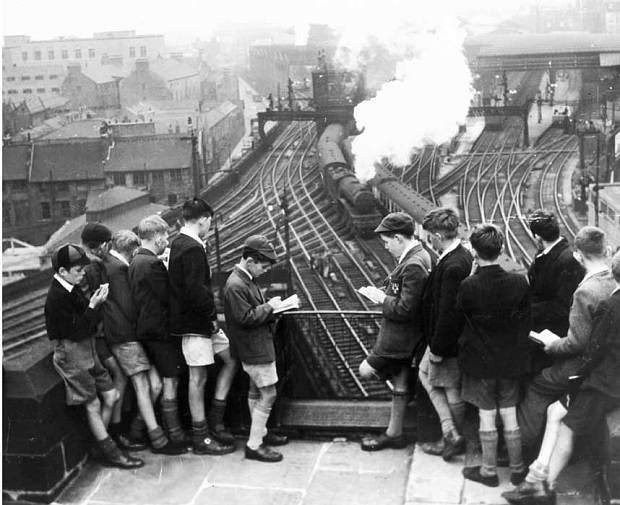
Finally, the article included this delightful picture of trainspotting, 1950 style.  It’s also an interesting socially commentary.  Look at the school uniforms.  All urchins are in uniform, and a number of schools seem to be represented.  Not so many years later, they’d all be kicking lumps out of each other, and all the caps would be thrown on the track.  A good time in some ways – but how many of these kids were living near the poverty line, with an outside toilet and a weekly bath in a tin tub?
Allan1_3359395b

Trainspotters at Newcastle Station, August 1950 (SSPL/NMeM/Daily Herald Archive)
 

Posted in Inspiration, Layout design, Prototype, Weird and wonderful | Tagged , , , | 1 Comment

AGM and wrong kind of sun?

The ESNG AGM occurred yesterday.  A good turnout of members, and all business was concluded with no heckling and very few snores.  It’s not that the committee object to being pelted with fruit, but prefer the members to take it out the can first….

The time came for committee elections, and s ever the room went very silent and as motionless as an auction for a lost Da Vinci drawing.  Followed by a forest of hands as the committee agreed to stand again…..  Plus ça change….

Plans for Stuttgart were further advanced as Duncan brought along a new van, that although it is small, when added to Allan’s truck, will probably carry all we need for this year’s show.  It’s the N-club anniversary year, and a lot of clubs will be attending, so we will probably take a smaller layout than in previous years.  However, the resulting N-club modular layout is intended to be larger than ever before and possibly the largest in the world (possibly excepting Texas, as they are always biggest).


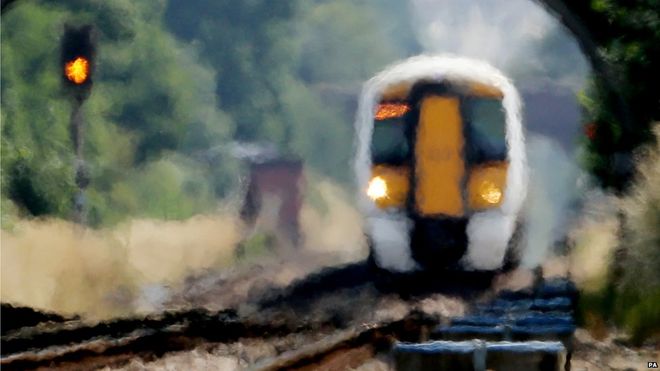
Last Monday First Great Western tweeted that:

“There will be no direct services from Paddington to Bourne End/Henley tomorrow due to hot weather.”

That prompted some incredulous responses on twitter. So, have our railways been defeated by the weather again? BBC transport correspondent, Richard Westcott said:

“We need to put that announcement into context.  It means a very small number of trains from Paddington won’t run direct as the points will be taken out of use to avoid them failing and causing disruption to the whole Western route. This is six trains out of several hundred that FGW operate each day.”

For the modeller, perhaps this is an excuse for the non-working point motor, and changing train services and timetable to suit?

I know that like model railways, the real thing is at risk from extreme temperatures and expansion of the rails.  Nevertheless, surely this must be classified as…..

Wrong kind of sun????

(For non-UK readers, a standing joke has been the railways blaming winter cancellations on the “wrong kind of snow”.  I believe this is the powdery kind that blows into nooks, crannies and bits of rail infrastructure that promptly stop working.)

And the BBC get into the discussion, blaming continuously welded rails.

_83973279_pa-17077467

Posted in ESNG, ESNG meetings, Out and about, Weird and wonderful | Tagged , , , | Leave a comment

A charming Japanese story – and an idea for the AGM

Can you resist the newspaper headline:

“Cat stationmaster Tama mourned in Japan and elevated as goddess”

This turned out to be a charming story of Japanese culture and a railway success story:

The calico cat was appointed stationmaster at the Kishi station in western Japan in 2007 and died early last week. Now she has been mourned by company officials.

Tama the stationmaster, Japan’s feline star of a struggling local railway, was mourned by company officials and fans and elevated into a goddess at a funeral on Sunday.

The calico cat was appointed stationmaster at the Kishi station in western Japan in 2007. Donning her custom-made stationmaster’s cap, Tama quietly sat at the ticket gate welcoming and seeing off passengers. The cat quickly attracted tourists and became world-famous, contributing to the railway company and local economy…..

Wakayama Electric Railway president Mitsunobu Kojima thanked the cat for her achievement, and said Tama will be enshrined at a nearby cat shrine next month.Before Tama’s arrival, the local Kishigawa Line was near-bankrupt; and the station was unmanned as it had lost its last staff.

Mr Kojima said appointing Tama as stationmaster was initially an excuse to keep the cat at the station.  “But she was really doing her job,” he said…..

During her tenure, Tama had contributed an estimated 1.1 billion yen (£5.65 million) to the local economy, Mr Kojima said….

The cat had climbed the corporate ladder from stationmaster to “ultra-stationmaster” and vice president of the company before receiving the additional title Sunday of “honourable eternal stationmaster”.Tama will be succeeded by another calico cat, Nitama, now an apprentice stationmaster.

japan-station-cat_3357178b

Read it all in the Daily Telegraph here.

However, apart from the obvious modelling opportunity for our Japanese modellers, could this be the way forward for ESNG?  Watch out Allan – perhaps I’ll nominate our budgie for ESNG chairman at tonight’s AGM – and wait for the people and millions to pour in.  Even millions of yen would be OK.  However, I’m not going to set out the relative merits of the candidates – I may lose one, if not two, old friends.  I’d only comment that the budgie can’t make such a good cup of tea…..

snitchpost

Posted in ESNG, ESNG meetings, Inspiration, Out and about | Tagged , , , | 1 Comment

“This is not logical, but it is often true.”

According to Spock, anyway.  The Chairman sent me this picture, culled from Facebook. untitled “Set the phasers to stun!”

Posted in Inspiration, Out and about, Weird and wonderful | Tagged , , , | Leave a comment

A good ‘believe it or not’ scenic feature?

Anyone can model a car crash or lots of emergency services on their layout.  However, this would really stretch the viewers belief.

Giant circular saw blade hits car on Chongqing-Guizhou Expressway in China

From the Daily Telegraph:

Last Wednesday, Mr Xiang was driving along the Chongqing-Guizhou Expressway in central China when he noticed a giant circular saw spinning at speed towards his windscreen.

The 5ft cutting blade collided with the car bonnet, ripping through its metal engine as Mr Xiang, whose first name has not been revealed, frantically wrestled the wheel of the swerving vehicle. Miraculously, the bouncing blade missed the driver, wedging itself 50cm deep into the front of his JMC truck.  Mr Xiang defied the odds by walking away from the crash with barely a scratch on him.”I heard a ‘bang’ and then I saw all the white smoke in front of me. I almost lost control of my car,” Mr Xiang told local reporters the day after the incident, still visibly shaken up by the encounter.

Remember the vehicle is left-hand drive!  The article concludes:

Road injuries are the third-leading cause of death in China, ahead of cancers, according to a global study in The Lancet medical journal from 2013.

I’m not surprised!

Posted in Inspiration, Layout design, Prototype, Weird and wonderful | Tagged , , , | Leave a comment

Coupling springs have sprung

This very useful tip appeared in the NRMA British Region magazine.  Most useful for those of us with Microtrains couplers, but now Dapol buckeyes are around it may also apply to them.  It was published under the wonderful title of “Tame those goldarn disappearing springs”….

NMRABR member Cliff South gave us an idea for replacing springs in Kadee couplers.

Put a fine silk thread through the middle when inserting it back in the coupler.  It cannot disappear then…..

So, where have those darned springs flown away to?  Assuming that you can find them, and I have a foot-long piece of wood with strip magnets glued along its length.  Run it over the carpet or lino and you’ll pick them up for sure…

(I hate to think WHAT I’d pick up from our carpet…)

Quite a good trick with tiny springs is to put a very small dot of superglue on just on end before fitting them….

You don’t lose them then as they are permanently attached to your fingers!

Posted in Hints and tips, Inspiration, Layout design | Tagged , , | Leave a comment

Off my trolley – San Pedro

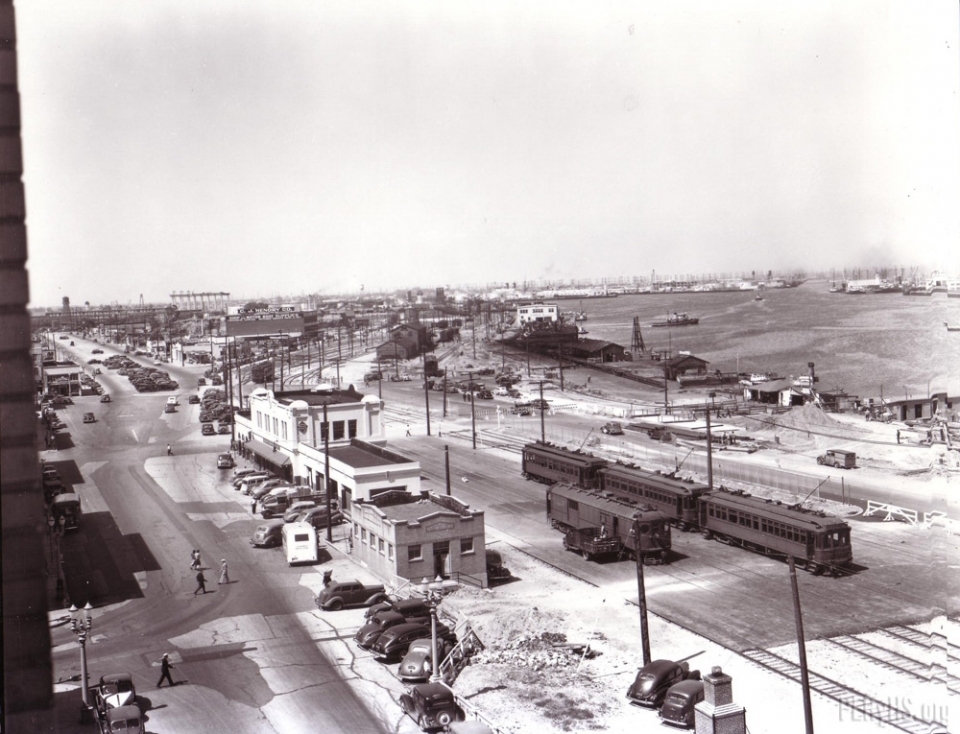
At the end of one line from LA and Watts were San Pedro and LA Harbour.  In the days of large ocean liners, collecting passengers from the liner and transporting them into LA generated a lot of traffic through San Pedro.

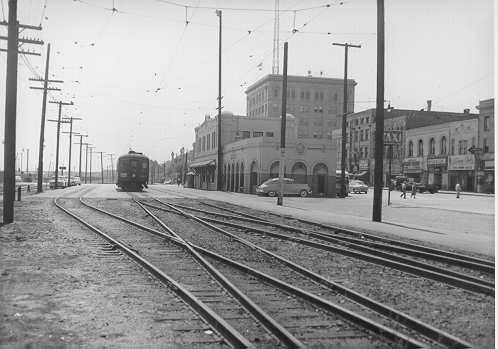
San Pedro was adjoined by a maze of PE and Southern Pacific fright yards, that lay between the depot and the harbour itself.  This old panorama gives the idea – the elegant PE depot can be seen centre left.  Note the box motor in the foreground being unloaded.

01 - View

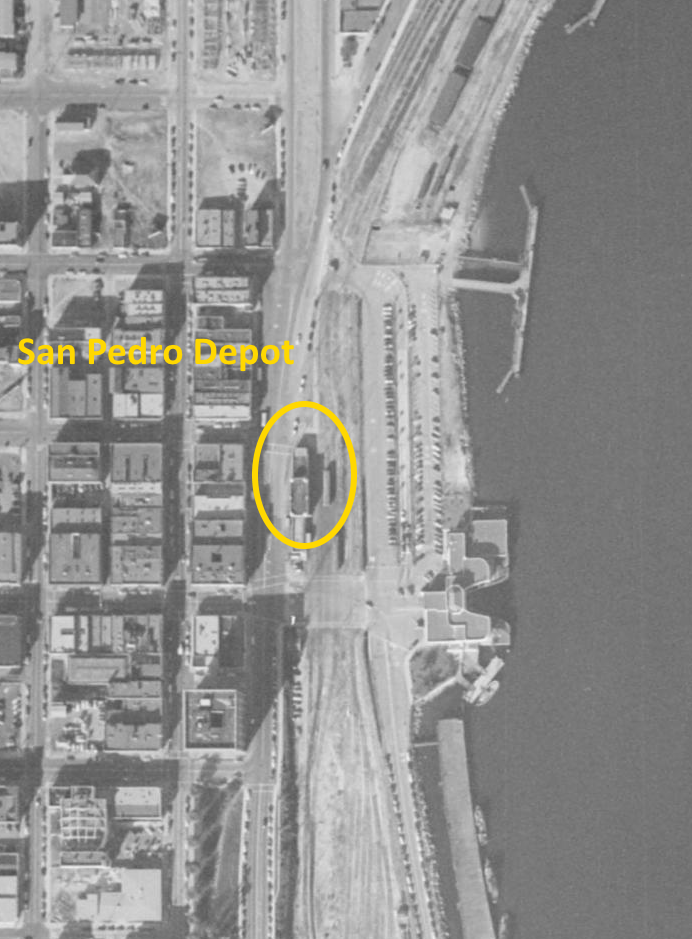
This aerial photograph from 1952 clearly shows the depot and a couple of interurbans standing close by.  Most of the freight lines have been lifted and replaced by the inevitable car parks.

02 - 12901-1952

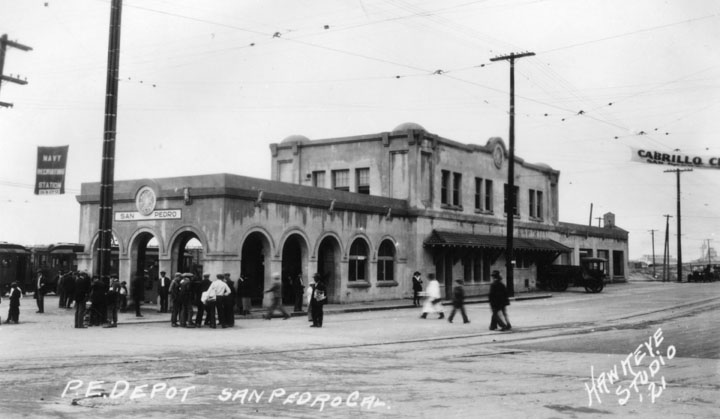
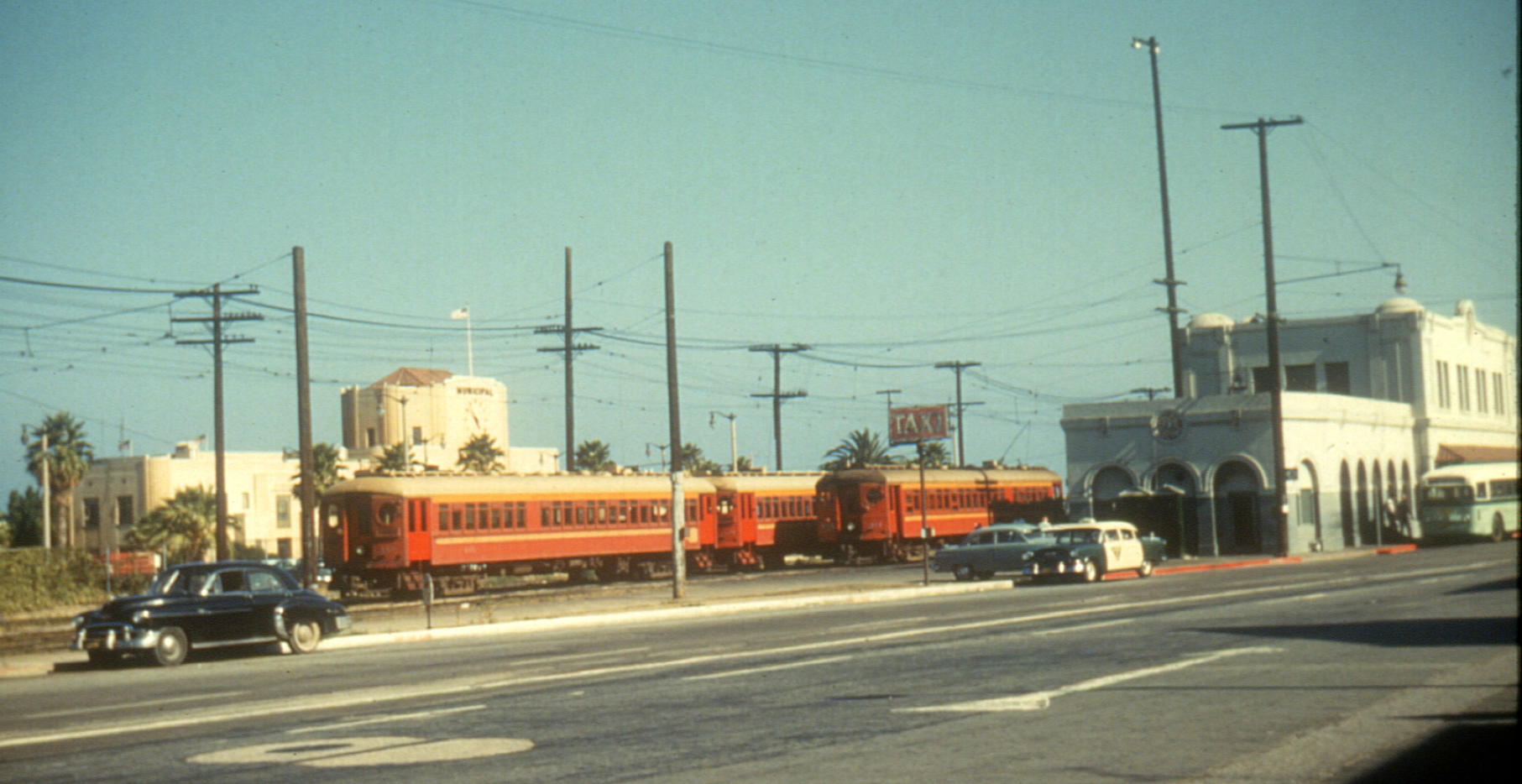
San Pedro depot is an attractive building and would make a good model.  These photographs show views from the town side.  Note the vintage car, cop car and bus in the colour view.  There are plenty of shots from the rail side available, but I have tried not to step on any copyright toes!

03 - 0006999 04 - San_Pedro_depot

Of course, the full San Pedro station complex might be too large for a manageable model railway.  But if we view the station from the harbour, it might just make a good N-club module.  Here’s a view from the LA end of the station, showing the interesting track layout and the street beyond.  (The depot and all the old structures have been demolished and redeveloped.  Only the multi-storey municipal building remains.)

05 - sanpedro2

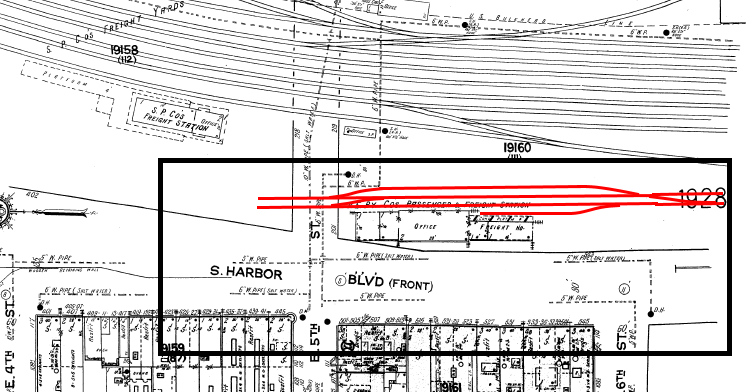
And this is the sort of layout one could build.  Unfortunately most of the old valuation maps contained rail lines, but not the PE electric tracks.  At least the depot is shown and gives some scale to the drawing.  A model of the station tracks and the freight siding for box cabs would make a good pair of N-club modules.  The road width behind could be compressed a little, to allow the shops and businesses to be included as background structures.  These buildings would probably be modelled as representative structures, but there might just be room for a recognisable model of the municipal tower.

This is a very achievable PE layout – it would be simplified, but keep the character of the San Pedro location.

06 - SanPedro1921-#1927-depots

Posted in Inspiration, Layout design, Prototype, Traction | Tagged , , , , | Leave a comment

An easier way to ballast your track?

Lance Mindheim  may have come up with a really good idea here….

Effectively applying ballast glue is a challenge at best.  The more powdery soils and small gauge products even more so.  The problem comes with application of the adhesive, specifically the surface tension of the liquid.  Agents such as alcohol and dish soap help slightly but there is always an ongoing battle to minimize craters and channels created by applying the glue with an eye dropper or bottle. Ballast “float” is also a pain in the butt.  I’ve always wondered if the problem could be solved if a powdered glue was mixed with the ballast before application.  I picked up some Dap Plastic Resin Glue from The Home Depot to run a test.  I mixed the powder into some N scale ballast at a rough ratio of 1:5 and spread it some N scale track.  Next, I took a fine mister bottle, filled it with water and rubbing alcohol, and misted it onto the ballast/glue blend.  I let it dry and, voila, it worked!  It seems very solid and I haven’t noticed any major discoloration, shrinkage, or cracks.  The bond is VERY strong.   I haven’t experimented with the best glue/soil ratio although if 1:5 works I’m not sure it warrants a lot of testing time.  This adhesive method would be particular helpful for large surface areas of fine blends such as soil patches and gravel roads.

And a second post tests the idea further….

The initial test on a six inch piece of test track of powdered glue as ballast adhesive showed promise.  I’ve since moved to using it full force on a large N scale project in my shop.  Again, success.  I find it is not only easier to use than traditional liquid adhesive but it’s also easier to get better results.  Better being defined as no floating ballast, no craters, and no mini trenches.  I haven’t yet dialed in the best ratio of glue to ballast so can only say the amount of powdered glue needed is “not much”.  At present I’m putting two, 10 oz. bags of ballast in a bucket with only 1.5 oz of glue and it holds very well (that comes to 1:13).  One caveat is that the glue is very sensitive to moisture in the air and when exposed to it will start to dry.  I’m noticing that after mixing the ballast and glue in a bucket and leaving it over night there was some drying.  That being the case I suggest storing your excess in a container with an airtight lid.  If over time I find I didn’t use quite enough powder the ballast would be knit together enough that a quick follow up with dilute matte medium would be easy to do as insurance.  Finally, there is warning label on the glue container letting you know the powder is a lung irritant and not good to breath.  That is certainly the case so wear your respirator when working with the stuff.

My only question is where to get an equivalent powdered glue in the UK.  Any ideas?

Posted in Hints and tips, Inspiration, Layout design | Tagged , , | 2 Comments

ESNG meeting – 17 June 2015 – and AGM coming

We seem to be having a run of slow meetings.  On Wednesday only two of us were there between 7 and 7:30, to be joined by the Cha(i)rman who had been doing some accidental babysitting.  Four others arrived after 8, but it was too late then to put the layout up and get trains running.

We had a pleasant chat over coffee, but the club depends on having trains up and running at nearly every meeting – and we need some people to help the committee at the start of the evening.  Winge over!  But I think this is a problem with many clubs – not only model railways – at the moment.  People are under such pressure at work, it’s difficult to commit to outside responsibilities, and things like hobbies lose out.  Even for those of us who have retired, or are close to retirement, life seems to speed up by the year – and there is always more to do to help others.

I’m not sure what the answer is.  Does anyone have any ideas?  ESNG offers an evening of running trains for those who haven’t a home layout, or want to run long trains they can’t fit at home.  And hopefully we also offer reasonable company and conversation!  My best idea is to change the name to ESCC – CC for curry club.  We always seem to get a good turnout for any meeting with curry attached….


Hopefully, we’ll get a better turnout for the AGM, on Thursday 2 July.  And perhaps we can discuss some of the above!


Posted in ESNG, ESNG meetings | Tagged , , , | Leave a comment

Direct train to Europe

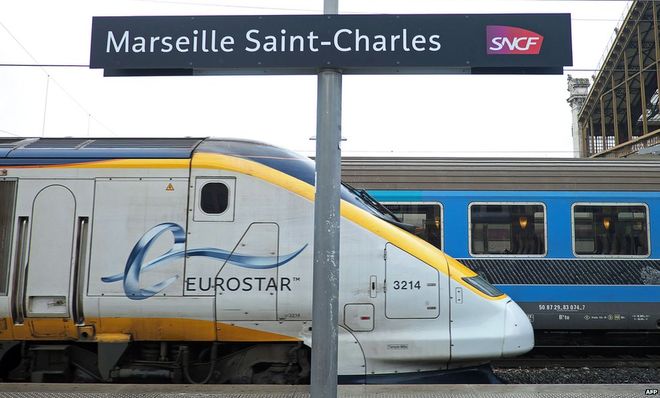
This is a good post to follow our Berlin adventures, and explains why we had to fly EasyJet rather than get a direct train London-Berlin.  In this article, the BBC looks at the new Eurostar service to Marseille and gives some thought to why we haven’t got direct trains elsewhere in Europe….

You can now board a train in London and a few hours later get off by the Mediterranean – the new direct service between St Pancras and Marseille is the furthest passengers have ever been able to go on a train from Britain without getting off. But why, more than 20 years after the Channel Tunnel opened, have direct services to the rest of Europe been so slow arriving?……

In a way the most straightforward problem to explain is the technology.  You can’t run any old train through the tunnel – currently only the Eurostar trains themselves comply with safety regulations.  In addition you need to have all the signalling systems on board for every country you pass through – and no two major countries use exactly the same system. Eurostars are already crammed with the equipment for the UK, for France and for Belgium and there’s physically no room for anything else….

One factor which may have changed since Eurostar began is how long passengers will sit on a train.  After 9/11 air travel started to become far more time-consuming….   People used to say no-one wanted to be on a train for more than three hours but I think four would now be more accurate.  That’s talking about business travel. If people are travelling for leisure – and if we can make their journey definitely part of the holiday – then probably six or seven hours is acceptable to the right destination……

The start of Eurostar pretty much coincided with the launch of budget airlines in Europe. That did for some of the more ambitious plans and competition with air is the second big consideration hindering expansion…..

The third big problem complicating expansion of services through the tunnel (is) Britain not being part of the EU Schengen treaty and retaining passport controls…

.But this is a very poor excuse…

“Sadly some very attractive destinations are in the wrong place. How wonderful if you could get from London to Barcelona in under four hours on a train. Unfortunately geography is in the way.”

_83275415_hi027006414

Posted in ESNG, Inspiration, Out and about, Prototype | Tagged , , | Leave a comment